CM Rekha Gupta Highlights Shah's Remark on Fugitive Returns
Synopsis
Delhi CM Rekha Gupta amplified Union Home Minister Amit Shah's claim that India has achieved remarkable success in bringing fugitive criminals back from abroad, spotlighting the government's extradition and repatriation drive.
Key Takeaways
Delhi CM Rekha Gupta shared a statement by Union Home Minister Amit Shah on October 13, 2026 , claiming India's 'remarkable success' in repatriating fugitive criminals.
The Fugitive Economic Offenders Act, 2018 is a key legal tool enabling asset attachment and prosecution of offenders who flee abroad.
India has increasingly used Interpol notices , extradition treaties, and diplomatic channels to repatriate wanted individuals.
The Ministry of Home Affairs has periodically highlighted these mechanisms as part of strengthened international law-enforcement cooperation.
The post included a video, indicating the remark was made at a public event or official address.
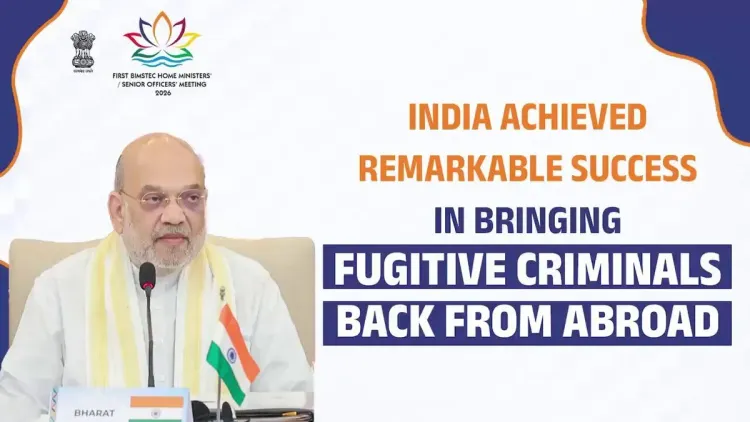
India's pursuit of fugitives across borders is drawing fresh attention — and fresh credit. Delhi Chief Minister Rekha Gupta on Tuesday, October 13, 2026, shared a pointed remark from Union Home and Cooperation Minister Amit Shah, amplifying his assertion that India has achieved 'remarkable success in bringing fugitive criminals back from abroad.'
Shah's claim and what it signals
The quote shared by CM Gupta is terse but deliberate: 'India has achieved remarkable success in bringing fugitive criminals back from abroad.' Coming from the country's top internal-security minister, it reads less like a passing remark and more like a scorecard moment — a signal that the government wants this on the national ledger. The post also carries a video, suggesting the original statement was made at a public event or press interaction.
The legal machinery behind the push
The backbone of India's extradition drive is the Fugitive Economic Offenders Act, 2018, which empowers authorities to attach assets of offenders who flee the country to escape prosecution. Beyond that law, Indian agencies have leaned heavily on extradition treaties, Interpol red notices, and direct diplomatic channels to compel foreign governments to return wanted individuals. The Ministry of Home Affairs has periodically highlighted these mechanisms as evidence of a more assertive posture in cross-border law enforcement.
The broader pattern is one of escalating institutional ambition: investigative agencies coordinating with foreign counterparts, legal teams pursuing asset-attachment orders abroad, and diplomatic missions pressed into service as instruments of justice. Each repatriated individual is both a legal outcome and a political statement.
Why Delhi's CM is amplifying it
CM Rekha Gupta sharing this remark from her party's senior-most Union minister is a reminder of how national law-enforcement wins get threaded into the BJP's governance narrative at every level — from the Centre down to state leadership. Fugitive repatriation, once a bureaucratic footnote, has become a flagship talking point, invoking accountability and the long reach of Indian law.
The real test of 'remarkable success' will come when specific case numbers and treaty milestones are placed before Parliament. Until then, the minister's words land as both a declaration and a dare.
Point of View
Accountability-first governance — one that frames extradition wins as proof of institutional reach and political will. Sharing this from the Delhi CM's handle extends that message to the state tier, reinforcing a unified party-government front on law enforcement. The absence of specific case numbers, however, leaves the claim open to scrutiny: parliamentary debates and official MHA data will ultimately determine whether 'remarkable' translates into verifiable outcomes. The broader arc is clear — fugitive repatriation has migrated from a technical legal process to a high-visibility political asset.
NationPress
13 Oct 2026
Frequently Asked Questions
What did Amit Shah say about fugitive criminals?
Union Home Minister Amit Shah stated that India has achieved remarkable success in bringing fugitive criminals back from abroad, a claim amplified by Delhi CM Rekha Gupta on October 13, 2026.
What is the Fugitive Economic Offenders Act?
The Fugitive Economic Offenders Act, enacted in 2018 , allows Indian authorities to attach the assets of economic offenders who flee the country to avoid prosecution, strengthening the legal framework for repatriation.
How does India bring back fugitives from abroad?
India uses a combination of extradition treaties, Interpol red notices, asset-attachment orders under the Fugitive Economic Offenders Act, and direct diplomatic channels to secure the return of individuals facing charges.
Why did Delhi CM Rekha Gupta share Amit Shah's statement?
As a BJP leader and Delhi Chief Minister, Rekha Gupta amplified Shah's remarks to highlight the party-led government's law-enforcement achievements at the national level.
Which ministry oversees India's extradition efforts?
The Ministry of Home Affairs , headed by Amit Shah, coordinates India's extradition and fugitive repatriation efforts in conjunction with investigative agencies and the Ministry of External Affairs.