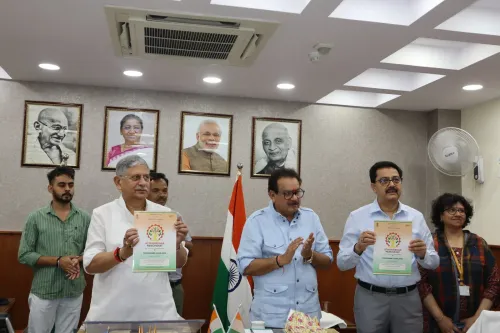
CM Rekha Gupta felicitates Padma Shri awardee at Amrit Ratna Samman 2026

Synopsis
Delhi Chief Minister Rekha Gupta attended the News18 Amrit Ratna Samman 2026 on June 17, honouring Padma Shri awardee Dr. Shubha V. Iyengar for developing Drishti, India's first indigenous runway visual range system, in alignment with the Aatmanirbhar Bharat vision.
Key Takeaways
Delhi CM Rekha Gupta attended the News18 Amrit Ratna Samman 2026 on June 17, 2026 and spoke on India's aspirations in Amrit Kaal .
Padma Shri awardee Dr.
Iyengar was felicitated for her pioneering work on Drishti , India's first indigenous runway visual range (RVR) system.
Drishti reduces India's dependence on imported aviation safety technology and supports safe aircraft operations in low-visibility conditions.
The recognition aligns with the Aatmanirbhar Bharat Abhiyan , launched in May 2020 , which prioritises indigenisation of critical aviation and defence technologies.
The event reflects India's broader Amrit Kaal roadmap (2022–2047) of achieving developed-nation status through domestic innovation.
Delhi Chief Minister Rekha Gupta attended the News18 Amrit Ratna Samman 2026 on Wednesday, June 17, 2026, where she shared her vision on India's aspirations during Amrit Kaal and felicitated Padma Shri awardee Dr. Shubha V. Iyengar for her landmark contribution to indigenous aviation technology.
Context
Speaking at the event, CM Gupta described it as 'a privilege' to honour Dr. Iyengar, crediting her pioneering work on Drishti — India's first indigenous runway visibility system — for strengthening aviation safety across the country. The recognition comes as India continues to spotlight domestic R&D successes in safety-critical infrastructure as part of its broader technological self-reliance drive.
Drishti is an indigenously developed Runway Visual Range (RVR) system designed to support safe aircraft operations in low-visibility conditions, reducing India's dependence on imported aviation systems. Its development is widely regarded as a milestone in civil aviation indigenisation.
Policy Backdrop
The felicitation is rooted in the Aatmanirbhar Bharat Abhiyan, launched in May 2020, which placed explicit emphasis on indigenising critical technologies across aviation, defence, and strategic sectors. Drishti's development directly embodies this policy thrust by replacing import-dependent runway visibility infrastructure with a domestically designed alternative.
Amrit Kaal — India's 25-year development roadmap spanning 2022 to 2047 — frames the broader ambition of achieving developed-nation status through self-reliance and domestic innovation. Recognition events such as the Amrit Ratna Samman serve to amplify individual contributions that advance this national vision.
Stakeholders and Impact
The aviation sector stands as the most immediate beneficiary of Drishti's deployment, with the system enabling safer aircraft operations during fog and low-visibility conditions that frequently disrupt flights, particularly at northern Indian airports during winter months. Indigenous technology developers and research institutions also gain visibility through such public felicitations, reinforcing the policy signal that domestic innovation will be institutionally recognised.
Dr. Iyengar's work represents a broader pattern of Indian scientists and engineers delivering solutions in sectors historically reliant on foreign technology, lending credibility to the government's indigenisation targets in civil aviation and dual-use systems.
What's Next
Attention will now turn to the potential expansion of Drishti deployments across a wider network of Indian airports, as well as the possibility of further indigenous avionics or navigation systems being announced in upcoming civil aviation or defence budgets. The spotlight on Dr. Iyengar's achievement may also accelerate institutional support for similar R&D initiatives aimed at reducing import dependence in safety-critical aviation infrastructure.
Point of View
Lending civilian aviation the same nationalist framing more commonly applied to defence. By personally felicitating Dr. Iyengar, Gupta reinforces the party's ownership of the Aatmanirbhar Bharat narrative at a state level, even where aviation policy is a central subject. The spotlight on Drishti also signals that low-visibility infrastructure — long a pain point for Indian airports — is being positioned as a self-reliance success story ahead of potential budget announcements. Such recognition events serve a dual purpose: celebrating genuine scientific achievement while simultaneously building political capital around the 2047 developed-India vision.
NationPress
21 Sept 2026
Frequently Asked Questions
What is Drishti, India's indigenous runway visibility system?
Drishti is India's first indigenously developed Runway Visual Range (RVR) system, designed to measure and report visibility conditions on airport runways, enabling safer aircraft operations during fog and low-visibility weather without relying on imported technology.
Who is Dr. Shubha V. Iyengar and why was she honoured?
Dr. Shubha V. Iyengar is a Padma Shri awardee recognised for her pioneering role in developing Drishti, India's first indigenous runway visual range system, which has significantly strengthened aviation safety and advanced the Aatmanirbhar Bharat mission in civil aviation.
What is the News18 Amrit Ratna Samman 2026?
The Amrit Ratna Samman is an awards ceremony that recognises individuals whose contributions align with India's national development goals, particularly the Amrit Kaal vision of achieving self-reliance and developed-nation status by 2047.
What is Amrit Kaal and how does it relate to indigenisation?
Amrit Kaal is India's 25-year development vision spanning 2022 to 2047, aimed at achieving developed-nation status. Indigenisation of critical technologies — including aviation safety systems like Drishti — is a core pillar of this roadmap under the Aatmanirbhar Bharat Abhiyan.
What did Delhi CM Rekha Gupta say at the Amrit Ratna Samman 2026?
Delhi CM Rekha Gupta said it was 'a privilege' to felicitate Dr. Shubha V. Iyengar, noting that her work on Drishti has strengthened aviation safety and advanced the vision of an Aatmanirbhar Bharat. She also shared her thoughts on India's aspirations during Amrit Kaal.