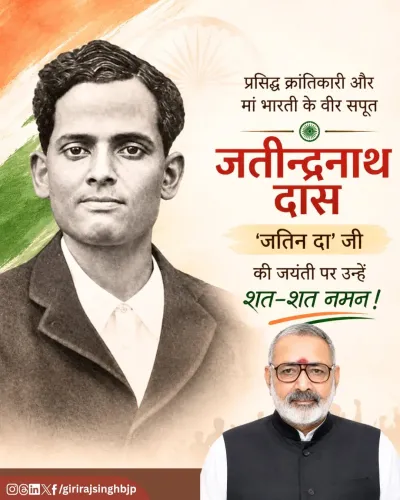
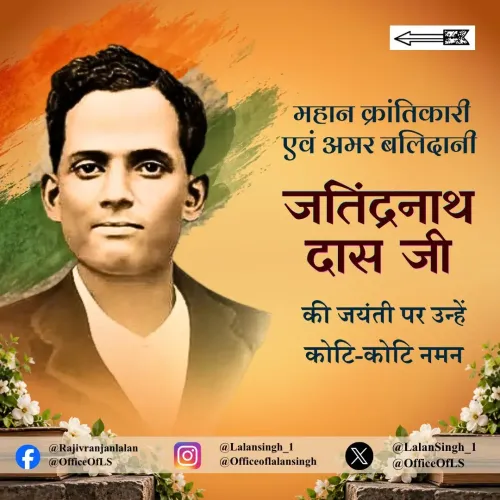
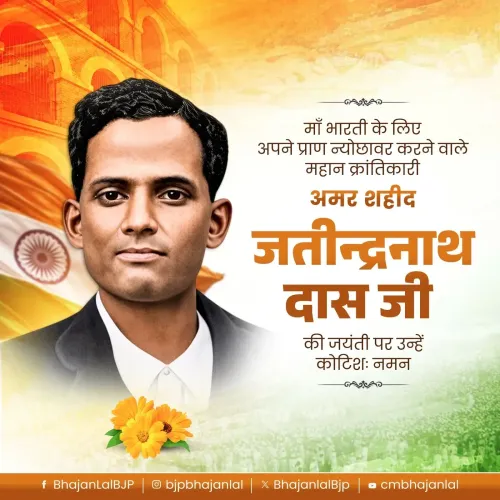
CM Rekha Gupta Honours Jatindra Nath Das on Birth Anniversary
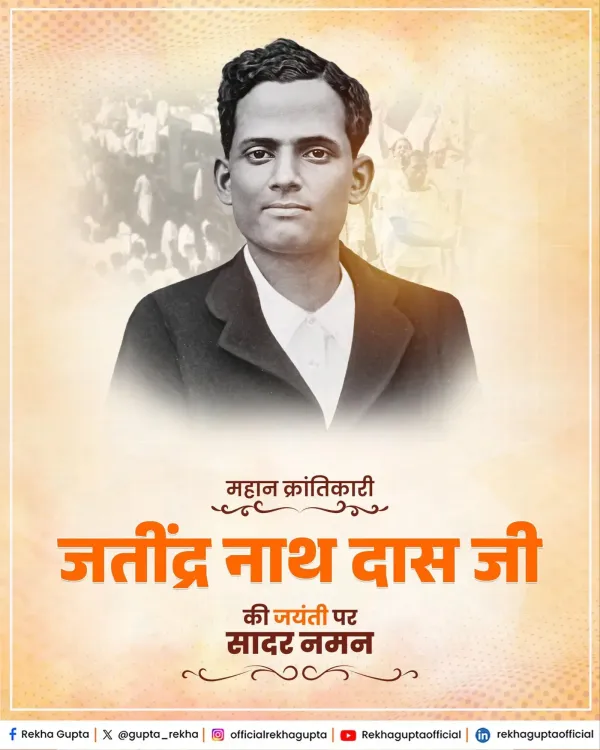
Synopsis
Delhi Chief Minister Rekha Gupta honoured revolutionary Jatindra Nath Das on his birth anniversary, recalling his 63-day hunger strike in Lahore Central Jail in 1929 — a protest for Indian political prisoners' rights that cost him his life at just 24 years of age.
Key Takeaways
Delhi CM Rekha Gupta posted a tribute to Jatindra Nath Das on his birth anniversary on October 27, 2026 .
Das was a member of the Hindustan Socialist Republican Association (HSRA) , the revolutionary network that also included Bhagat Singh .
He conducted a 63-day hunger strike inside Lahore Central Jail in 1929 , demanding rights for Indian political prisoners.
Das died on September 13, 1929 , at the age of 24 , and is regarded as one of India's foremost martyrs of the freedom struggle.
His death triggered widespread public mourning and intensified nationalist opposition to British colonial imprisonment policies.
At just 24 years of age, Jatindra Nath Das chose a hunger strike over submission — and held it for 63 days until his body gave out inside Lahore Central Jail in 1929. Delhi Chief Minister Rekha Gupta on Tuesday, October 27 paid tribute to the Bengali revolutionary on his birth anniversary, honouring a sacrifice that shook colonial India nearly a century ago.
Posting in Hindi on X, CM Gupta wrote: 'महान क्रांतिकारी एवं अमर स्वतंत्रता सेनानी जतिंद्र नाथ दास जी की जयंती पर शत-शत नमन' — 'A hundredfold salute to the great revolutionary and immortal freedom fighter Jatindra Nath Das on his birth anniversary.' She noted that his 'indomitable courage, sacrifice, and patriotism will forever inspire the people of this nation.'
The 63-day hunger strike that rattled the Raj
Jatindra Nath Das was a key figure in the Hindustan Socialist Republican Association (HSRA) — the same underground network that produced Bhagat Singh and other militant anti-colonial organizers of the late 1920s. His hunger strike in Lahore Central Jail was not a personal protest; it was a coordinated demand for the rights of Indian political prisoners, who were being held under conditions harsher than those applied to ordinary criminal inmates.
The strike lasted 63 days. Das died on September 13, 1929. The news triggered mass grief across undivided India — his funeral procession in Calcutta drew enormous crowds, and his death amplified the moral case against British imprisonment policy at a moment of rising nationalist fervour. He was, in the language of the independence movement, a martyr by deliberate, principled choice.
A tradition of commemoration across the political spectrum
CM Gupta's tribute is part of a well-established practice in Indian public life: leaders from across parties mark the birth and death anniversaries of independence-era revolutionaries with formal statements, reminding citizens of the lineage of sacrifice behind the republic. The HSRA network in particular — Das, Bhagat Singh, Sukhdev, Rajguru — commands a durable, cross-ideological reverence that makes commemorations like this one broadly resonant rather than narrowly partisan.
For a chief minister governing the national capital, invoking such figures also carries a civic weight: Delhi is home to institutions, streets, and monuments named after the freedom struggle's most radical wing, and tributes like this one connect contemporary governance to that deeper national memory.
Point of View
Making such commemorations low-risk but high-visibility acts of national solidarity. For CM Rekha Gupta, invoking Jatindra Nath Das on a working Tuesday morning signals an active cultivation of the freedom-struggle narrative as part of her governance identity in the national capital. The broader pattern — BJP, Congress, and Left leaders alike marking HSRA anniversaries — reflects a quiet consensus that the militant, self-sacrificial wing of the independence movement belongs to all Indians, not to any single ideological tradition. What gives these tributes staying power is less their political intent and more the sheer weight of the history they invoke: a 24-year-old choosing death over capitulation is a story that does not require editorial embellishment.
NationPress
27 Oct 2026
Frequently Asked Questions
Who was Jatindra Nath Das?
Jatindra Nath Das was a Bengali revolutionary and member of the Hindustan Socialist Republican Association (HSRA) who died on September 13, 1929, after a 63-day hunger strike inside Lahore Central Jail, demanding better treatment for Indian political prisoners under British colonial rule. He was 24 years old at the time of his death.
Why did Jatindra Nath Das go on a hunger strike?
Das went on hunger strike to protest the conditions under which Indian political prisoners were held in British jails, demanding that they be granted rights and dignity distinct from those accorded to ordinary criminal inmates. The strike was a coordinated action by HSRA-linked prisoners.
How long did Jatindra Nath Das fast before he died?
Jatindra Nath Das fasted for 63 days before dying in Lahore Central Jail on September 13, 1929, making his hunger strike one of the longest and most consequential acts of non-violent resistance in the Indian independence movement.
What did Delhi CM Rekha Gupta say about Jatindra Nath Das?
CM Rekha Gupta posted in Hindi on X, offering 'a hundredfold salute' to Das on his birth anniversary and stating that his 'indomitable courage, sacrifice, and patriotism will forever inspire the people of this nation.'
What was the HSRA and who were its members?
The Hindustan Socialist Republican Association was a revolutionary underground organisation in colonial India active in the late 1920s. Its most prominent members included Bhagat Singh, Sukhdev, Rajguru, and Jatindra Nath Das — all of whom died young as a result of their resistance activities against British rule.