Assam CM Himanta Reports 30.88% Conviction Rate for September 2026

Synopsis
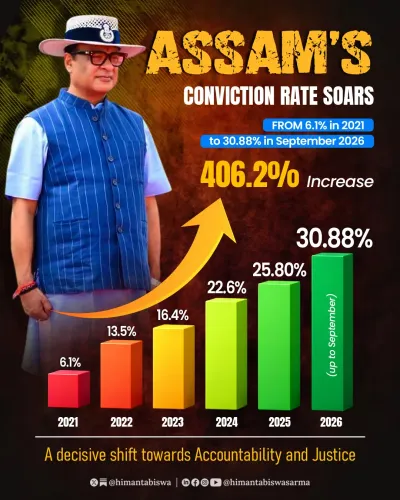
Assam's Chief Minister's Office reported a 30.88% conviction rate for September 2026, reflecting CM Himanta Biswa Sarma's push to track criminal justice outcomes as a monthly governance metric — part of a wider BJP-state trend of publishing law-and-order dashboards.
Key Takeaways
Assam's conviction rate stood at 30.88% for September 2026 , as announced by the Chief Minister's Office on October 27, 2026 .
Chief Minister Dr Himanta Biswa Sarma has made monthly criminal-justice metrics a signature governance tool since taking office in May 2021 .
The state launched police modernisation and case-disposal drives in 2021–2022 to improve both arrest-to-charge and charge-to-conviction pipelines.
Monthly conviction-rate reporting aligns with a broader pattern of BJP-governed states releasing regular law-and-order performance dashboards since 2019 .
The National Crime Records Bureau (NCRB) annual report and state assembly proceedings on case pendency will provide fuller context for this monthly snapshot.
A number that tells a story about courts, cops, and accountability — Assam's conviction rate climbed to 30.88% in September 2026, Chief Minister's Office of Assam announced on Tuesday, October 27, 2026, attributing the figure to Chief Minister Dr Himanta Biswa Sarma's sustained push on criminal justice performance.
The number behind the headline
A conviction rate measures the proportion of criminal trials that end in a guilty verdict against the total cases decided by courts in a given period. At 30.88%, Assam's September figure represents the share of concluded trials where prosecution secured a conviction — a metric the state government has been tracking and publishing as part of its law-and-order accountability drive since CM Sarma assumed office in May 2021.
State governments across India periodically publish conviction-rate data to demonstrate administrative efficiency in the criminal justice pipeline. Assam's monthly reporting aligns with a broader pattern of BJP-ruled states releasing regular law-and-order dashboards — a practice that gained momentum after 2019.
Sarma's law-and-order governance playbook
Dr Himanta Biswa Sarma, a former Congress leader who joined BJP in 2015 and became Chief Minister in May 2021, has consistently prioritised law-and-order metrics as a visible governance signal. His administration launched police modernisation and case-disposal drives in 2021–2022, positioning courtroom outcomes — not just arrests — as the true measure of justice delivery.
The move to publicise monthly conviction figures is deliberate: it shifts the accountability lens from police action at the front end to judicial outcomes at the back end, where case preparation and prosecution quality ultimately determine whether an arrest becomes a conviction.
What 30.88% means in national context
India's national conviction rates, as tracked annually by the National Crime Records Bureau (NCRB) under the Ministry of Home Affairs, have historically hovered in a range that varies sharply across states and offence categories. A monthly state-level figure captures a snapshot rather than a structural trend, and the exact methodology — how pending cases, acquittals, and compounded matters are counted — matters significantly when reading such numbers.
The next full-year NCRB 'Crime in India' report and any forthcoming Assam Legislative Assembly questions on case pendency or police strength will offer the fuller picture that a single month's figure cannot.
For a state that once ranked among India's most conflict-affected, a conviction rate above 30% in a single month is a data point the government wants voters and the judiciary alike to notice — and the Chief Minister's Office made sure they did.
Point of View
Making prosecutors and courts jointly accountable. For CM Sarma, it feeds a broader BJP narrative of decisive, data-driven governance in the Northeast ahead of electoral cycles. The optics are strong, but the figure's credibility will ultimately depend on methodology transparency — specifically how acquittals, withdrawals, and pending cases are handled — which the state has yet to fully disclose publicly.
NationPress
27 Oct 2026
Frequently Asked Questions
What is Assam's conviction rate for September 2026?
Assam's conviction rate for September 2026 was reported at 30.88%, according to the Chief Minister's Office of Assam.
What does conviction rate mean in criminal justice?
Conviction rate is the percentage of concluded criminal trials in a given period that resulted in a guilty verdict, measuring how effectively the prosecution converts charges into court-confirmed convictions.
Who is Himanta Biswa Sarma and what is his role in Assam?
Dr Himanta Biswa Sarma is the Chief Minister of Assam since May 2021. A former Congress leader who joined BJP in 2015, he has prioritised law-and-order metrics and police modernisation as central governance themes.
How does Assam's conviction rate compare to the national average?
India's national conviction rates, tracked by the NCRB, vary widely across states and offence types. A direct comparison requires the same methodology and time period; the next NCRB 'Crime in India' report will offer a reliable national benchmark.
Why do state governments publish monthly conviction rates?
Publishing monthly conviction-rate data lets state governments demonstrate criminal-justice efficiency beyond arrest figures, holding the entire prosecution and court pipeline accountable — a practice increasingly common among BJP-governed states since 2019.