CM Rekha Gupta marks 75 years of Bharatiya Jan Sangh
Synopsis
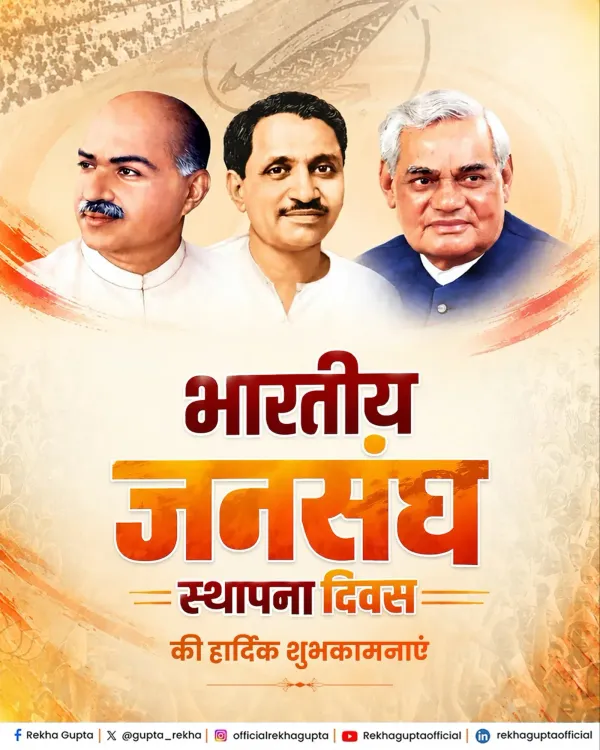
Delhi Chief Minister Rekha Gupta marked the Bharatiya Jan Sangh's 75th Foundation Day on 21 October 2026, honouring founder Dr. Shyama Prasad Mookerjee and the party's 1951 'Nation First' pledge — a tradition BJP leaders use to assert unbroken ideological continuity.
Key Takeaways
Delhi CM Rekha Gupta posted greetings on the 75th Foundation Day of the Bharatiya Jan Sangh on 21 October 2026 .
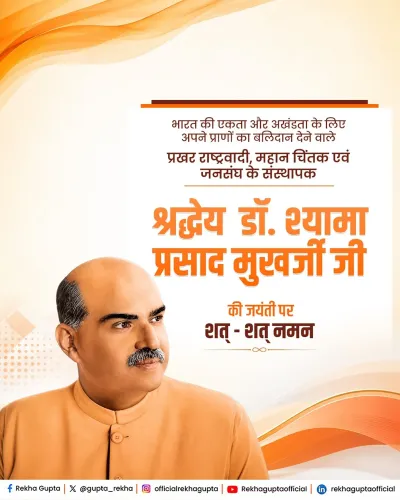
The Jan Sangh was formally established on 21 October 1951 at Delhi's Ramlila Maidan under founder-president Dr.
Shyama Prasad Mookerjee .
The party's founding principles — 'Nation First,' cultural nationalism and welfare of the last citizen — are invoked as the ideological roots of today's BJP .
Mookerjee died in detention in 1953 while championing the full integration of Jammu and Kashmir into India.
The Jan Sangh merged into the Janata Party in 1977 ; its successors founded the BJP in 1980 .
BJP leaders mark this anniversary annually to assert a continuous political legacy stretching back 75 years .
Seventy-five years after a political idea took root at Delhi's Ramlila Maidan, Delhi Chief Minister Rekha Gupta paused on Wednesday, 21 October 2026 to mark a founding moment that her party traces as the origin of its entire ideological DNA.
In a post on X, CM Gupta extended greetings on the 75th Foundation Day of the Bharatiya Jan Sangh, writing that the party was established with the conviction of 'Nation First,' an unbreakable faith in Indian culture, and a resolve for the welfare of the last person in society. She credited Dr. Shyama Prasad Mookerjee and the organisation's dedicated workers for laying an ideological and organisational foundation that, she said, continues to inspire national service, good governance and public welfare to this day. The post carried the hashtag #जनसंघ_से_जनजन_तक — 'From Jan Sangh to every person.'
The founding moment: Ramlila Maidan, 21 October 1951
The Bharatiya Jan Sangh was formally established on 21 October 1951 at Delhi's Ramlila Maidan — a date BJP leaders now treat as a foundational anniversary on par with the party's own 1980 founding. The explicit guiding slogan at launch was 'Nation First,' paired with cultural nationalism and a sharp critique of the Congress model of governance that dominated Indian politics at the time.
At its helm stood Dr. Shyama Prasad Mookerjee, the Bengali statesman, former Union minister and founding president of the party. Mookerjee became its most iconic symbol when he died in detention in 1953 while championing the full integration of Jammu and Kashmir into India — a cause that BJP leaders invoke as prophetic vindication decades later. The Jan Sangh's journey continued through the 1977 Janata Party merger before its ideological successors founded the BJP in 1980.
Why BJP leaders make this anniversary a yearly ritual
Marking the Jan Sangh's founding day is a near-universal practice among BJP leaders — and intentionally so. By drawing a direct line from 1951 to the present, the party projects itself not as a post-Emergency creation but as the 75-year-old carrier of a civilisational political idea. It frames the narrative around ideological continuity: one thread running from Mookerjee's 'Nation First' slogan through the Atal Bihari Vajpayee era to the current leadership.
For a sitting Chief Minister, joining that chorus carries additional weight — it anchors local governance rhetoric in a longer historical legitimacy and signals solidarity with the national party's ideological positioning. CM Gupta's reference to 'the welfare of the last person in society' also threads Jan Sangh's foundational promise directly into the present language of welfare delivery.
As BJP units across the country observe the diamond-jubilee year of the Jan Sangh's founding, the anniversary is likely to be accompanied by organisational events that reinforce the party's historical narrative in the months ahead.
Point of View
Participating in this annual ritual doubles as a signal of ideological alignment with the national leadership at a moment when Delhi's political calendar remains consequential. The reference to 'the welfare of the last person in society' is also a deliberate stitch between a historical slogan and the contemporary vocabulary of direct-benefit welfare delivery, suggesting the party sees the two as one unbroken thread. Whether the anniversary translates into substantive organisational activity in Delhi will be the real measure of its political utility.
NationPress
21 Oct 2026
Frequently Asked Questions
When was the Bharatiya Jan Sangh founded?
The Bharatiya Jan Sangh was founded on 21 October 1951 at Delhi's Ramlila Maidan by Dr. Shyama Prasad Mookerjee .
Who founded the Bharatiya Jan Sangh?
Dr. Shyama Prasad Mookerjee , a Bengali politician and former Union minister, was the founder-president of the Bharatiya Jan Sangh.
What happened to the Bharatiya Jan Sangh after its dissolution?
The Jan Sangh merged into the Janata Party in 1977 . Its leaders later established the Bharatiya Janata Party (BJP) in 1980 , which claims the Jan Sangh's ideological legacy.
Why did Shyama Prasad Mookerjee die in detention?
Dr. Shyama Prasad Mookerjee died in detention in 1953 after being arrested while campaigning for the full integration of Jammu and Kashmir into India.
Why do BJP leaders mark the Jan Sangh Foundation Day every year?
BJP leaders observe the Jan Sangh Foundation Day to assert ideological continuity between the 1951 party and the present-day BJP , highlighting 'Nation First' values, cultural nationalism and anti-dynastic politics as a shared legacy.