CM Rekha Gupta Pays Tribute to Dr. Kalam on Birth Anniversary
Synopsis
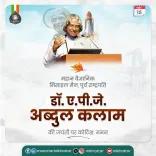
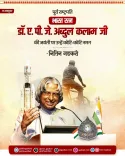
Delhi Chief Minister Rekha Gupta on 15 October 2026 honoured Dr. A.P.J. Abdul Kalam on his birth anniversary, citing his missile-science legacy, Bharat Ratna honour, and lifelong inspiration to India's youth to dream big and serve the nation.
Key Takeaways
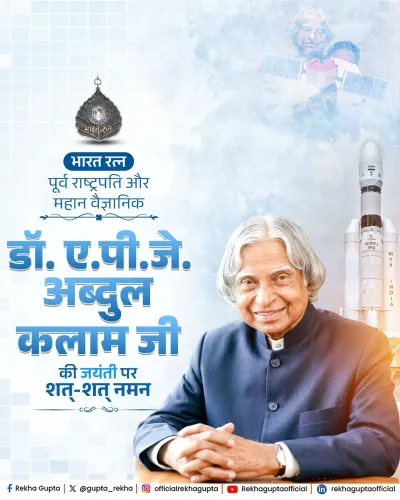
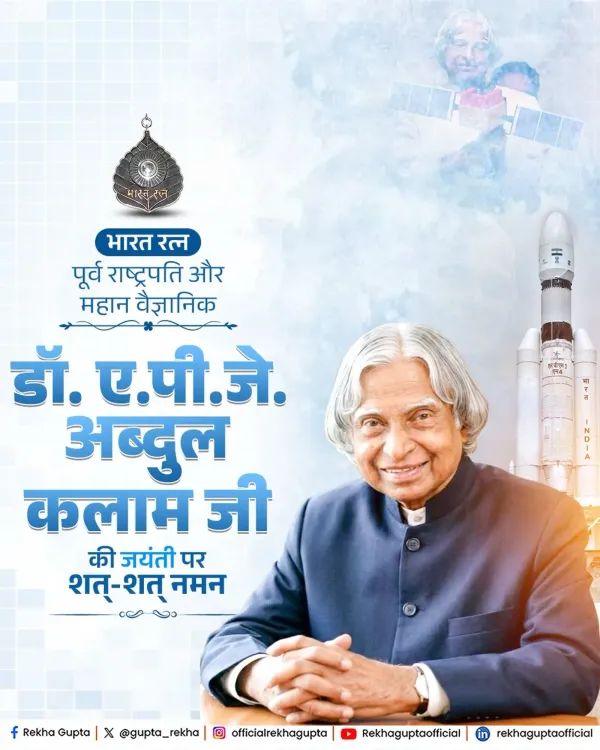
Delhi CM Rekha Gupta posted a Hindi tribute to Dr.
Abdul Kalam on his birth anniversary, 15 October 2026 .
Kalam served as India's 11th President from 2002 to 2007 and was awarded the Bharat Ratna in 1997 .
CM Gupta highlighted his role in making India self-reliant through science and inspiring youth to pursue national service.
The tribute invoked self-reliance (swavalamban) and duty-consciousness (kartavyanishtha) as Kalam's enduring lessons.
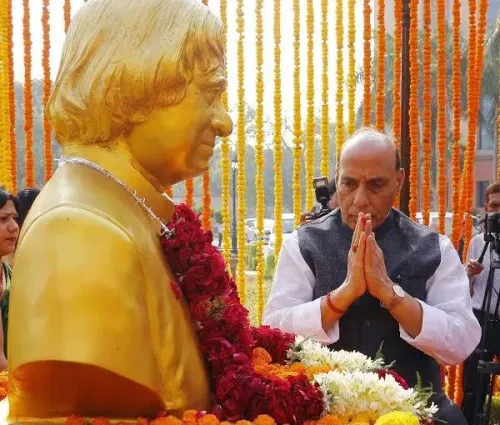
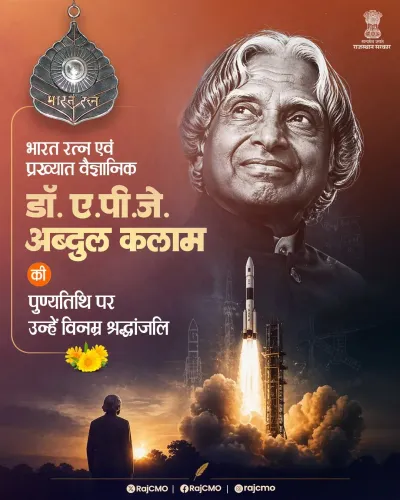
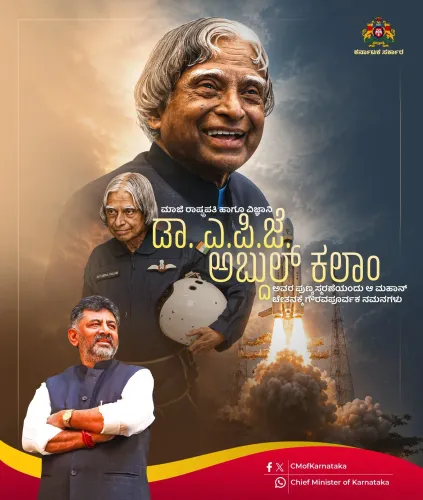
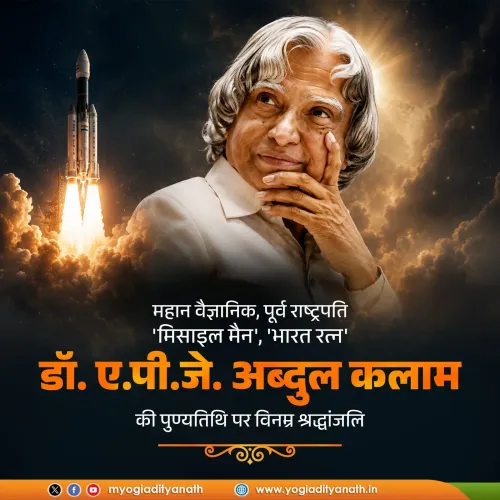
Political leaders across party lines annually mark 15 October as a moment of cross-partisan reverence for Kalam's legacy.
Ninety-five years after his birth in the coastal town of Rameswaram, Dr. A.P.J. Abdul Kalam continues to inspire a nation — and on Thursday, 15 October 2026, Delhi Chief Minister Rekha Gupta joined the chorus of remembrance with a heartfelt tribute to the scientist-statesman who made India believe in its own genius.
Posting in Hindi on X, CM Gupta offered what she called 'koti-koti naman' — a million salutations — to the man she described as a great scientist, former President, and recipient of the Bharat Ratna. 'His scientific contribution to making the nation self-reliant and capable, his simple life, high ideals, and unwavering dedication to the motherland will always be a source of inspiration,' she wrote.
From Rameswaram to Rashtrapati Bhavan: a life of national service
Dr. Avul Pakir Jainulabdeen Abdul Kalam rose from a modest family in Rameswaram, Tamil Nadu, to become the architect of India's missile defence programme and, ultimately, the 11th President of India from 2002 to 2007. He was the driving force behind landmark defence projects that placed India among the world's select aerospace powers. The Bharat Ratna, the country's highest civilian honour, was conferred on him in 1997 — five years before he entered Rashtrapati Bhavan.
Yet for millions of Indians, especially students, Kalam was less a bureaucrat or a politician and more a dream-keeper. CM Gupta captured this precisely: 'Dr. Kalam made science a medium of national service and awakened in the youth the confidence to dream big and to realise those dreams.' That sentence is not just tribute — it is a policy philosophy.
Why 'Missile Man' still speaks to the self-reliance moment
Kalam's legacy lands with particular resonance in an era when Atmanirbhar Bharat — self-reliant India — has become the defining frame of national ambition. His career embodied the idea long before it became a slogan: indigenously developed missiles, a homegrown space programme, and a relentless insistence that India need not borrow its confidence from abroad. CM Gupta's tribute explicitly invoked 'swavalamban' (self-reliance) and 'kartavyanishtha' (duty-consciousness) as the twin pillars of his example.
Every 15 October, educational institutions, state governments, and student bodies across India organise lectures, science fairs, and essay competitions in Kalam's name. The day has quietly become a calendar marker for the country's aspirational class — the first-generation college students, the engineering hopefuls, the young scientists in government labs — who found in his story proof that the distance between a small town and the stars is bridgeable.
A cross-party consensus on one legacy
Notably, tributes to Kalam on his birth anniversary arrive from across the political spectrum — a rare moment of unanimous reverence in an otherwise fractious public discourse. His identity as a Muslim scientist who led a Hindu-majority nation's most celebrated defence achievements, who lived with legendary simplicity even as President, and who chose classrooms over corridors of power in his final years, makes his legacy genuinely difficult to narrow into any one ideological lane.
For CM Gupta and her party, the emphasis on self-reliance and national-first thinking aligns naturally with current policy priorities. But the message she posted is one that any Indian, regardless of affiliation, would find hard to contest.
Kalam once wrote that 'dreams are not what you see in your sleep — dreams are things that do not let you sleep.' On his birth anniversary, India remembers a man who kept an entire generation awake with possibility.
Point of View
And Kalam's career — missiles designed indigenously, a presidency lived without pomp — is perhaps the most potent one available. The framing of science as 'national service' is not incidental; it signals an ambition to channel young Indians' aspirations toward defence, space, and deep-tech sectors. That politicians across the spectrum echo these same themes every 15 October suggests Kalam's legacy functions as shared civic capital, deployed by each side but owned by none — a rare stabilising force in an era of sharp political polarisation.
NationPress
15 Oct 2026
Frequently Asked Questions
When is APJ Abdul Kalam's birth anniversary?
Dr. A.P.J. Abdul Kalam was born on 15 October 1931 in Rameswaram, Tamil Nadu, and his birth anniversary is observed on that date every year.
What did Delhi CM Rekha Gupta say about Dr. Kalam?
CM Gupta paid tribute in Hindi, saying Kalam's scientific contributions, simple life, and dedication to the motherland will always be inspiring, and that he awakened in India's youth the confidence to dream big.
Why is Dr. Kalam called the Missile Man of India?
Dr. Kalam earned the title 'Missile Man of India' for his pivotal role in developing India's indigenous ballistic missile programme, including the Agni and Prithvi missiles, through the Defence Research and Development Organisation (DRDO) .
When did APJ Abdul Kalam receive the Bharat Ratna?
Dr. A.P.J. Abdul Kalam was awarded the Bharat Ratna , India's highest civilian honour, in 1997 .
What is the significance of 15 October in India?
15 October is observed as the birth anniversary of Dr. A.P.J. Abdul Kalam and is widely marked by educational institutions, state governments, and youth organisations across India with lectures, science events, and student programmes in his memory.