CM Revanth Reddy Hails Vikram-1 Launch as Triumph for Hyderabad

Synopsis
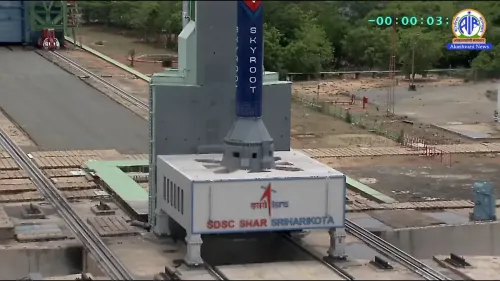
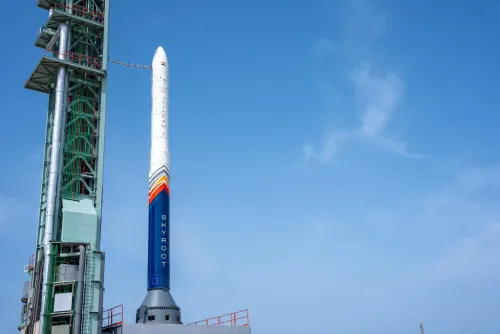
Telangana Chief Minister A. Revanth Reddy hailed the successful launch of Vikram-1, India's first privately built orbital rocket by Hyderabad's Skyroot Aerospace, from Sriharikota on 18 July 2026, calling it a proud moment for India and a testament to Telangana's growing innovation ecosystem.
Key Takeaways
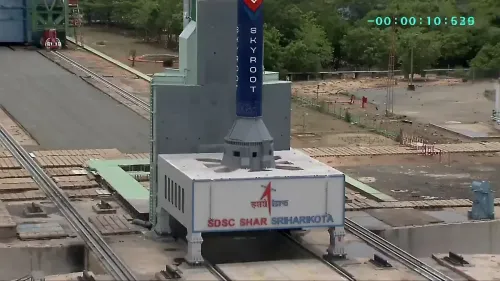
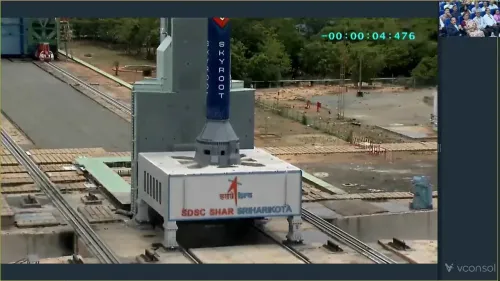
Vikram-1 , described as India's first privately developed orbital rocket, successfully launched from Sriharikota on 18 July 2026 .
Skyroot Aerospace , founded in 2018 and headquartered in Hyderabad , developed the vehicle under the mission designation #MissionAagaman .
The launch was enabled by India's IN-SPACe framework established in 2020 , which opened ISRO facilities to private launch providers.
Revanth Reddy positioned the milestone as evidence that Telangana is central to India's private space ambitions.
Hyderabad's aerospace cluster, home to multiple space startups, stands to attract further investment following the successful demonstration.
The mission advances India's broader goal of capturing a share of the global small satellite launch market through domestic private providers.
Telangana Chief Minister A. Revanth Reddy on Saturday, 18 July 2026 congratulated Skyroot Aerospace after Vikram-1, described as India's first privately built orbital rocket, lifted off from the Satish Dhawan Space Centre, Sriharikota, marking a landmark moment for the country's private space sector and for Hyderabad, where the company is headquartered.
Context
Posting on X under the hashtags #Vikram1, #MissionAagaman, and #HyderabadRising, Chief Minister Revanth Reddy wrote: 'Reaching for the skies… it is a proud day for India, and even greater pride for Hyderabad. Vikram-1, India's first privately built orbital rocket, developed by Hyderabad's own firm Skyroot, has successfully lifted off from Sriharikota.' He added that 'Telangana is where India's space dreams take shape' and extended congratulations to the entire Skyroot team.
The launch, conducted from ISRO's Satish Dhawan Space Centre on the Andhra Pradesh coast, represents the culmination of years of development by Skyroot Aerospace, a Hyderabad-based startup founded in 2018 by former ISRO engineers. The company has been developing the Vikram series of small satellite launch vehicles since its inception.
Policy Backdrop
The successful flight is a direct outcome of India's gradual opening of the space sector to private enterprise. In 2020, the Government of India established IN-SPACe — the Indian National Space Promotion and Authorisation Centre — to regulate and enable private participation in space activities, ending decades of exclusive state control over launch infrastructure.
Skyroot Aerospace benefited from early support under the Startup India initiative and ISRO's Technology Transfer and Industry Partnership programmes, which from 2017 to 2023 progressively opened the Sriharikota launch complex to qualified private entities. The company secured seed funding and technical mentorship, allowing it to progress from concept to orbital-class hardware within roughly eight years.
India's strategic interest in the private launch market is tied to the global boom in small satellite deployments. By enabling domestic private launch providers, the country aims to capture a share of the international small-satellite launch market while freeing ISRO to focus on flagship scientific and exploration missions.
Stakeholders and Impact
Hyderabad has emerged as a significant aerospace cluster, hosting multiple space startups alongside established defence manufacturing units. Chief Minister Revanth Reddy's post explicitly frames the launch as a validation of Telangana's innovation ecosystem, a narrative the state government has cultivated through industrial policy incentives aimed at attracting high-technology firms.
The immediate beneficiaries include small satellite operators — both domestic and international — who now have access to an additional Indian launch option. A functioning private orbital launch vehicle expands the country's overall launch cadence and reduces dependence on a single state-run provider. Broader aerospace supply chains in Hyderabad, including component manufacturers and engineering services firms, stand to gain from increased commercial activity.
The development also carries symbolic weight for India's Atmanirbhar Bharat self-reliance agenda in strategic sectors, demonstrating that deep-tech startups can deliver mission-critical systems with limited but targeted government support.
What's Next
Attention will now turn to Skyroot Aerospace's commercial launch manifest and whether the company announces follow-on flights under Mission Aagaman or subsequent mission designations. Central and state government funding commitments for private launch infrastructure are also expected to come into sharper focus following a successful orbital demonstration.
For Telangana, the launch reinforces the state's pitch to space and defence technology investors, and Chief Minister Revanth Reddy is likely to leverage the milestone in ongoing efforts to attract further investment to Hyderabad's aerospace corridor. India's private space sector, still in an early commercial phase, will look to this mission as a proof point for future venture and institutional funding rounds.
Point of View
A space Congress-led state governments have increasingly contested with BJP-ruled rivals. By foregrounding Hyderabad's role rather than crediting central policy alone, the Chief Minister subtly asserts state-level agency in a domain often dominated by the Union government's Atmanirbhar narrative. The launch also arrives at a moment when IN-SPACe's regulatory framework is still maturing, meaning early commercial successes carry outsized signalling value for investors and policymakers alike. If Skyroot secures a robust commercial manifest on the back of this mission, Telangana's claim as India's premier private space hub will be harder for competing states to contest.
NationPress
18 Oct 2026
Frequently Asked Questions
What is Vikram-1 and who built it?
Vikram-1 is described as India's first privately developed orbital-class rocket, built by Skyroot Aerospace , a Hyderabad-based startup founded in 2018 by former ISRO engineers to develop the Vikram series of small satellite launch vehicles.
Where did Vikram-1 launch from?
Vikram-1 launched from ISRO's Satish Dhawan Space Centre at Sriharikota , on the Andhra Pradesh coast, which is India's primary orbital launch complex.
Why did Telangana CM Revanth Reddy comment on the Vikram-1 launch?
Chief Minister A. Revanth Reddy congratulated Skyroot Aerospace because the company is headquartered in Hyderabad , Telangana's capital, making the launch a point of regional pride and a validation of the state's aerospace innovation ecosystem.
What is IN-SPACe and how does it relate to private rocket launches in India?
IN-SPACe (Indian National Space Promotion and Authorisation Centre) was established by the Government of India in 2020 to regulate and facilitate private sector participation in space activities, including granting qualified companies access to ISRO's launch infrastructure at Sriharikota.
What is Mission Aagaman?
Mission Aagaman is the designation used in connection with the Vikram-1 launch, as referenced in Chief Minister Revanth Reddy's post on X. Further details about the mission's payload and objectives are expected to be disclosed by Skyroot Aerospace.