CM Yogi Approves Link Expressway to Connect Bulandshahr to Noida Airport
Synopsis
Uttar Pradesh has approved a Link Expressway from Bulandshahr to connect Noida International Airport with the Ganga Expressway. CM Yogi Adityanath says the corridor will open a new chapter of industrialisation for the district, attracting investment and generating large-scale employment.
Key Takeaways
The Uttar Pradesh government has approved construction of a Link Expressway from Bulandshahr to connect Noida International Airport with the Ganga Expressway .
Noida International Airport at Jewar is described as the country's largest airport and is being developed by a Zurich Airport -led consortium.
The Ganga Expressway is a 594-km corridor linking Meerut to Prayagraj , approved by the state cabinet in 2018 .
CM Yogi Adityanath says improved connectivity will attract investment and generate large-scale employment in Bulandshahr .
The project extends UP's expressway-led growth model to a district historically dependent on agriculture and small-scale industry.
Key next steps include tenders, land acquisition notifications, and environmental clearances for the Link Expressway.
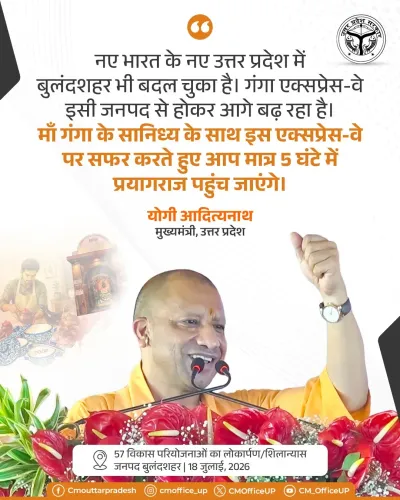
The Chief Minister's Office of Uttar Pradesh announced on Saturday, 18 July 2026 that the state government has approved the construction of a Link Expressway from Bulandshahr to connect Noida International Airport — described as the country's largest airport — with the Ganga Expressway, a move Chief Minister Yogi Adityanath says will usher the district into a new era of industrialisation.
Context
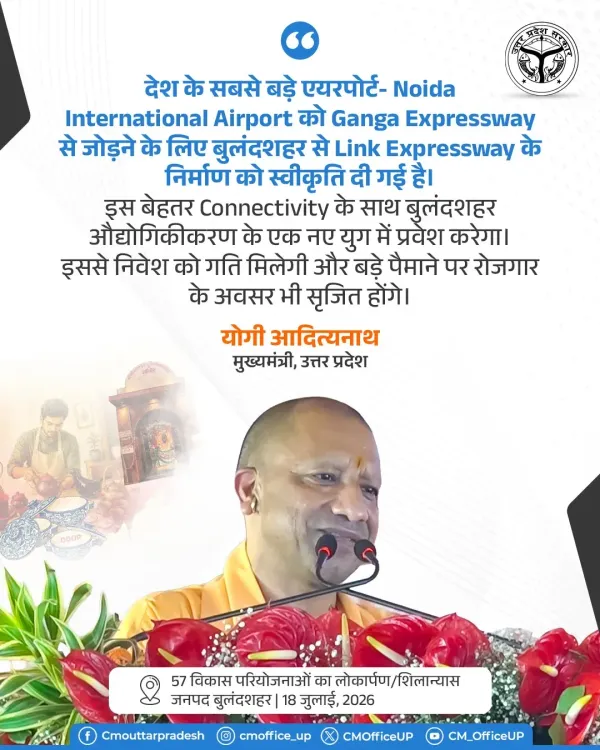
Posting on behalf of CM Yogi Adityanath, the Chief Minister's Office stated: 'देश के सबसे बड़े एयरपोर्ट- Noida International Airport को Ganga Expressway से जोड़ने के लिए बुलंदशहर से Link Expressway के निर्माण को स्वीकृति दी गई है' — meaning, approval has been granted for the construction of a Link Expressway from Bulandshahr to connect Noida International Airport, the country's largest, with the Ganga Expressway. The Chief Minister added that the improved connectivity would accelerate investment and generate employment opportunities at scale.
Noida International Airport, being developed as a greenfield facility at Jewar in Gautam Buddh Nagar, is positioned to become one of India's most significant aviation hubs. The Ganga Expressway — a 594-kilometre access-controlled corridor linking Meerut to Prayagraj — forms the backbone of this new connectivity arc across western and central Uttar Pradesh.
Policy Backdrop
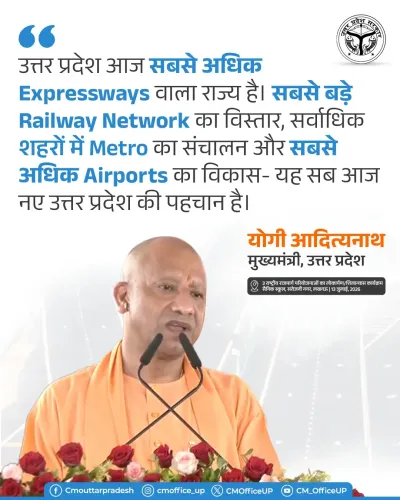
The approval fits squarely within the Uttar Pradesh government's infrastructure-first strategy, pursued consistently since 2017, of building expressway networks to attract industrial investment and disperse economic activity beyond the core National Capital Region. The state has already developed the Agra-Lucknow Expressway and the Purvanchal Expressway under this framework, with each corridor anchored by promises of logistics advantages and investor-friendly zones.
The Ganga Expressway received state cabinet approval in 2018, while Noida International Airport was awarded to a Zurich Airport-led consortium in 2019 following central and state clearances. The proposed Bulandshahr Link Expressway would effectively stitch these two flagship projects together, giving a historically agriculture-dependent district a direct corridor to a major international airport.
Stakeholders and Impact
Bulandshahr, a western Uttar Pradesh district traditionally reliant on agriculture and small-scale industry, stands to gain the most from this connectivity upgrade. Direct expressway access to Noida International Airport is expected to make the district attractive to logistics firms, warehousing operators, and light manufacturers seeking proximity to a major cargo and passenger hub without the land-cost pressures of the NCR core.
The broader logistics sector in western Uttar Pradesh would also benefit, as freight moving between the Ganga Expressway corridor and the new airport would no longer need to navigate congested urban roads. Residents of Bulandshahr and surrounding areas would gain faster access to international travel and the employment ecosystem that large airport-adjacent industrial clusters typically generate.
What's Next
The immediate milestones to watch are the issuance of project tenders, land acquisition notifications, and environmental clearances for the Bulandshahr Link Expressway. These procedural steps will determine the actual construction timeline and the scale of displacement and rehabilitation that the project entails.
Subsequent announcements on dedicated industrial estates or investor commitments in Bulandshahr will indicate whether the connectivity approval translates into the large-scale employment creation that CM Yogi Adityanath has promised. The project will also be closely watched as a test case for the state's ability to extend its expressway-led growth model to secondary districts ahead of future investor summits.
Point of View
The state is betting that connectivity alone can shift industrial geography. The timing — coming as Noida International Airport inches toward operationalisation — is deliberate, signalling to investors that the hinterland around Jewar is being prepared for industrial absorption. Whether the employment promises materialise will depend heavily on how quickly land acquisition and environmental processes move, two areas where UP's expressway projects have historically faced delays.
NationPress
18 Jul 2026
Frequently Asked Questions
What is the Bulandshahr Link Expressway?
The Bulandshahr Link Expressway is a proposed road corridor approved by the Uttar Pradesh government to connect Bulandshahr district with both the Ganga Expressway and Noida International Airport at Jewar, aimed at boosting industrial investment and employment in the region.
Where is Noida International Airport located?
Noida International Airport is a greenfield facility under construction at Jewar in Gautam Buddh Nagar, Uttar Pradesh, and is being developed by a Zurich Airport-led consortium as one of India's largest aviation hubs.
What is the Ganga Expressway and how long is it?
The Ganga Expressway is a 594-kilometre access-controlled expressway in Uttar Pradesh linking Meerut to Prayagraj. It received state cabinet approval in 2018 and is a key part of UP's expressway expansion programme.
How will the Link Expressway benefit Bulandshahr?
The expressway will give Bulandshahr direct access to Noida International Airport and the Ganga Expressway corridor, making the district attractive to logistics firms, manufacturers, and warehousing operators, and is expected to generate large-scale employment.
What are the next steps for the Bulandshahr Link Expressway project?
The immediate next steps include issuance of project tenders, land acquisition notifications, and environmental clearances. These will determine the construction timeline and whether the promised industrial and employment benefits materialise.