CM Revanth Reddy Performs Bhoomi Pooja at Yadagirigutta Temple
Synopsis
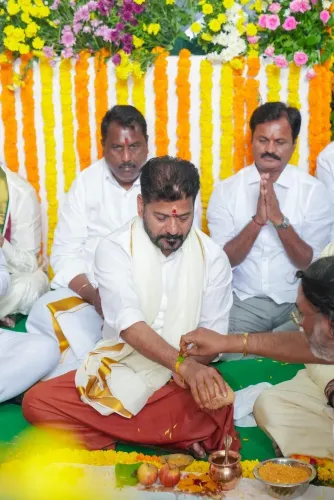
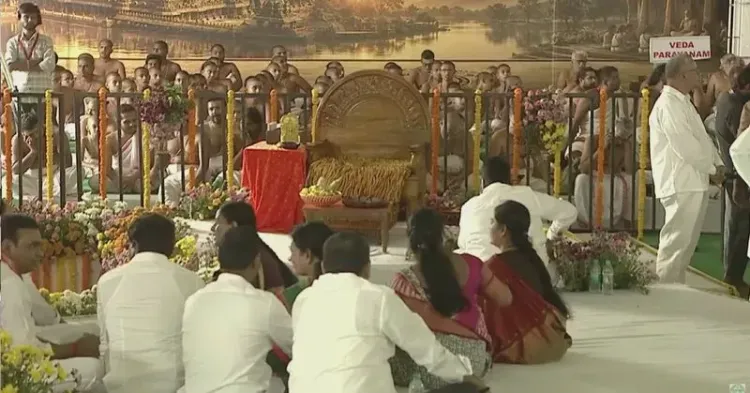
Chief Minister A. Revanth Reddy performed the Bhoomi Pooja for the Sri Lakshmi Narasimha Swamy Veda Patashala and laid the foundation stone for development works at Yadagirigutta on 23 May 2026, continuing Telangana's multi-government push to develop the temple town as a premier pilgrimage and cultural destination.
Key Takeaways
Revanth Reddy performed the Bhoomi Pooja for the Sri Lakshmi Narasimha Swamy Veda Patashala at Yadagirigutta on 23 May 2026 .
A foundation stone was also laid for broader development works at the Sri Lakshmi Narasimha Swamy Temple complex.
Yadagirigutta in Yadadri Bhuvanagiri district is one of Telangana's most prominent pilgrimage centres, drawing lakhs of devotees each year.
The previous BRS government spent over Rs 1,500 crore on redeveloping the temple complex between 2015 and 2022 ; the current Congress administration is continuing and expanding that effort.
The new Veda Patashala will provide institutional support for traditional Vedic education within the temple premises.
Completion timelines and state budget allocations for the project are yet to be formally announced.
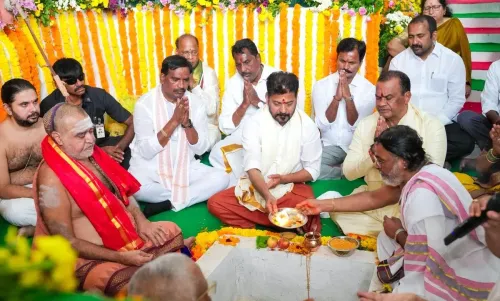
The Chief Minister's Office of Telangana announced on Saturday, 23 May 2026 that Chief Minister A. Revanth Reddy participated in a Bhoomi Pooja for the Sri Lakshmi Narasimha Swamy Veda Patashala and laid the foundation stone for development works at the Sri Lakshmi Narasimha Swamy Temple in Yadagirigutta, marking a significant step in the ongoing expansion of the temple city.
Context
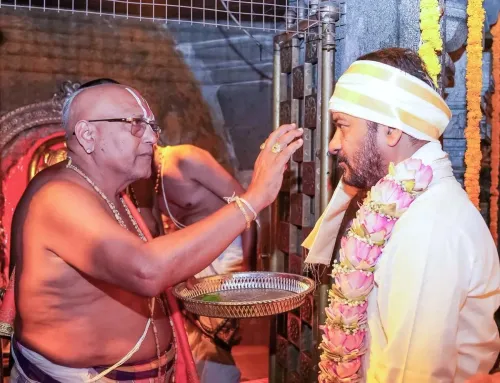
Yadagirigutta, located in Yadadri Bhuvanagiri district of Telangana, is one of the most revered pilgrimage centres in the state, home to the ancient Sri Lakshmi Narasimha Swamy Temple dedicated to the fourth avatar of Lord Vishnu. The temple draws lakhs of devotees annually and has been at the centre of successive state governments' cultural and religious infrastructure plans. Saturday's ceremony added a new chapter by grounding the construction of a Veda Patashala — a traditional Vedic learning institution — within the temple premises.
The Bhoomi Pooja, a consecrated ground-breaking ritual, was performed by CM Revanth Reddy in the presence of officials and devotees. The foundation stone laying signals the formal commencement of a broader set of development works intended to enhance the temple city's infrastructure and its capacity for religious education.
Policy Backdrop
The development of Yadagirigutta as a modern temple city has been a stated priority across political administrations since Telangana's formation in 2014. The previous BRS government under K. Chandrashekar Rao undertook a large-scale redevelopment of the temple complex between 2015 and 2022 at a reported cost exceeding Rs 1,500 crore, constructing new temple structures and pilgrim amenities. The current Congress government, which came to power in December 2023, has continued this trajectory while adding components centred on Vedic education and cultural preservation.
The inclusion of a Veda Patashala reflects a broader policy impulse to embed traditional learning institutions within major pilgrimage sites, positioning them as centres of both devotion and cultural continuity. This approach aligns with a pattern seen at several prominent temple towns across India where state governments have sought to combine religious tourism with heritage education.
Stakeholders and Impact
Vedic scholars and students stand to benefit most directly from the new Patashala, which is intended to sustain the oral and textual traditions associated with the temple. Pilgrims and tourists visiting Yadagirigutta are expected to gain enhanced facilities as the broader development works progress. Local residents and traders in the temple town, whose livelihoods are closely tied to pilgrimage footfall, also have a direct stake in the scale and pace of the project.
The Telangana tourism sector stands to gain from the elevation of Yadagirigutta as a comprehensive religious and cultural destination, potentially drawing visitors beyond the state's borders and integrating the site into wider pilgrimage circuits in southern India.
What's Next
Attention will now turn to the timelines set for completion of the Veda Patashala and the associated development works, as well as any dedicated budget allocations the state government may announce to fund the project. Whether the site is formally incorporated into a regional pilgrimage tourism circuit — a step that could unlock central government support — remains a key question for stakeholders and administrators alike.
The ceremony at Yadagirigutta signals that the Congress-led Telangana government intends to maintain the political and cultural salience of the temple city, even as it seeks to distinguish its approach from that of its predecessor through the addition of Vedic education infrastructure.
Point of View
Revanth Reddy reinforces his government's claim to the temple-city narrative ahead of what remains a politically competitive terrain in the state. The Veda Patashala component, in particular, broadens the project's appeal beyond brick-and-mortar development to encompass cultural preservation — a framing that carries weight with both religious communities and a wider electorate.
NationPress
8 Oct 2026
Frequently Asked Questions
What happened at Yadagirigutta on 23 May 2026?
Chief Minister A. Revanth Reddy performed the Bhoomi Pooja for the Sri Lakshmi Narasimha Swamy Veda Patashala and laid the foundation stone for development works at the Sri Lakshmi Narasimha Swamy Temple in Yadagirigutta on 23 May 2026.
What is a Veda Patashala and why is one being built at Yadagirigutta?
A Veda Patashala is a traditional institution for Vedic learning, where students are trained in ancient Sanskrit scriptures and oral traditions. The one announced at Yadagirigutta is intended to sustain the religious and cultural heritage associated with the Sri Lakshmi Narasimha Swamy Temple.
How much did the previous government spend on Yadagirigutta development?
The BRS government under K. Chandrashekar Rao reportedly spent over Rs 1,500 crore on redeveloping the Yadagirigutta temple complex between 2015 and 2022, including new temple structures and pilgrim amenities.
Who is A. Revanth Reddy?
A. Revanth Reddy is the Chief Minister of Telangana, heading the Congress government that came to power after the state assembly elections in December 2023.
Where is Yadagirigutta located?
Yadagirigutta is a temple town in Yadadri Bhuvanagiri district of Telangana, situated roughly 60 kilometres from Hyderabad, and is one of the most significant Hindu pilgrimage sites in the state.