CM Rio meets Union Minister Jual Oram, seeks support for Nagaland film and creative sector
Synopsis
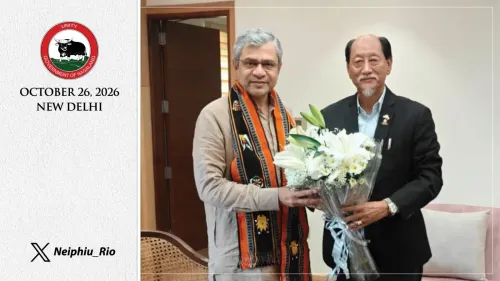
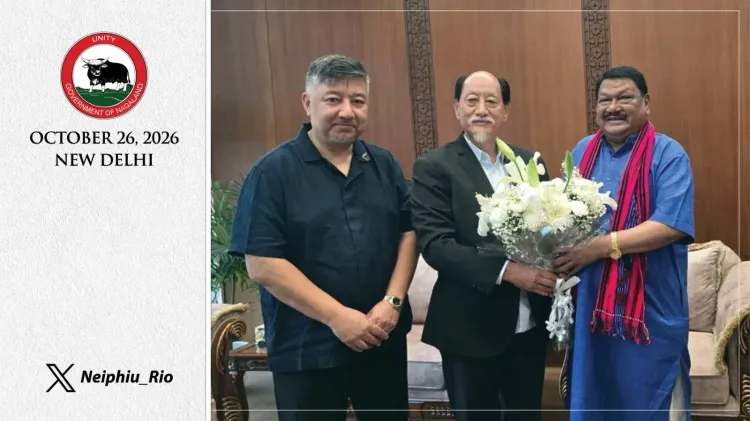
Nagaland Chief Minister Neiphiu Rio called on Union Minister for Tribal Affairs Jual Oram on 26 October 2026, seeking institutional support for the ANGH film project and assistance to strengthen the state's broader creative sector. Oram assured support for the initiative.
Key Takeaways
CM Neiphiu Rio met Union Minister Jual Oram in New Delhi on 26 October 2026 .
The central ask was institutional support for the ANGH film project and Nagaland's wider creative sector.
Jual Oram is the Union Minister for Tribal Affairs and a senior BJP leader from Odisha with prior tenure in the same role.
The Ministry of Tribal Affairs is the nodal central body for tribal welfare and cultural development across India.
The meeting continues a broader pattern of Northeast chief ministers routing cultural-promotion requests through the Tribal Affairs Ministry.
Formal follow-up — such as MoUs or funding allocations — has not yet been publicly confirmed.
Nagaland Chief Minister Neiphiu Rio took the case for his state's creative economy to the highest tribal-affairs desk in New Delhi on Monday, 26 October 2026, calling on Union Minister for Tribal Affairs Jual Oram to press for institutional backing — most notably for the ANGH film project — and broader support to strengthen Nagaland's arts and culture sector.
What Rio asked — and what Oram promised
Rio, posting on X after the meeting, confirmed that the two leaders 'discussed institutional support for ANGH film, and assistance to strengthen the State's creative sector.' He added he was 'grateful for his assurance of support in advancing this initiative' — a diplomatic signal that Oram's Ministry of Tribal Affairs is broadly on board, even if formal funding or MoU details remain to be formalised.
The specific contours of the ANGH project have not been confirmed in public records, but the ask itself is telling: Nagaland's government is reaching for central institutional muscle — not just goodwill — to back indigenous Naga storytelling on film.
Why the Ministry of Tribal Affairs is the right door to knock on
The Ministry of Tribal Affairs is the nodal body for welfare and cultural development of Scheduled Tribes across India. Northeast chief ministers have increasingly routed cultural-promotion requests through this ministry as the central government deepens its push to bring tribal creative expressions into the mainstream media and entertainment economy. For Nagaland — a state whose population is overwhelmingly tribal and whose oral, musical and visual traditions are globally distinctive — that channel carries real leverage.
Jual Oram, a senior BJP leader from Odisha, previously held the Tribal Affairs portfolio during an earlier tenure, giving him institutional familiarity that Rio would have found useful across the table.
Nagaland's long push for a national creative platform
This meeting is part of a pattern. Nagaland has for years pursued national-level partnerships to amplify indigenous narratives — from the Hornbill Festival's projection as a cultural flagship to engagements with central culture and information bodies. Extending that effort into film and the broader creative sector marks a deliberate next step: one that converts soft cultural assets into a structured industry backed by institutional finance and policy support.
If the assurances translate into formal allocations or an MoU between Nagaland and the Union Ministry, it could provide a replicable model for other Northeast states seeking to build their own creative economies on the strength of tribal heritage.
The kicker is this: Nagaland has the stories — now it wants the scaffolding to tell them at scale.
Point of View
Rio is leveraging the tribal identity of Nagaland's population as a policy lever — smart politics that maps cultural aspiration onto an existing central-government mandate. Oram's assurance, even if non-binding at this stage, signals Centre-state alignment on tribal creative economies that could set a precedent for other Northeast states. The test will be whether goodwill converts into budgeted line items before the next budget cycle.
NationPress
26 Oct 2026
Frequently Asked Questions
What is the ANGH film project in Nagaland?
The ANGH film is a project that Nagaland Chief Minister Neiphiu Rio is seeking institutional support for through the Union Ministry of Tribal Affairs. Specific details of the project have not been confirmed in public records as of October 2026.
Who is Jual Oram and what ministry does he head?
Jual Oram is a senior BJP leader from Odisha who serves as the Union Minister for Tribal Affairs. He previously held the same portfolio in an earlier tenure and oversees welfare and cultural development for Scheduled Tribes across India.
Why did Nagaland CM Rio meet the Tribal Affairs Minister?
CM Rio called on Minister Oram to seek institutional support for the ANGH film project and to request assistance in strengthening Nagaland's broader creative and arts sector, in line with the state's push to develop its indigenous cultural economy.
What role does the Ministry of Tribal Affairs play in cultural promotion?
The Ministry of Tribal Affairs is the central government's nodal body for the welfare and development of Scheduled Tribes, including support for tribal cultural heritage and creative expressions. Northeast chief ministers have increasingly used this channel for cultural-promotion initiatives.
Has any formal funding been announced for Nagaland's film sector from the centre?
As of 26 October 2026, no formal MoU or specific funding allocation has been publicly confirmed. Minister Oram expressed an assurance of support, with formal mechanisms expected to be worked out in subsequent state-central coordination meetings.