CM Sai: 99.95% land registrations get auto-mutation in Chhattisgarh
Synopsis
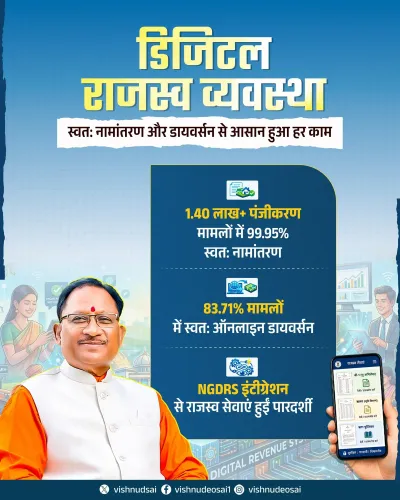
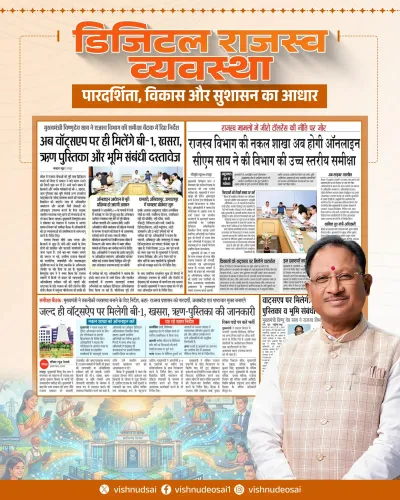
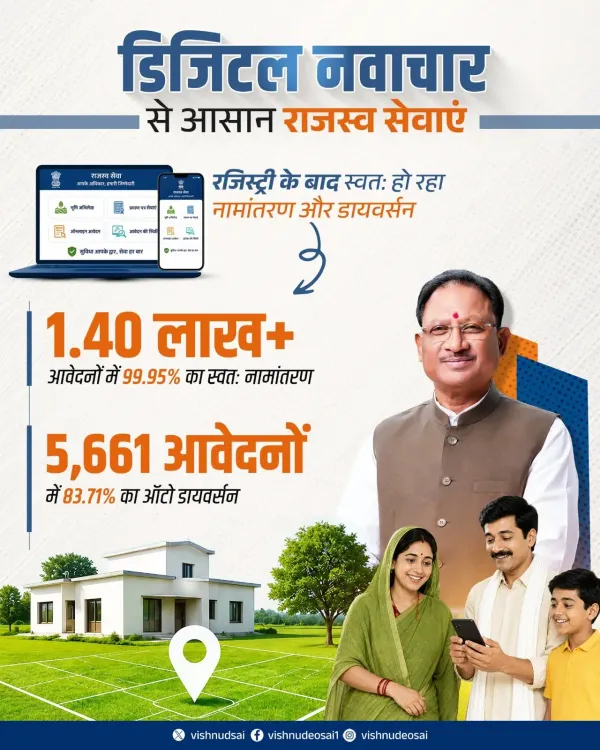
Chhattisgarh CM Vishnu Deo Sai announced on 12 July 2026 that over 99.95% of land registrations now see automatic mutation and 83.71% automatic diversion under digital revenue reforms, marking a significant reduction in manual intervention in the state's property administration.
Key Takeaways
More than 99.95% of land registration cases in Chhattisgarh now undergo automatic mutation ( swatah namantaran ), eliminating the need for a separate manual application.
83.71% of cases now see automatic diversion ( swatah diversion ), streamlining land-use reclassification for citizens.
The reforms build on the National Land Records Modernization Programme (2008) and the Digital India initiative launched in 2015 .
CM Vishnu Deo Sai , in office since December 2023 , has framed digital revenue services as the cornerstone of his 'good governance' agenda.
The automation directly benefits rural and tribal landowners in Chhattisgarh by cutting delays, reducing office visits, and improving transparency in property records.
Full GIS integration and potential legislative codification of zero-manual-intervention norms are flagged as the next milestones.
Chhattisgarh Chief Minister Vishnu Deo Sai on Sunday, 12 July 2026, highlighted sweeping digital reforms in the state's revenue administration, stating that more than 99.95 per cent of land registration cases now undergo automatic mutation and 83.71 per cent see automatic diversion — eliminating manual bottlenecks that have historically delayed property transactions in the state.
Context
Posting in Hindi on X, CM Sai wrote: 'सुशासन सरकार में डिजिटल नवाचारों के माध्यम से राजस्व सेवाएं पहले से अधिक सरल, त्वरित और पारदर्शी हुईं हैं' — ('Under the good-governance government, revenue services have become simpler, faster and more transparent through digital innovations'). He described automatic mutation and diversion as 'clear proof of technology-based administrative efficiency and the seamless services being delivered to citizens.'
Mutation (namantaran) is the process of updating land ownership records after a sale or transfer, while diversion (diversion) refers to reclassifying agricultural land for non-agricultural use. Both processes have long been flashpoints for delays, corruption, and disputes in Chhattisgarh and across India.
Policy Backdrop
The push to automate land records in Chhattisgarh draws on a national lineage that began with the National Land Records Modernization Programme (NLRMP), launched in 2008, which mandated computerisation of land records to reduce disputes and manual intervention. The state had rolled out e-District and online revenue service initiatives from the mid-2010s onward as part of successive waves of e-governance reform.
The broader Digital India programme, launched in 2015 by the Union government, provided a further impetus for states to integrate Aadhaar-linked portals and online dashboards into revenue administration. CM Sai, who took charge in December 2023, has positioned digital governance as a signature plank of his administration, framing technology-driven service delivery as the hallmark of 'good governance' (sushasan).
Stakeholders and Impact
Chhattisgarh, formed in 2000, has a large rural and tribal population for whom land ownership documentation is foundational to livelihoods, credit access, and legal security. Delays in mutation and diversion have historically forced landowners — particularly smallholders — to make repeated visits to revenue offices and, in many cases, pay informal fees to expedite paperwork.
Automation of these processes directly benefits landowners who complete a registration, as ownership records are updated without a separate manual application. Revenue officials are simultaneously freed from high-volume routine processing, potentially reducing a significant source of administrative friction. The high automation rate in diversion cases also signals faster clearance for small businesses and developers seeking to convert land use.
What's Next
The next phase of reform that analysts and officials have flagged involves full integration of automated land services with state Geographic Information System (GIS) platforms, which would link spatial mapping to ownership records in real time. Legislative changes to formally codify zero-manual-intervention norms in revenue law remain a potential further step. CM Sai's government has signalled continued commitment to expanding technology-driven service delivery, with the stated goal of ensuring 'simple, time-bound and transparent services reach every citizen.'
Point of View
Corruption-free government that the party has cultivated since 2014. The outstanding challenge — GIS integration and legislative reform — will determine whether these efficiency gains are institutionalised or remain contingent on executive priority.
NationPress
12 Jul 2026
Frequently Asked Questions
What is automatic mutation of land records in Chhattisgarh?
Automatic mutation means that once a land sale or transfer is registered, ownership records are updated digitally without the buyer needing to file a separate manual application. Chhattisgarh CM Vishnu Deo Sai stated on 12 July 2026 that over 99.95% of registration cases now trigger this automatic update.
What does 83.71% automatic diversion mean for Chhattisgarh landowners?
Automatic diversion means agricultural land is reclassified for non-agricultural use without manual processing by revenue officials. CM Sai's post on 12 July 2026 cited 83.71% of diversion cases being handled automatically, reducing delays for farmers and developers.
What is the National Land Records Modernization Programme?
The National Land Records Modernization Programme (NLRMP) was launched by the Union government in 2008 to computerise land records across India, reduce property disputes, and cut manual intervention in revenue administration. Chhattisgarh's current automation reforms are part of this longer national lineage.
How has Chhattisgarh improved its land registration process under CM Vishnu Deo Sai?
Since CM Vishnu Deo Sai took office in December 2023, the state has accelerated digital revenue reforms so that the vast majority of land mutations and diversions now happen automatically after registration, removing the need for citizens to visit revenue offices multiple times.
What is the next step for digital land records in Chhattisgarh?
The next phase involves integrating automated land services with state GIS platforms to link spatial mapping with ownership records in real time, along with possible legislative changes to formally mandate zero-manual-intervention processes in revenue law.