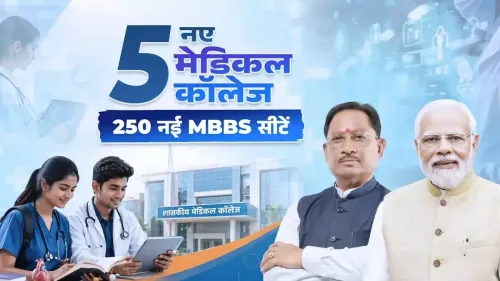
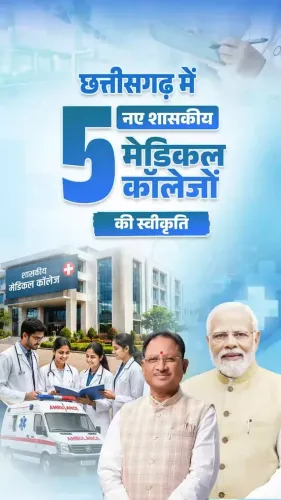
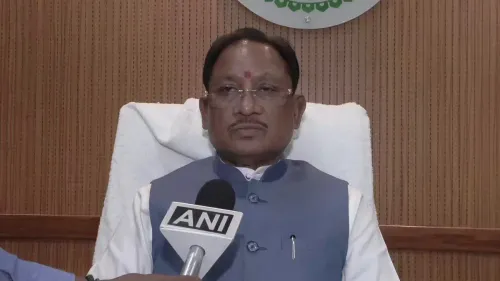
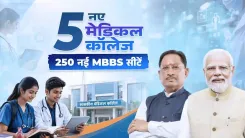
CM Sai announces 5 new govt medical colleges for Chhattisgarh
Synopsis
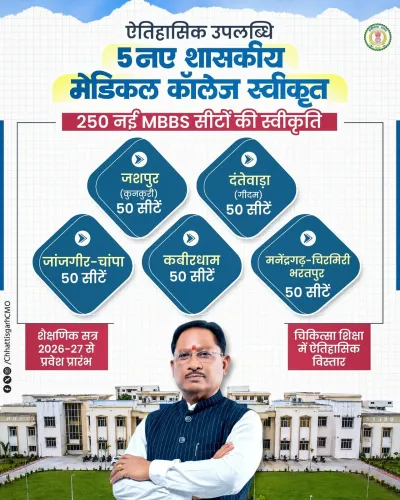
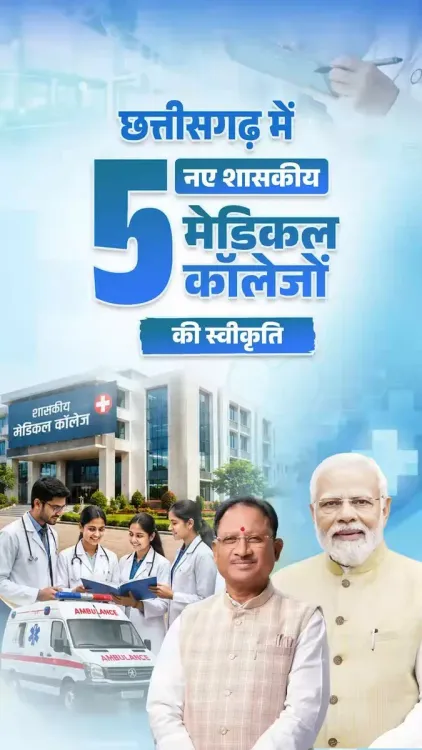
Chhattisgarh Chief Minister Vishnu Deo Sai announced on 13 July 2026 that the state has been approved for five new government medical colleges, aimed at expanding medical education and quality healthcare to remote tribal districts from Dantewada to Jashpur under the BJP's 'double engine government' framework.
Key Takeaways
Five new government medical colleges have been approved for Chhattisgarh , announced by Chief Minister Vishnu Deo Sai on 13 July 2026 .
The expansion is intended to bring medical education opportunities to remote and tribal districts, specifically citing Dantewada in the south and Jashpur in the north.
The approval is framed under the 'double engine sarkar' model, reflecting coordination between the BJP-led state and central governments.
The central government has backed similar medical college expansions across states with low doctor-to-population ratios since 2014 .
Key next steps include site selection, central funding release, and National Medical Commission regulatory clearances before admissions can begin.
Tribal youth, rural patients, and medical aspirants from economically weaker sections are the primary intended beneficiaries.
Chhattisgarh Chief Minister Vishnu Deo Sai announced on Monday, 13 July 2026 that the state has received approval for five new government medical colleges, marking a significant expansion of medical education infrastructure under what he described as the 'double engine sarkar' (double engine government) — referring to the BJP being in power at both the state and central levels.
Context
In his post, Chief Minister Sai stated: 'Better medical education, a stronger health system — in the double engine government, Chhattisgarh has received approval for 5 new government medical colleges. This will provide new opportunities in medical education for youth from remote areas from Dantewada to Jashpur, and will also give fresh momentum to the expansion of quality health services across every region of the state.'
The announcement signals a coordinated push between the Vishnu Deo Sai-led state government and the central government to address long-standing gaps in medical education access across Chhattisgarh's vast and often remote geography.
Policy Backdrop
The central government has, since 2014, run centrally sponsored schemes to establish new government medical colleges in districts with low doctor-to-population ratios, with a particular focus on states that have historically lagged in health human resources. Chhattisgarh, a state with a large tribal population spread across remote districts, has been among the priority targets for such interventions.
AIIMS Raipur, established in 2012, remains the state's flagship tertiary medical institution, but the new colleges are intended to decentralise medical training beyond the capital region. Districts such as Dantewada in the south — historically affected by Left Wing Extremism — and Jashpur in the north have had extremely limited access to higher education and healthcare infrastructure, making them natural candidates for new institutional investment.
The Bharatiya Janata Party has consistently used the 'double engine government' frame to highlight policy alignment between state and central administrations, particularly for infrastructure and social sector schemes in states it governs.
Stakeholders and Impact
The most direct beneficiaries of the five new colleges will be medical aspirants from tribal and remote districts, who currently face significant barriers — financial and logistical — in accessing MBBS-level education. New government colleges typically carry subsidised fee structures that make medical education more accessible to students from economically weaker sections.
On the healthcare delivery side, expanding the pipeline of locally trained doctors is expected to improve physician availability in rural and tribal areas, which have historically suffered from acute shortages of qualified medical personnel. Chhattisgarh's remote districts, including those in the Bastar division where Dantewada is located, have among the lowest doctor-to-population ratios in the country.
Rural patients, particularly women and children in tribal belts, stand to gain from improved local healthcare capacity as graduates from these colleges are more likely to serve in the regions where they trained.
What's Next
The immediate focus will shift to district-level site selection for the five colleges, the formal release of central funding under the applicable scheme, and the regulatory approvals required from the National Medical Commission. Each of these steps carries its own timeline and procedural requirements before any college can admit its first batch of students.
The announcement sets an ambitious baseline: if all five colleges reach operational status, Chhattisgarh would substantially increase its total MBBS seat capacity, with downstream effects on both healthcare access and employment in the state's most underserved regions. The pace of implementation will be closely watched by medical aspirants, health advocates, and political observers alike.
Point of View
Chief Minister Sai is reinforcing the political dividend of single-party alignment between Raipur and New Delhi — a message aimed as much at voters in Dantewada and Jashpur as at policy audiences. The focus on remote districts also signals an attempt to address a genuine structural deficit: Chhattisgarh's doctor shortage in tribal belts has been a persistent governance challenge across political cycles. Whether the announcement translates into operational colleges within a meaningful timeframe will determine its lasting policy and political impact.
NationPress
13 Jul 2026
Frequently Asked Questions
How many new medical colleges has Chhattisgarh been approved for?
Chhattisgarh has received approval for 5 new government medical colleges , as announced by Chief Minister Vishnu Deo Sai on 13 July 2026 .
Which districts in Chhattisgarh will benefit from the new medical colleges?
Chief Minister Sai specifically mentioned remote areas from Dantewada in southern Chhattisgarh to Jashpur in the north as regions that will benefit from new medical education opportunities.
What is the 'double engine government' referred to in the announcement?
The 'double engine sarkar' is a political phrase used by the BJP to describe states where the party governs both the state and central governments simultaneously, implying better policy coordination and faster project approvals.
Why does Chhattisgarh need more government medical colleges?
Chhattisgarh has a large tribal population spread across remote districts with historically low doctor-to-population ratios and limited access to medical education, making new government colleges critical for both training doctors and improving local healthcare delivery.
When will the new Chhattisgarh medical colleges start admissions?
No specific date has been announced yet. The colleges must first complete site selection, receive central funding, and obtain regulatory clearances from the National Medical Commission before they can admit students.