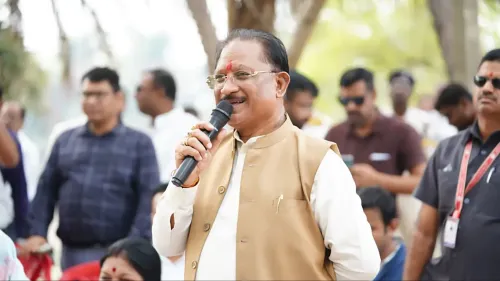
CM Sai Pushes Chhattisgarh Farmers Toward Horticulture
Synopsis
The Chhattisgarh CMO announced on 25 May 2026 that farmers in Jashpur district are cultivating strawberries, pears, and apples under CM Vishnu Deo Sai's push to shift the state's tribal farming communities from traditional paddy cultivation to high-value horticulture through training and modern inputs.
Key Takeaways
The Chhattisgarh CMO announced on 25 May 2026 that farmers are moving from traditional to innovative agriculture under CM Vishnu Deo Sai .
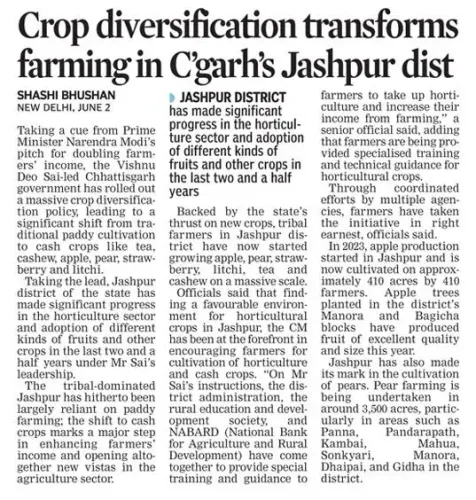
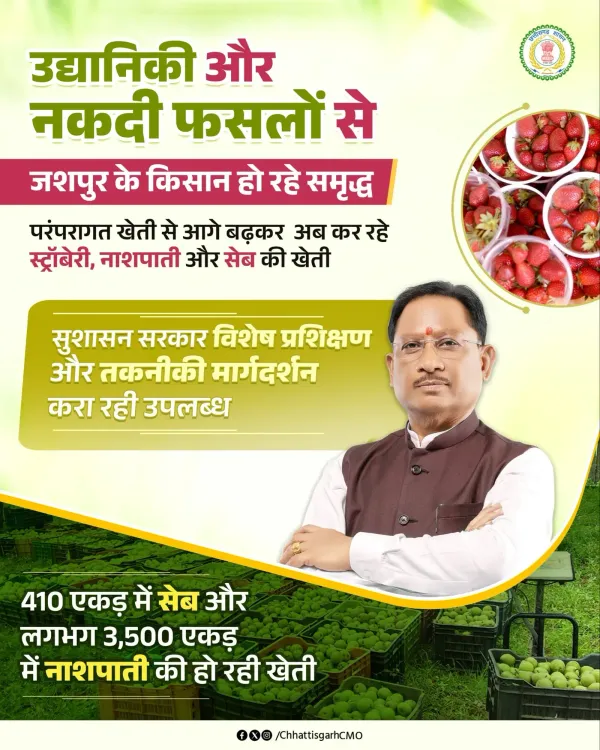
Farmers in Jashpur district — a northern Chhattisgarh district with a significant tribal population — are now growing strawberries, pears, and apples.
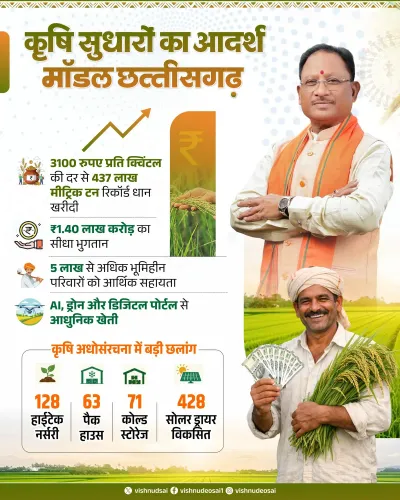
The state government says it is providing special training, technical guidance, and modern farming facilities to boost farmer incomes.
The initiative falls under the Suशासन Sarkar ('Good Governance Government') brand of the Sai administration, which took office in December 2023 .
The push builds on the National Horticulture Mission (2005-06) and state-level crop diversification efforts targeting tribal districts since the mid-2010s.
Scaling the model and establishing cold-chain and market linkage infrastructure remain key challenges for sustaining farmer income gains.
The Chief Minister's Office of Chhattisgarh announced on Monday, 25 May 2026 that farmers in the state are moving beyond traditional agriculture under the leadership of Chief Minister Vishnu Deo Sai, with growers in Jashpur district now cultivating high-value crops including strawberries, pears, and apples.
Context
The CMO's post, shared in Hindi, states: 'Chhattisgarh ke kisan ab paramparagat kheti se aage badhkar navachar ki or badh rahe hain' — 'Farmers of Chhattisgarh are now moving beyond traditional farming toward innovation.' The announcement specifically highlights Jashpur, a northern district of the state, as a centre of this agricultural shift, where growers are cultivating strawberries, pears, and apples as symbols of self-reliance.
The government describes this push under the banner of 'Suशासन Sarkar' ('Good Governance Government'), a recurring theme of the Vishnu Deo Sai-led administration, which came to power in December 2023 following state assembly elections. The post credits the government with providing 'special training, technical guidance, and modern farming facilities' to boost farmer incomes.
Policy Backdrop
The drive to diversify away from paddy cultivation in Chhattisgarh has roots in both central and state-level horticulture policy. The National Horticulture Mission, launched in 2005-06, extended central assistance to the state for promoting high-value fruit crops and farmer training. State horticulture policy initiatives since the mid-2010s have specifically targeted tribal districts — including Jashpur — to encourage crop diversification.
Jashpur carries a significant tribal population and has been identified as a district with the agro-climatic conditions suitable for temperate and semi-temperate fruits. The cultivation of strawberries and pome fruits such as apples and pears in this belt reflects a broader national priority of reducing dependence on rain-fed staple agriculture and improving market access for marginal and tribal farmers.
Stakeholders and Impact
The primary beneficiaries cited are Jashpur's farming communities, including a substantial proportion of tribal cultivators who have historically depended on paddy and other traditional crops. Access to technical guidance and modern inputs — as described in the government's announcement — is intended to reduce production risk as these farmers transition to unfamiliar, higher-investment crops.
High-value horticulture typically offers significantly better returns per acre than paddy, but requires greater upfront investment, cold-chain infrastructure, and reliable market linkages. The success of such programmes in tribal belts of central India depends heavily on sustained state support beyond the training phase, including post-harvest facilities and access to urban or export markets.
What's Next
The broader question for the Sai government is whether the horticulture push in Jashpur can be scaled to additional districts across Chhattisgarh. Policy watchers will look for a mid-term review of income gains from strawberry and apple cultivation, and for announcements on cold storage and market linkage infrastructure that would make diversification economically sustainable for small and marginal farmers. If Jashpur's model demonstrates measurable income improvement, it could serve as a template for tribal agricultural belts in neighbouring states as well.
Point of View
As tribal voter consolidation has been central to the BJP's electoral arithmetic in Chhattisgarh. However, the announcement stops short of citing specific acreage, yield data, or income figures, making it difficult to assess the programme's scale beyond its symbolic value. The longer-term test will be whether the state invests in the cold-chain and market infrastructure that transforms pilot horticulture clusters into a durable income shift for small farmers.
NationPress
11 Oct 2026
Frequently Asked Questions
Which crops are Jashpur farmers growing under the Chhattisgarh government's new scheme?
Farmers in Jashpur district are cultivating strawberries, pears, and apples as part of the state government's push to diversify beyond traditional paddy farming.
Who is the Chief Minister of Chhattisgarh in 2026?
Vishnu Deo Sai of the BJP is the Chief Minister of Chhattisgarh, having been sworn in after the party's victory in the December 2023 state assembly elections.
What is the Suशासन Sarkar initiative in Chhattisgarh?
'Suशासन Sarkar' translates to 'Good Governance Government' and is the branding used by the Vishnu Deo Sai-led Chhattisgarh government to describe its administrative and welfare programmes, including agricultural support initiatives.
What support is the Chhattisgarh government providing to farmers for horticulture?
According to the Chief Minister's Office, the government is offering special training, technical guidance, and modern farming facilities to help farmers shift to high-value fruit crops and increase their incomes.
Why is Jashpur district significant for horticulture in Chhattisgarh?
Jashpur is a northern Chhattisgarh district with a significant tribal population and agro-climatic conditions suitable for temperate fruit crops; it has been a focus of state and central horticulture diversification efforts since the mid-2010s.