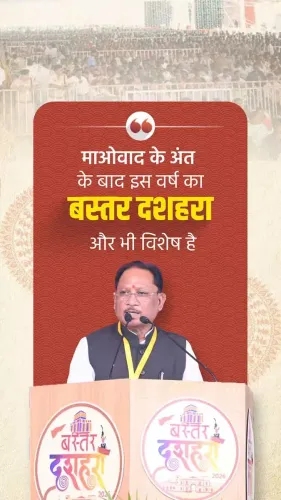
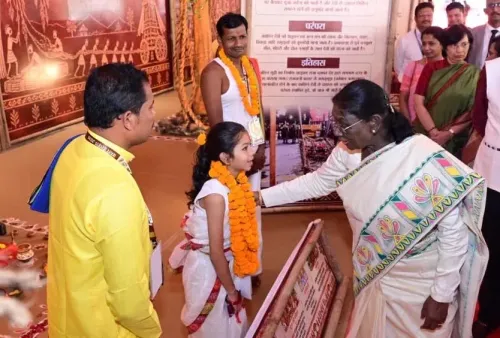
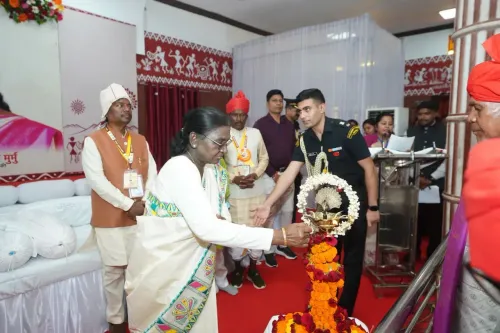
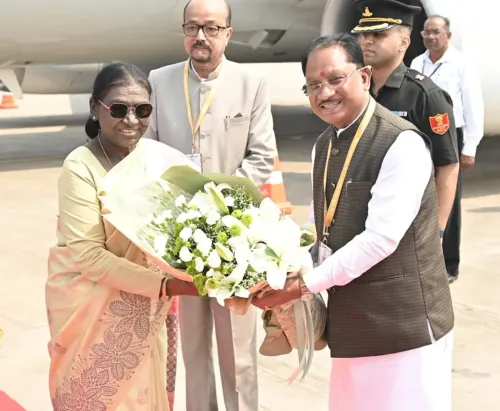
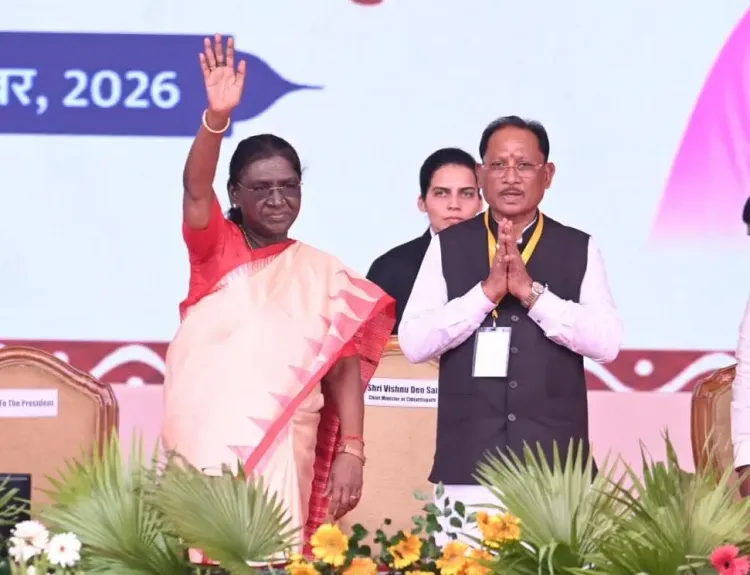
CM Sai at Bastar Dussehra with President Murmu
Synopsis
Chhattisgarh CM Vishnu Deo Sai attended Bastar Dussehra 2026 alongside President Draupadi Murmu and Governor Ramen Deka, hailing the festival as an expression of tribal pride and reaffirming the state's 'development with heritage' commitment.
Key Takeaways
CM Vishnu Deo Sai attended Bastar Dussehra 2026 on October 23, 2026 , calling it a moment of 'deep personal pride.' President Draupadi Murmu , India's first tribal woman President, graced the event — lending it rare national significance.
Governor Ramen Deka was also present, completing Chhattisgarh's full constitutional leadership at the festival.
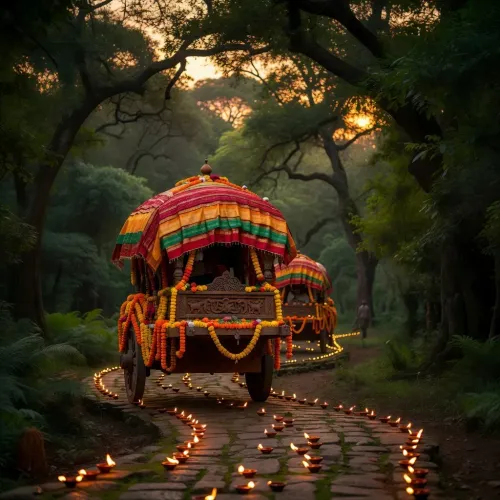
Bastar Dussehra is centred on devotion to Maa Danteshwari and features the iconic Muria Darbar tribal assembly.
CM Sai invoked the BJP government's governing mantra 'Vikas bhi, virasat bhi' — 'Development too, heritage too' — pledging to preserve tribal culture while advancing welfare.
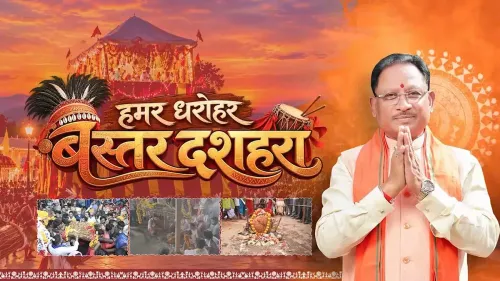
At one of India's most ancient and distinctive festivals, Chhattisgarh Chief Minister Vishnu Deo Sai joined President Draupadi Murmu and Governor Ramen Deka at the Bastar Dussehra celebrations in Chhattisgarh on Friday, October 23, 2026 — calling it a moment of 'deep personal pride' to witness the living traditions and cultural splendour of the Bastar region.
Maa Danteshwari at the heart of Bastar Dussehra
Unlike any other Dussehra in the country, the Bastar Dussehra is not centred on the Ramayana narrative but on unwavering devotion to Maa Danteshwari, the principal deity of the Bastar tribal communities. CM Sai described the festival as 'aastha ka utsav, janjatiya gaurav ki abhivyakti' — a celebration of faith and an expression of tribal pride — that serves as a unique confluence of cultural consciousness connecting generations.
The festival draws participation from the Muria community and other indigenous groups, with the Muria Darbar — a traditional assembly of tribal elders and communities — forming one of its most iconic components. CM Sai noted that traditions woven into everyday life, and society's collective role in preserving them, are what make this mahapaarv (grand festival) truly singular.
President Murmu's presence — a milestone of tribal recognition
President Draupadi Murmu, the first tribal woman to hold India's highest constitutional office, gracing the event lent it rare national significance. For tribal communities across Bastar — and for India's broader Adivasi population — the President's attendance was more than ceremonial. It was a symbolic convergence: the country's first citizen, herself from a tribal background, present at one of the subcontinent's oldest tribal cultural observances.
Governor Ramen Deka joined the gathering, completing a representation of all three tiers of Chhattisgarh's constitutional leadership at the festival.
'Vikas bhi, virasat bhi' — the BJP's twin-track tribal pledge
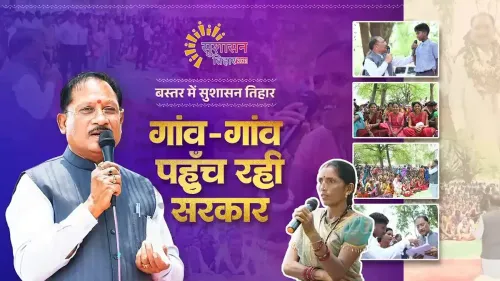
CM Sai closed his post with the state government's governing mantra: 'Vikas bhi, virasat bhi' — 'Development too, heritage too.' He reaffirmed the administration's resolve to preserve this invaluable cultural legacy while giving 'new flight' to the hopes and aspirations of tribal brothers and sisters.
The phrase encapsulates the BJP-led Chhattisgarh government's stated approach since returning to power: treating tribal festivals and cultural institutions not merely as events on a calendar but as live policy touchstones — platforms to project both developmental intent and cultural belonging to a state where tribals form a substantial share of the population.
Chhattisgarh has historically used state participation in Bastar Dussehra to signal cultural recognition to its Adivasi communities, and the 2026 edition — anchored by the President's presence — raises that signal to a national frequency.
Point of View
Her presence at one of the country's oldest Adivasi festivals gives the BJP's cultural outreach a powerful symbolic frame that transcends state politics. CM Sai's invocation of 'Vikas bhi, virasat bhi' is consistent with the party's broader national tribal strategy — positioning itself as the custodian of both Adivasi welfare and indigenous identity. With Chhattisgarh's substantial tribal electorate and ongoing insurgency pressures in the Bastar belt, such high-profile cultural events serve a dual purpose: affirming belonging and building trust in a region where the state has long needed to earn it.
NationPress
23 Oct 2026
Frequently Asked Questions
What is Bastar Dussehra and how is it different from other Dussehra celebrations?
Bastar Dussehra is a unique tribal festival in the Bastar region of Chhattisgarh centred on devotion to Maa Danteshwari, unlike the mainstream Dussehra which follows the Ramayana narrative. It is one of India's longest-running festivals and includes the Muria Darbar, a traditional assembly of tribal elders.
Why did President Draupadi Murmu attend Bastar Dussehra 2026?
President Draupadi Murmu, India's first tribal woman President, attended Bastar Dussehra 2026 as a distinguished guest, lending national recognition to the festival. Her presence carried deep symbolic weight for tribal communities across the country.
Who is Maa Danteshwari and why is she worshipped during Bastar Dussehra?
Maa Danteshwari is the principal deity of the Bastar tribal communities and the presiding goddess of the Dantewada region. The entire Bastar Dussehra is organised as an act of devotion to her, making it spiritually and culturally distinct from other Dussehra festivals.
What is the Muria Darbar at Bastar Dussehra?
The Muria Darbar is a traditional assembly of tribal communities, particularly the Muria people, held as part of Bastar Dussehra. It is one of the most iconic components of the festival, representing the democratic and participatory traditions of Bastar's indigenous society.
What does 'Vikas bhi, virasat bhi' mean in the context of Chhattisgarh tribal policy?
'Vikas bhi, virasat bhi' translates to 'Development too, heritage too' and is the BJP-led Chhattisgarh government's stated commitment to pursue economic development for tribal communities while simultaneously preserving their cultural traditions and identity.