CM Sai: Centre Approves 5 New Medical Colleges, 250 MBBS Seats for Chhattisgarh
Synopsis
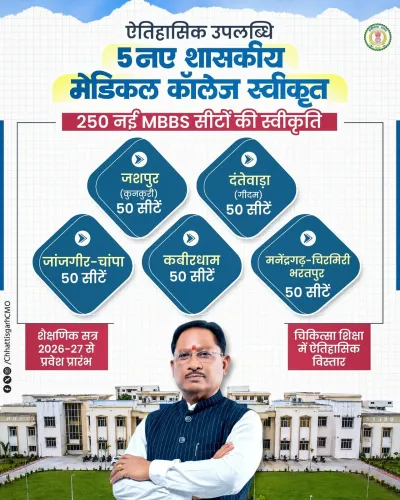
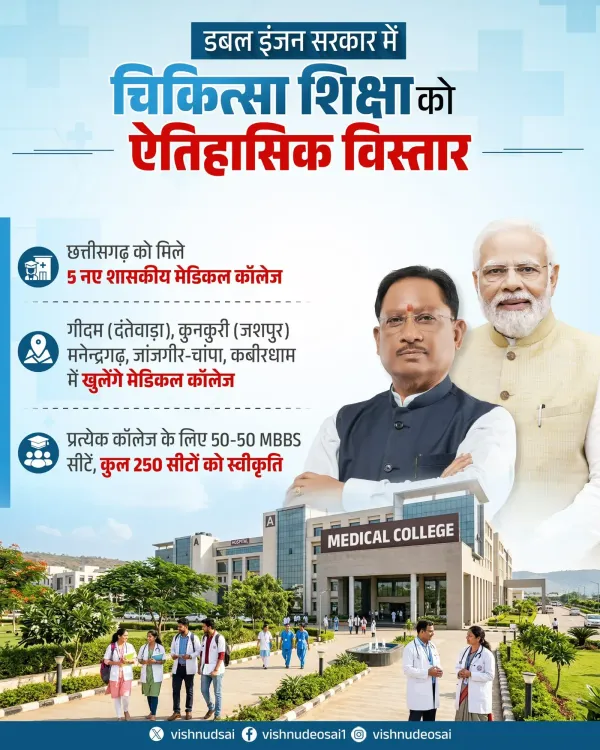
Chief Minister Vishnu Deo Sai announced on 14 July 2026 that the Centre has approved five new government medical colleges and 250 additional MBBS seats for Chhattisgarh, aiming to expand medical education access and improve healthcare reach in the state's remote and tribal regions.
Key Takeaways
The Centre has approved 5 new government medical colleges for Chhattisgarh , as announced by CM Vishnu Deo Sai on 14 July 2026 .
250 new MBBS seats will be added alongside the five colleges, expanding affordable medical education in the state.
The announcement is framed under the BJP's 'double engine government' concept, with aligned leadership at the centre ( PM Modi ) and state ( CM Sai ) levels.
The Pradhan Mantri Swasthya Suraksha Yojana (PMSSY) has been the central policy vehicle driving medical college expansion nationally since 2003 .
Nationally, MBBS seats have grown from approximately 51,000 to over 1,00,000 between 2014 and 2023 through successive scheme phases.
Formal operationalisation requires National Medical Commission inspections and state-level infrastructure development before student admissions can begin.
Chhattisgarh Chief Minister Vishnu Deo Sai on Tuesday, 14 July 2026 announced that the central government, under Prime Minister Narendra Modi, has approved five new government medical colleges and 250 additional MBBS seats for the state, describing the move as a leap forward for medical education under the 'double engine' government.
Context
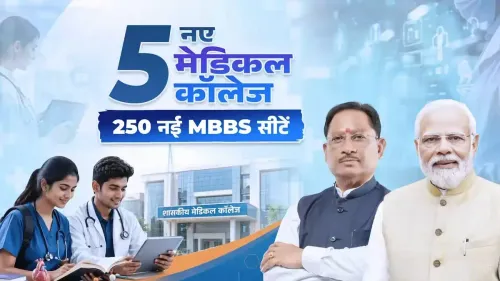
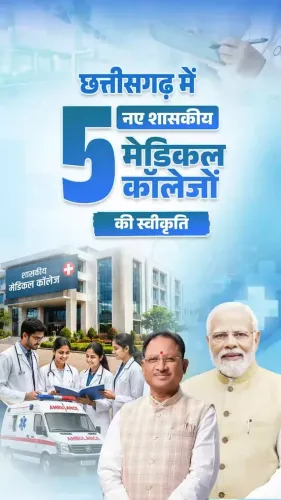
Posting in Hindi on X, CM Sai said: 'डबल इंजन सरकार ने छत्तीसगढ़ को 5 नए शासकीय मेडिकल कॉलेजों और 250 नई MBBS सीटों की स्वीकृति प्रदान की है' ('The double engine government has granted approval for 5 new government medical colleges and 250 new MBBS seats for Chhattisgarh'). He added that the decision would open fresh opportunities in medical education for the state's youth and ensure the expansion of better healthcare services to remote areas.
The term 'double engine government' is a BJP formulation referring to aligned governance at both the central and state levels — with Modi leading at the centre and Sai heading Chhattisgarh since December 2023.
Policy Backdrop
The approval fits within a broader central policy push to expand medical education infrastructure across India. The Pradhan Mantri Swasthya Suraksha Yojana (PMSSY), launched in 2003 and significantly scaled up after 2014, has been the primary vehicle for funding new government medical colleges and upgrading district hospitals nationwide.
Between 2014 and 2023, successive phases of the scheme helped raise total MBBS seats nationally from approximately 51,000 to over 1,00,000, with more than 100 new medical colleges approved across states. Chhattisgarh, a state with a large tribal and rural population, has seen incremental additions to its government medical college network since attaining statehood in 2000.
Stakeholders and Impact
The most direct beneficiaries are medical aspirants from Chhattisgarh, particularly those from economically weaker and rural backgrounds who rely on government institutions for affordable medical education. An increase of 250 MBBS seats in government colleges can meaningfully reduce competition pressure and out-of-pocket costs compared with private institutions.
For rural and tribal communities in districts such as Bastar, Surguja, and Korba — which have historically faced acute shortages of doctors — the long-term benefit lies in the policy intent to locate new colleges in under-served areas, thereby improving doctor availability over time. The actual on-ground impact will depend on the specific districts chosen for the five colleges and the pace of infrastructure development.
What's Next
Attention will now turn to state government notifications detailing the locations of the five new colleges, the release of central funds under the applicable scheme, and subsequent inspections by the National Medical Commission for formal seat recognition. Each of these steps is required before admissions can begin.
The announcement sets a political marker for the Sai government, which will be expected to translate the central approval into operational institutions within a credible timeframe — a process that, based on past experience with medical college projects, typically spans several years from approval to the first batch of students.
Point of View
Adding 250 MBBS seats to a state with Chhattisgarh's doctor-to-population ratio is meaningful but modest; the harder test will be whether the five colleges are sited in genuinely under-served districts rather than in towns that already have reasonable healthcare access. The real accountability moment arrives when the National Medical Commission conducts inspections — that is when approvals translate, or fail to translate, into actual seats.
NationPress
14 Jul 2026
Frequently Asked Questions
How many new medical colleges has the Centre approved for Chhattisgarh in 2026?
The Centre has approved 5 new government medical colleges for Chhattisgarh, as announced by Chief Minister Vishnu Deo Sai on 14 July 2026 .
How many new MBBS seats will Chhattisgarh get from this approval?
250 new MBBS seats will be added through the five newly approved government medical colleges in Chhattisgarh.
Which central scheme funds new government medical colleges in Indian states?
The Pradhan Mantri Swasthya Suraksha Yojana (PMSSY) , launched in 2003 and expanded significantly after 2014 , is the primary central scheme used to fund new government medical colleges and upgrade district hospitals across India.
What does 'double engine government' mean in the context of Chhattisgarh?
'Double engine government' is a BJP phrase referring to the same party governing both at the centre — led by PM Narendra Modi — and at the state level — led by CM Vishnu Deo Sai in Chhattisgarh since December 2023 — with the argument that aligned governance delivers faster development.
When will the new medical colleges in Chhattisgarh start admissions?
Admissions can begin only after the state government notifies college locations, central funds are released, and the National Medical Commission conducts formal inspections for seat recognition — a process that typically spans several years from initial approval.