Rajasthan CM Bhajanlal orders special drive to break illegal arms supply chains
Synopsis
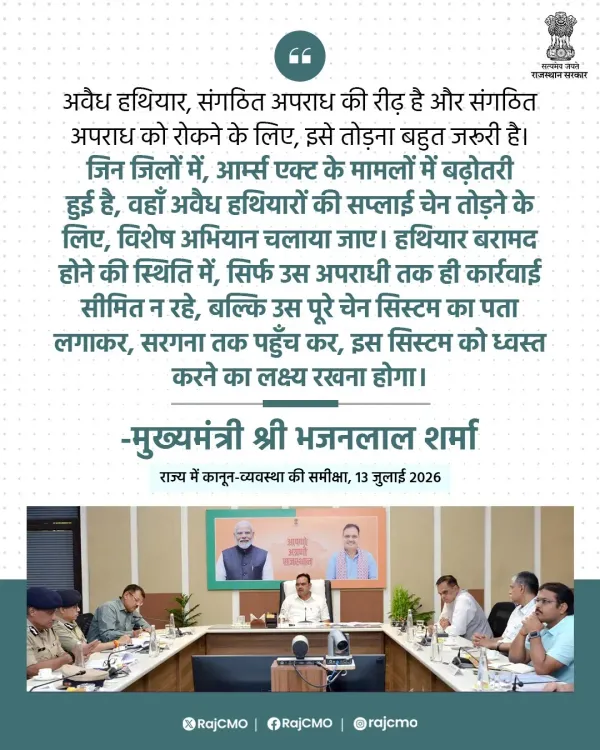
The Chief Minister's Office of Rajasthan on 14 July 2026 directed a special campaign to break illegal arms supply chains in districts recording a rise in Arms Act cases, addressing the instruction to CM Bhajanlal Sharma under the government's 'Our Leading Rajasthan' governance push.
Key Takeaways
The Chief Minister's Office of Rajasthan issued the directive on 14 July 2026 , targeting districts with measurable increases in Arms Act cases.
The campaign is explicitly framed around breaking the illegal arms supply chain in high-incidence districts, not a statewide sweep.
The directive is addressed to Chief Minister Bhajanlal Sharma , signalling a top-level political push on law-and-order metrics.
Rajasthan Police and district administrations are the primary implementing agencies for the special drive.
Rajasthan's western border districts have a documented history of cross-border arms smuggling, giving the directive particular geographic significance.
The BJP government, in office since December 2023 , has prioritised illegal arms recovery as a measurable law-and-order goal.
The Chief Minister's Office of Rajasthan on Tuesday, 14 July 2026 directed that a special campaign be launched in districts where cases registered under the Arms Act have risen, with the explicit aim of dismantling illegal weapons supply chains feeding those areas. The directive, addressed to Chief Minister Bhajanlal Sharma, signals a shift from statewide enforcement to targeted, data-driven district operations.
Context
The post, shared on the official @RajCMO handle, states in Hindi: 'Jin zilon mein Arms Act ke mamlon mein badhotari hui hai, wahan awaidh hathiyaron ki supply chain todne ke liye vishesh abhiyan chalaya jaye' — ('In districts where Arms Act cases have increased, a special campaign should be run to break the illegal arms supply chain'). The message is tagged to @BhajanlalBjp, indicating it is a direct instruction to the Chief Minister, and carries the hashtag #आपणो_अग्रणी_राजस्थान ('Our Leading Rajasthan'), the BJP government's governance branding in the state.
The directive does not name specific districts, but frames the campaign as a response to measurable rises in Arms Act FIR data — pointing to an evidence-triggered enforcement model rather than a blanket crackdown.
Policy Backdrop
The Arms Act, 1959 is the central legislation governing possession, manufacture, and licensing of firearms across India. Violations — including unlicensed possession and illegal trade — are cognisable offences, and spikes in FIRs under the Act are routinely used by state administrations as a trigger for targeted police operations.
Rajasthan's western border districts have historically been associated with cross-border smuggling networks, given the state's long frontier with Pakistan. Following the BJP government's assumption of office in December 2023, law-and-order metrics — including illegal arms recovery — were foregrounded as a governance priority. Rajasthan administrations across political lines have periodically launched district-specific drives when Arms Act case counts rise, making this directive consistent with a well-established state enforcement pattern.
Stakeholders and Impact
Rajasthan Police and district administrations are the primary implementing bodies for any such special campaign. A targeted drive would require district Superintendents of Police to map FIR clusters, identify supply routes, and coordinate intelligence-led raids — a resource-intensive exercise concentrated in high-incidence zones rather than spread uniformly across the state's 50 districts.
Communities in districts with elevated Arms Act cases stand to be directly affected by intensified searches and verification drives. Legal firearms holders in those areas may also face closer scrutiny of their licences during the campaign period.
What's Next
The immediate next step will be the Home Department and Director General of Police translating this directive into operational orders identifying the specific districts to be covered. Analysts will watch for the release of the next quarterly crime statistics by Rajasthan Police, which are expected to provide the evidentiary basis for which districts are prioritised. District-level operation reports submitted to the Home Department will be the clearest measure of whether the campaign moves from announcement to ground action.
If sustained, the drive could set a replicable template for other high-Arms-Act states, where data-triggered district-level campaigns are increasingly preferred over statewide operations that strain police bandwidth.
Point of View
The Rajasthan CMO is signalling a data-driven enforcement posture — one that is politically harder to dismiss as optics and easier to defend on outcome metrics. The move fits squarely into the BJP government's post-2023 law-and-order narrative in Rajasthan, where illegal arms recovery has been a headline deliverable. Tagging CM Bhajanlal Sharma directly on the official handle also serves an accountability function, publicly committing the Chief Minister to follow-through. Whether the campaign produces verifiable supply-chain disruptions or remains a periodic enforcement exercise will depend on the operational specificity of the Home Department's response.
NationPress
12 Oct 2026
Frequently Asked Questions
What did the Rajasthan CMO direct on 14 July 2026?
The Chief Minister's Office of Rajasthan directed that a special campaign be launched in districts recording a rise in Arms Act cases, with the goal of breaking the illegal arms supply chain in those areas.
Which districts in Rajasthan will be targeted in the arms crackdown?
The CMO directive does not name specific districts; the selection is to be based on data showing increases in Arms Act FIR registrations, with the Home Department and police expected to identify the zones.
What is the Arms Act and why does it matter in Rajasthan?
The Arms Act, 1959 is the central law governing possession and licensing of firearms in India. Rajasthan's western border districts have historically been linked to cross-border arms smuggling, making enforcement of the Act a recurring state priority.
Who is Bhajanlal Sharma and why was this directive addressed to him?
Bhajanlal Sharma is the BJP Chief Minister of Rajasthan, in office since December 2023. The CMO directive was tagged to his official account, indicating it is a formal instruction to him to initiate the special campaign.
What happens after the CMO issues such a directive?
The Home Department and Director General of Police are expected to translate the directive into operational orders, identifying target districts and deploying district police for intelligence-led raids and supply-chain mapping.