CM Sai: Chhattisgarh First State to Pass Ease of Doing Business Bill
Synopsis
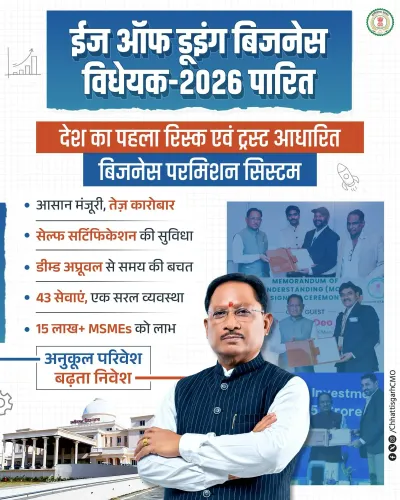
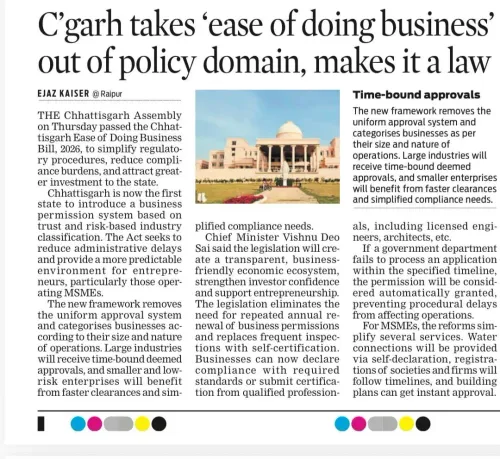
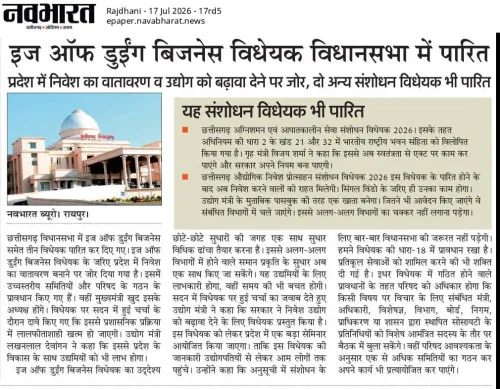
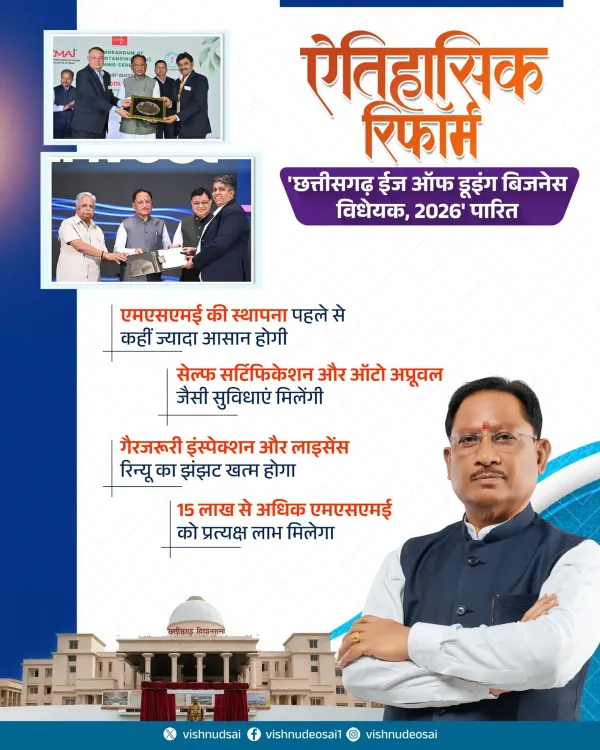
Chhattisgarh has become the first Indian state to pass a dedicated Ease of Doing Business Bill, Chief Minister Vishnu Deo Sai announced on 17 July 2026. The legislation aims to create a transparent, investment-friendly environment to attract industry, spur economic expansion, and generate employment in the mineral-rich central Indian state.
Key Takeaways
Chhattisgarh is the first state in India to pass a standalone 'Ease of Doing Business' Bill, according to CM Vishnu Deo Sai .
The bill's stated goals are attracting investment, enabling industrial expansion, and creating new employment opportunities.
CM Sai framed the legislation as central to the Viksit Chhattisgarh (Developed Chhattisgarh) vision.
India's ease-of-doing-business reform framework has been active since 2014 , with DPIIT-led state-level action plans running since 2015 .
Implementation rules, single-window clearance systems, and future investment data will determine the bill's real-world impact.
The move may prompt other state governments to consider similar standalone legislation.
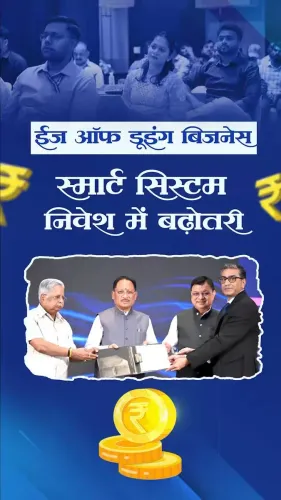
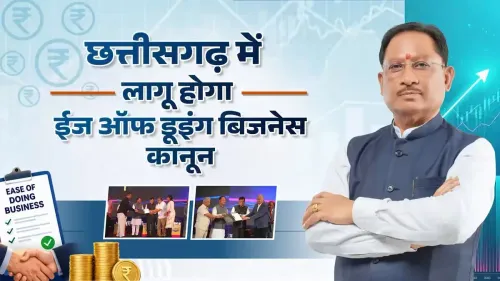
Chhattisgarh Chief Minister Vishnu Deo Sai announced on Friday, 17 July 2026, that Chhattisgarh has become the first state in India to pass a dedicated 'Ease of Doing Business' Bill, calling it a milestone in the state's drive to attract investment and create employment.
Context
Posting on X, CM Sai declared: 'Ease of Doing Business' vidheyak parit karne wala desh ka pehla rajya bana Chhattisgarh — 'Chhattisgarh has become the first state in the country to pass an Ease of Doing Business Bill.' He described the legislation as a 'historic bill' and a 'milestone' toward realising the vision of a Viksit Chhattisgarh (Developed Chhattisgarh).
The Chief Minister underlined that his government's consistent effort has been to ensure a 'simple, transparent and investment-friendly environment' for industries in the state, giving fresh momentum to business activity.
Policy Backdrop
India's Ease of Doing Business push dates to 2014, when the central government launched the initiative and subsequently introduced annual state-level Business Reforms Action Plans through the Department for Promotion of Industry and Internal Trade (DPIIT) from 2015 onward.
These reforms were designed to streamline regulatory approvals, reduce compliance burdens, and benchmark Indian states against each other on investor-friendliness. Chhattisgarh, a central Indian state rich in mineral resources, has been working to diversify its economy beyond resource extraction by expanding its manufacturing and services base.
Multiple states across India have enacted or amended legislation to cut red tape and fast-track business clearances, making the competitive federal landscape increasingly active. By codifying ease-of-doing-business principles into a standalone bill, Chhattisgarh is positioning itself as a legislative first-mover in this space.
Stakeholders and Impact
The bill is aimed squarely at three constituencies: existing industries seeking to expand, domestic and foreign investors evaluating new projects, and entrepreneurs looking for a simpler entry point into the state's economy. CM Sai specifically cited 'attracting investment, expanding industries, and creating new employment opportunities' as the bill's three core objectives.
For a state with significant untapped industrial potential, a legislative framework that promises transparent and time-bound approvals could materially shift investor sentiment. Employment generation — a perennial political and economic priority — is expected to be a key metric by which the bill's success will be judged.
What's Next
Attention will now shift to the implementation rules that the state government frames under the new legislation, including whether a robust single-window clearance mechanism is established. Subsequent investment announcements, ground-breaking ceremonies, and employment data from Chhattisgarh in the coming months will serve as early indicators of whether the bill translates legislative intent into on-ground outcomes.
The development also sets a precedent that other state governments may study closely, potentially accelerating a broader legislative trend across India's federal landscape toward codified business-reform statutes.
Point of View
Chhattisgarh under CM Vishnu Deo Sai is making a calculated legislative bet — converting a central government reform agenda into enforceable state law, which gives it a structural edge over rival states still relying on executive orders and circulars. The move fits a broader BJP-governed-state pattern of using legislative firsts to signal governance credibility to investors ahead of election cycles. However, the bill's real test will be in implementation: India's reform history is littered with well-drafted laws that foundered on bureaucratic inertia. If Chhattisgarh pairs this legislation with a functional single-window system and measurable employment outcomes, it could genuinely reshape the state's industrial trajectory.
NationPress
17 Jul 2026
Frequently Asked Questions
What is the Chhattisgarh Ease of Doing Business Bill 2026?
It is a legislation passed by the Chhattisgarh state assembly that codifies business-friendly reforms into law, aiming to create a simple, transparent, and investment-friendly regulatory environment for industries in the state.
Is Chhattisgarh really the first state to pass an Ease of Doing Business Bill?
Chief Minister Vishnu Deo Sai claimed on 17 July 2026 that Chhattisgarh is the first state in India to pass such a dedicated bill. The claim has not been independently verified at the time of this report.
What is the Viksit Chhattisgarh vision mentioned by CM Sai?
Viksit Chhattisgarh, meaning 'Developed Chhattisgarh,' is the state government's overarching development goal, aligned with the central government's broader Viksit Bharat vision, focusing on industrial growth, infrastructure, and employment.
How does this bill relate to India's national Ease of Doing Business initiative?
India's Ease of Doing Business initiative was launched in 2014 and has been implemented through DPIIT-led annual Business Reforms Action Plans for states since 2015. Chhattisgarh's bill converts those reform principles into standalone state legislation.
What impact will the Ease of Doing Business Bill have on jobs in Chhattisgarh?
CM Sai stated the bill is aimed at creating new employment opportunities by attracting investment and enabling industrial expansion, though actual employment outcomes will depend on implementation and investor response in the coming months.