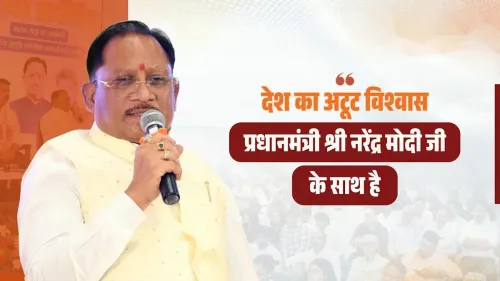
CM Sai: Chhattisgarh moves from punitive to justice-based laws

Synopsis
Chhattisgarh CM Vishnu Dev Sai has championed India's new criminal codes — the Bharatiya Nyaya Sanhita and allied laws — as a shift from colonial punishment-based systems to justice-centred governance, with the laws in force since July 2024.
Key Takeaways
CM Vishnu Dev Sai publicly endorsed the new criminal laws on 2 August 2026 , framing them as a move from punishment to justice.
Parliament passed three new criminal codes in December 2023 , replacing the IPC (1860) , CrPC, and Indian Evidence Act.
All three laws came into force on 1 July 2024 across India.
The Bharatiya Nagarik Suraksha Sanhita introduces mandatory trial timelines and strengthens victim rights.
Chhattisgarh's BJP government has linked the reform to its 'Viksit Chhattisgarh' and 'Sushashan' governance agenda.
State-level police and judicial training programmes are the critical next step for real-world implementation.
A colonial criminal code that governed India for over 163 years has been replaced — and Chhattisgarh Chief Minister Vishnu Dev Sai is making clear that his state is firmly behind the shift. On Sunday, 2 August 2026, the Chief Minister's Office of Chhattisgarh quoted CM Sai on X, framing the new criminal laws as a defining break from a punitive past.
The post carried CM Sai's words directly: 'नए भारत की आवश्यकताओं को ध्यान में रखते हुए दंड-आधारित व्यवस्था के स्थान पर न्याय-आधारित कानून लागू किए गए हैं' — 'Keeping in mind the needs of the new India, justice-based laws have been implemented in place of a punishment-based system.'
Three laws, one clean break from 1860
Parliament enacted three landmark criminal codes in December 2023 — the Bharatiya Nyaya Sanhita, the Bharatiya Nagarik Suraksha Sanhita, and the Bharatiya Sakshya Adhiniyam — replacing the Indian Penal Code of 1860, the Code of Criminal Procedure, and the Indian Evidence Act respectively. All three came into force from 1 July 2024. The reform is the most sweeping overhaul of India's criminal justice architecture since independence. The Bharatiya Nagarik Suraksha Sanhita in particular introduces hard timelines for trials and places victim rights at the centre of procedure — a structural reorientation away from the state-versus-accused binary that defined colonial-era law.Sai's framing: justice over punishment
For CM Sai — a BJP leader who took charge of Chhattisgarh after the party's decisive win in the December 2023 assembly elections — the new laws align neatly with the 'Viksit Chhattisgarh' governance agenda. The hashtags accompanying the post — #NyayBasedLaws, #DigitalJustice, #GoodGovernance — signal that the state is framing implementation not just as legal compliance but as a political and administrative identity. The broader national pattern is clear: states are now tasked with aligning police forces, magistrates, and court systems with the new central framework. That means retraining officers, updating digital case-management platforms, and recalibrating procedures at every level of the criminal justice chain. For a state like Chhattisgarh — which has historically faced complex law-and-order challenges in its interior districts — how swiftly and thoroughly that alignment happens will matter well beyond symbolism. The rhetoric is set. The real test is in the courtrooms and police stations of Raipur, Bilaspur, and beyond.Point of View
The state is signalling ideological ownership of the reform, not mere administrative compliance. The real political test will come as implementation data — charge-sheet timelines, trial completion rates, victim compensation uptake — begins to surface at the state level. For a state with a complex internal security landscape, the gap between legislative intent and ground reality will define whether this reform becomes a governance success story or a talking point.
NationPress
2 Aug 2026
Frequently Asked Questions
What are the new criminal laws that replaced the IPC in India?
Parliament passed the Bharatiya Nyaya Sanhita, Bharatiya Nagarik Suraksha Sanhita, and Bharatiya Sakshya Adhiniyam in December 2023, replacing the IPC (1860), CrPC, and Indian Evidence Act. All three came into effect on 1 July 2024.
What did Chhattisgarh CM Vishnu Dev Sai say about the new criminal laws?
CM Sai said that 'keeping in mind the needs of the new India, justice-based laws have been implemented in place of a punishment-based system,' endorsing the shift from colonial-era punitive codes to victim-centric justice.
When did the Bharatiya Nyaya Sanhita come into effect?
The Bharatiya Nyaya Sanhita and the two allied criminal codes came into effect on 1 July 2024, after being enacted by Parliament in December 2023.
How is Chhattisgarh implementing the new criminal laws?
Chhattisgarh is aligning its police and judicial administration with the new central laws. The state government has framed the reform under its 'Viksit Chhattisgarh' and 'Sushashan' governance agenda, though specific state-level implementation statistics are yet to be officially published.
What is the difference between the old IPC and the new Bharatiya Nyaya Sanhita?
The Bharatiya Nyaya Sanhita replaces the punishment-centric Indian Penal Code of 1860 with a framework that emphasises justice, victim rights, defined trial timelines, and technology-enabled processes — moving away from the colonial-era state-versus-accused model.