CM Sai Corners Congress on Coal Mining in No-Trust Debate
Synopsis
During the no-confidence motion debate on 18 July 2026, Chhattisgarh CM Vishnu Deo Sai confronted the Congress opposition by citing a purported video of ex-CM Bhupesh Baghel defending coal extraction in forests and hills as unavoidable for electricity supply.
Key Takeaways
CM Vishnu Deo Sai addressed the no-confidence motion in the Chhattisgarh Legislative Assembly on 18 July 2026 .
He cited a purported video of ex-CM Bhupesh Baghel stating that coal — found in hills and forests — was essential for electricity supply.
Sai argued the Congress, which now criticises tree-felling, had itself defended forest diversion for coal mining when in power from 2018 to 2023 .
Chhattisgarh governments of both parties have historically approved coal block allocations in forested regions since the state's formation in 2000 .
The debate directly affects coal mining workers and tribal forest communities whose livelihoods and land rights hinge on mining policy.
The no-confidence motion proceedings are ongoing, with further responses from the opposition expected.
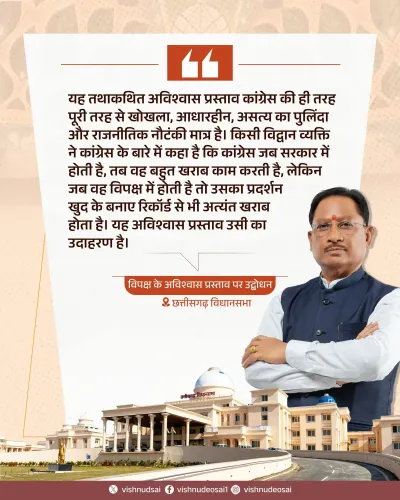
Chhattisgarh Chief Minister Vishnu Deo Sai on Saturday, 18 July 2026, directly confronted the opposition in the Chhattisgarh Legislative Assembly during debate on a no-confidence motion, citing a purported video of the then Chief Minister acknowledging that coal — and therefore forest and hill diversion — was unavoidable for electricity supply.
Context
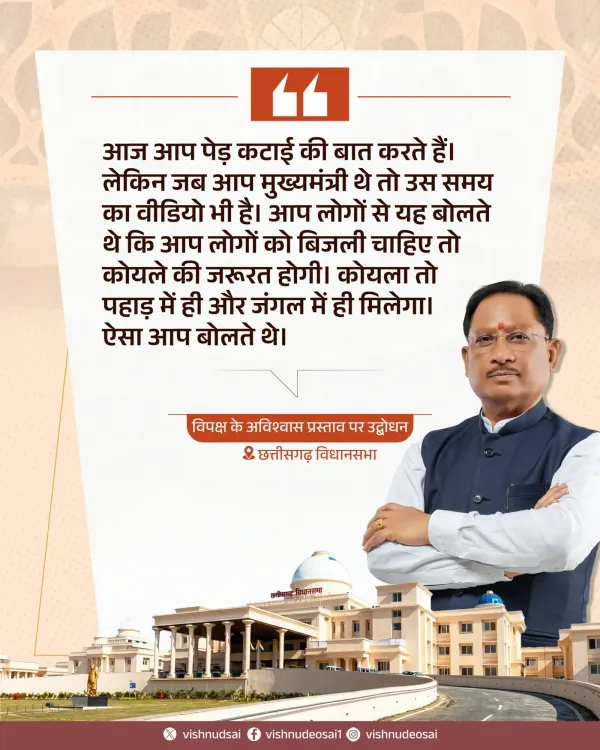
Addressing the House, CM Sai quoted the opposition's own past position back at them: 'Aap logon ko bijli chahiye to koyle ki zaroorat hogi. Koyala to pahad mein hi aur jungle mein hi milega' ('If you want electricity, you will need coal. Coal is found only in hills and forests') — words he attributed to Bhupesh Baghel when Baghel served as Chief Minister between 2018 and 2023. Sai made these remarks while responding to the opposition's no-confidence motion in the state legislature.
The thrust of his argument was that the Congress, which now criticises tree-felling and forest diversion for coal mining, had itself defended the same trade-off when in power. He told the House that a video exists documenting those earlier remarks, though the content of that video could not be independently verified from available records.
Policy Backdrop
Chhattisgarh has been a coal-producing state since its formation in 2000, with successive governments — both Congress and BJP — approving coal block allocations in forested regions to support thermal power generation and state revenue. The state sits atop some of India's largest coal reserves, concentrated in districts whose landscapes are dominated by dense forests and tribal habitations.
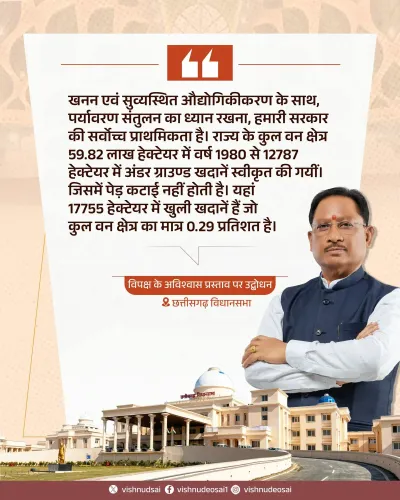
This structural tension — between energy security and forest conservation — has defined Chhattisgarh's political economy for over two decades. Governments of all stripes have invoked electricity demand as justification for mining clearances, even as environmental and tribal rights groups have consistently challenged forest diversion orders.
Stakeholders and Impact
The immediate political stakeholders are the ruling BJP and the opposition Congress, whose competing claims over environmental credibility are now being litigated on the assembly floor. Beyond the legislature, the debate touches directly on coal mining workers whose livelihoods depend on continued extraction, and on tribal forest communities whose land and resource rights are affected by every new diversion proposal.
For tribal communities in districts such as Korba and Surguja, the political back-and-forth carries material consequences: the pace and scope of coal block clearances is shaped in part by which party controls the narrative on environmental trade-offs. CM Sai's remarks signal that the BJP intends to neutralise Congress criticism by pointing to the Congress's own record in office.
What's Next
The no-confidence motion debate is expected to continue, with the opposition likely to respond to CM Sai's video claim and attempt to draw a distinction between past policy positions and present-day tree-felling controversies. Observers will watch whether the Congress produces a counter-narrative or contests the authenticity of the remarks attributed to Baghel.
Longer term, the exchange underscores that coal and forest policy will remain a live fault line in Chhattisgarh politics, with both parties constrained by their own governance records as the state navigates India's energy transition.
Point of View
' forcing the Congress to defend a legacy rather than prosecute a charge. The tactic is particularly potent in a mineral-rich state where every government has faced the same structural trade-off between energy demand and forest cover. By invoking a video — even one whose contents remain unverified in the public record — Sai raises the evidentiary stakes and compels Baghel to either confirm, contextualise, or contest past remarks. The exchange reflects a broader national pattern in which environmental accountability is deployed selectively as a political weapon rather than as a consistent policy standard.
NationPress
18 Jul 2026
Frequently Asked Questions
What did CM Vishnu Deo Sai say in the Chhattisgarh Assembly on 18 July 2026?
CM Vishnu Deo Sai cited a purported video of former CM Bhupesh Baghel in which Baghel reportedly said that electricity requires coal and coal is found only in hills and forests, using this to counter the Congress's current criticism of tree-felling for mining.
What is the no-confidence motion in Chhattisgarh Assembly 2026?
The no-confidence motion is a formal opposition move in the Chhattisgarh Legislative Assembly to express lack of confidence in the Vishnu Deo Sai-led BJP government; the debate on the motion was under way on 18 July 2026.
Did Bhupesh Baghel support coal mining in forests when he was Chief Minister?
CM Sai claimed during the assembly debate that a video exists of Baghel, during his tenure as Chief Minister from 2018 to 2023, telling people that coal — which is found in hills and forests — was necessary for electricity; the exact content of that video could not be independently verified from available records.
Why is coal mining controversial in Chhattisgarh?
Chhattisgarh's coal reserves are located under dense forests and tribal lands, meaning extraction requires forest diversion and displacement of communities; successive governments have approved such clearances citing energy security, while environmental and tribal rights groups have consistently opposed them.
What happens next after the no-confidence motion debate in Chhattisgarh?
The debate is expected to continue with the Congress likely responding to Sai's claims; the outcome of the motion and any follow-up statements on coal block clearances or forest diversion proposals will be closely watched.