CM Sai Credits PM Surya Ghar Scheme for Chhattisgarh Solar Push
Synopsis
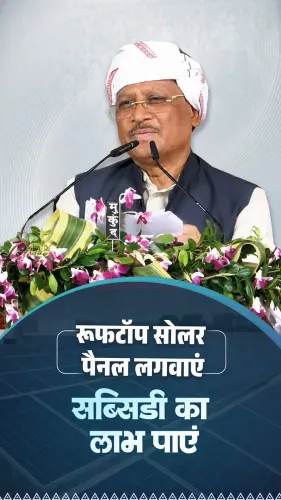
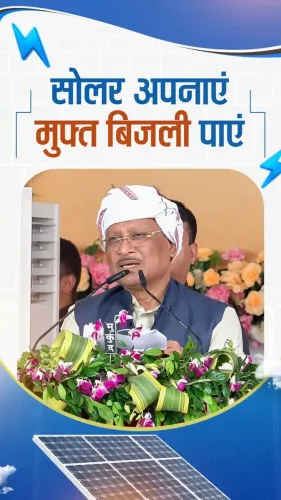
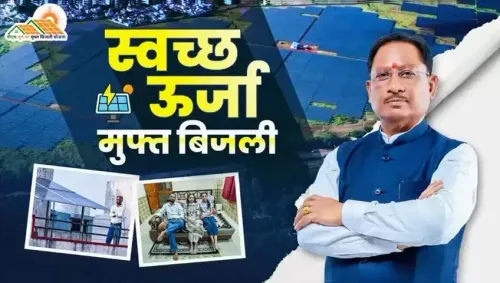
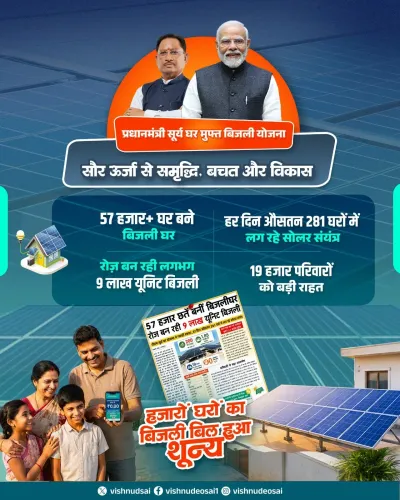
Chhattisgarh Chief Minister Vishnu Deo Sai praised PM Modi's PM Surya Ghar Muft Bijli Yojana on 27 October 2026, saying rooftop solar panels are cutting power bills and boosting clean energy adoption across thousands of households in the state.
Key Takeaways
PM Surya Ghar Muft Bijli Yojana was launched in February 2024 and offers up to 300 units of free electricity per month via household rooftop solar installations.
Chief Minister Vishnu Deo Sai says thousands of Chhattisgarh families are now self-generating electricity and seeing reduced power bills.
Chhattisgarh, historically a coal-dependent state, is positioning itself as a growing contributor to India's distributed solar capacity.
India's national target of 500 GW non-fossil fuel capacity by 2030 is a key driver behind schemes like PM Surya Ghar.
The state-level promotion mirrors similar campaigns in other BJP-governed states , with political credit channelled toward Prime Minister Narendra Modi .
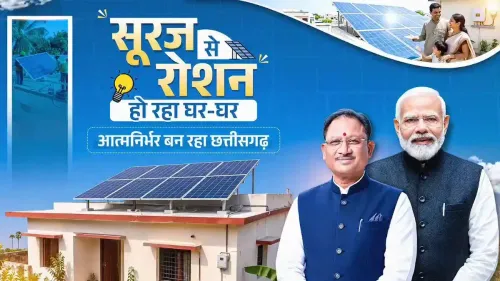
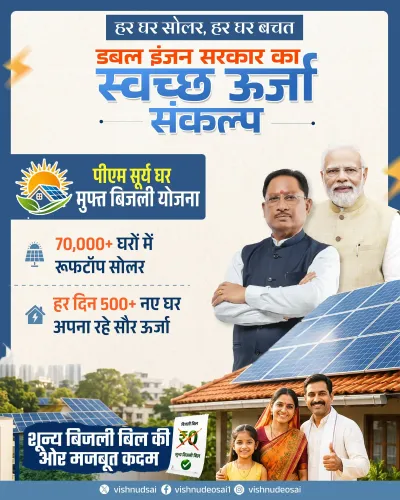
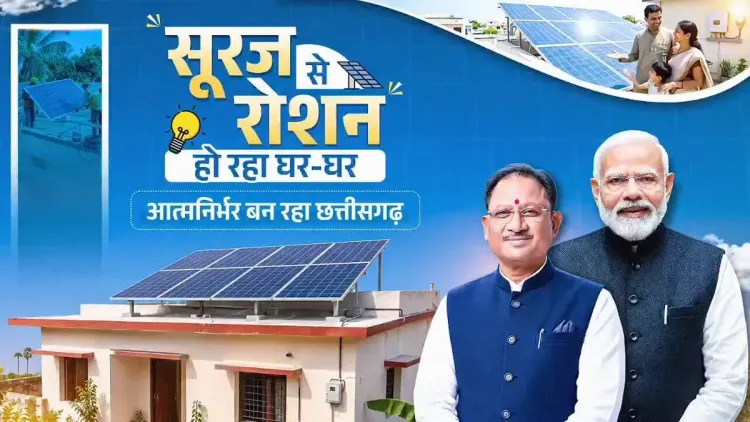
Rooftop solar panels are quietly rewriting household economics across Chhattisgarh — and Chief Minister Vishnu Deo Sai wants the country to know it. On Tuesday, 27 October 2026, Sai took to X to credit Prime Minister Narendra Modi's flagship PM Surya Ghar Muft Bijli Yojana with driving a clean-energy wave into ordinary homes across the state.
Posting in Hindi, the Chief Minister said thousands of families in Chhattisgarh are now generating their own electricity through rooftop solar installations, cutting their power bills and boosting household savings. 'घर की छत पर लगे सोलर पैनल से परिवारों की बचत बढ़ने के साथ स्वच्छ ऊर्जा को बढ़ावा मिल रहा है' — 'rooftop solar panels are increasing family savings while promoting clean energy' — he wrote, tagging @narendramodi directly.
What PM Surya Ghar Promises — and How It Works
Launched in February 2024 off the back of an announcement in the Union Budget 2024-25, the PM Surya Ghar Muft Bijli Yojana provides central financial assistance to households for rooftop solar systems capable of delivering up to 300 units of free electricity per month. The scheme is designed to reduce the burden on state electricity distribution companies while simultaneously placing the means of power production directly in the hands of consumers.
The logic is elegant: a household that generates its own solar power does not just save on bills — it feeds surplus electricity back into the grid, earning credits. Over time, the subsidy pays for itself through reduced discom liabilities and lower fossil-fuel imports. For a state like Chhattisgarh, historically dependent on coal-fired generation, that shift carries real economic weight.
Chhattisgarh's Place in India's 500 GW Ambition
Chhattisgarh sits at an interesting crossroads: it is one of India's major coal-producing states, yet its BJP government — in power since December 2023 — has aligned itself firmly with the Centre's renewable energy agenda. Sai's post is the latest signal that the state intends to ride the distributed solar wave rather than resist it.
The broader stakes are significant. India has committed to 500 GW of non-fossil fuel electricity capacity by 2030, and rooftop solar schemes like PM Surya Ghar are central to hitting that number without building enormous new transmission infrastructure. Every home that goes solar is, in a small but cumulative way, a node in that national grid transformation.
Similar state-level promotions of the scheme have rolled out across other BJP-governed states, and Chhattisgarh's messaging fits a pattern: credit flows upward to the Prime Minister, momentum flows outward to voters who are literally watching their electricity meters slow down.
Whether Chhattisgarh's installation numbers and subsidy disbursements are tracking ahead of target will be the real test — and those figures, expected in the months ahead, will tell a more complete story than any social-media post can.
Point of View
Reinforcing both the policy's reach and the party's unified brand. For Chhattisgarh specifically, publicly championing renewable energy serves a dual purpose — it aligns the coal-belt state with India's green transition narrative while delivering a tangible, voter-visible benefit in lower electricity bills. The scheme also eases pressure on Chhattisgarh's state discom, making the political calculus straightforward. Watch the actual installation and subsidy disbursement data: if Chhattisgarh's numbers are strong, the state could become a BJP showcase for distributed solar ahead of the next electoral cycle.
NationPress
27 Oct 2026
Frequently Asked Questions
What is PM Surya Ghar Muft Bijli Yojana?
PM Surya Ghar Muft Bijli Yojana is a central government scheme launched in February 2024 that provides financial assistance to households for installing rooftop solar panels, enabling them to generate up to 300 units of free electricity per month.
How is PM Surya Ghar scheme benefiting Chhattisgarh families?
According to Chief Minister Vishnu Deo Sai, thousands of Chhattisgarh households are generating their own electricity through rooftop solar panels installed under the scheme, reducing their power bills and increasing household savings.
When was PM Surya Ghar Muft Bijli Yojana launched?
The scheme was launched in February 2024, following its announcement in the Union Budget 2024-25, as part of the central government's push to accelerate rooftop solar adoption across India.
What is India's solar energy target by 2030?
India has set a target of 500 GW of non-fossil fuel electricity capacity by 2030, with rooftop solar schemes like PM Surya Ghar playing a central role in achieving distributed generation goals.
Who is Chhattisgarh Chief Minister Vishnu Deo Sai?
Vishnu Deo Sai is the Chief Minister of Chhattisgarh and a BJP leader who assumed office in December 2023 after the party's victory in the state assembly elections.