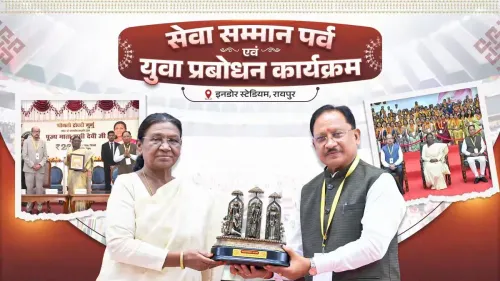
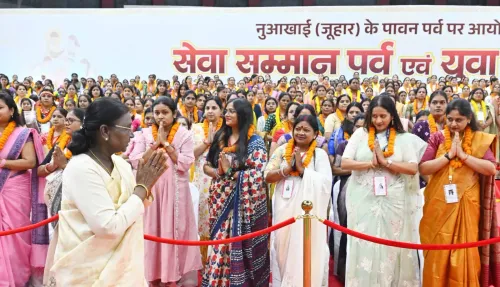
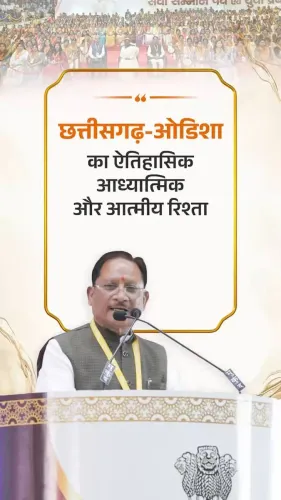
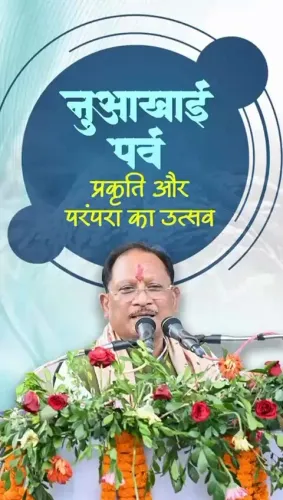
CM Sai shares President Murmu's tribute to Nuakhai harvest festival
Synopsis
Chhattisgarh CM Vishnu Deo Sai amplified President Draupadi Murmu's message on Nuakhai, the tribal harvest festival celebrated in Chhattisgarh and western Odisha as an expression of agricultural tradition, gratitude to nature, and community solidarity.
Key Takeaways
CM Vishnu Deo Sai shared President Draupadi Murmu's message on Nuakhai on 22 October 2026 .
President Murmu described Nuakhai as a festival that preserves agricultural traditions, expresses gratitude to nature, and celebrates community spirit.
Nuakhai is an annual harvest festival observed by tribal communities in Chhattisgarh and western Odisha , centred on offering the first grains of new paddy to a deity.
President Murmu is India's first tribal head of state, from the Santali community of Odisha , lending personal weight to her remarks on the festival.
CM Sai , Chhattisgarh's first tribal Chief Minister from the BJP , has consistently highlighted Adivasi cultural occasions as part of the state's governance outreach.
A festival rooted in the soil, celebrated before the first grain of the new harvest is eaten — Nuakhai carries the heartbeat of tribal agrarian life in Chhattisgarh and western Odisha, and on Thursday, 22 October 2026, Chhattisgarh Chief Minister Vishnu Deo Sai amplified that heartbeat by sharing President Draupadi Murmu's words on the occasion.
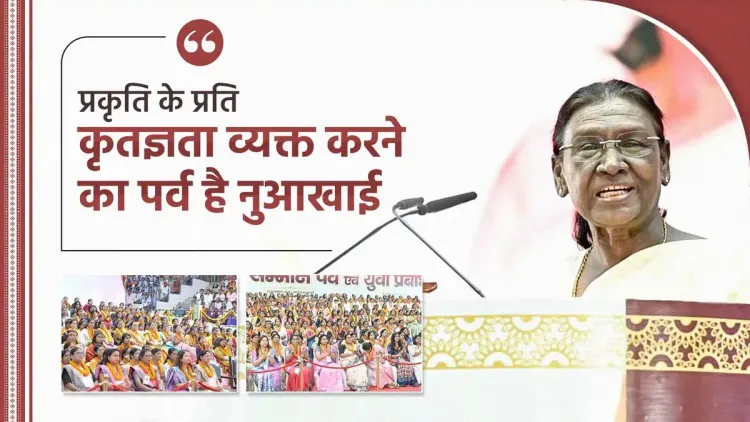
Posting on X, CM Sai quoted the President's message: 'Nuakhai parv krishi parampara ko sanjokar rakhne, prakriti ke kritagnyata vyakt karne aur samudayik bhavnaon ka utsav hai' — 'Nuakhai is a festival that preserves agricultural traditions, expresses gratitude to nature, and celebrates community spirit.' The brevity of the message carries real weight: in three phrases, President Murmu — herself from an Adivasi community in Odisha — distilled exactly what the festival means to millions who observe it.What Nuakhai actually is — and why it endures
Nuakhai, which translates roughly to 'new food', is an annual harvest festival observed primarily by tribal communities across Chhattisgarh and the western districts of Odisha. The ritual centres on offering the first grains of the freshly harvested paddy to a presiding deity before the community partakes. It is a living contract between farmers and the earth — a collective acknowledgement that the harvest is not merely an economic output but a gift.
The festival reinforces bonds of kinship and social solidarity. Families reunite, elders are honoured, and the sharing of new rice becomes a communal act of thanksgiving. In an era of rapid agricultural disruption, Nuakhai serves as a cultural anchor for communities whose identity is inseparable from the land they till.
Why President Murmu's voice on Nuakhai carries particular resonance
President Draupadi Murmu, who took office in July 2022 as India's first tribal head of state, comes from the Santali community of Odisha — a region where festivals like Nuakhai are woven into daily life. When she speaks about preserving agricultural traditions and expressing gratitude to nature, she does so not as an observer but as someone for whom these values are biographical. That authenticity is precisely what CM Sai's decision to amplify her words signals to the tribal communities of Chhattisgarh.
Chhattisgarh's tribal cultural calendar and the BJP's outreach
Chhattisgarh has a substantial Scheduled Tribe population, and cultural festivals like Nuakhai sit at the intersection of governance, identity, and political mobilisation. CM Sai, the state's first tribal Chief Minister from the BJP, has consistently used such occasions to reinforce the party's connect with Adivasi communities. Sharing the President's message — rather than only his own — elevates the moment beyond partisan messaging and frames it as a constitutional endorsement of indigenous cultural heritage.
The pattern is worth noting: national-level leaders publicly aligning with regional harvest and tribal festivals has become a visible thread in BJP-ruled states across central and eastern India, signalling cultural continuity alongside development narratives.
For tribal farmers across Chhattisgarh, the harvest festival is not a political calendar entry — it is the calendar itself. The question worth watching is whether the official attention translates into sustained cultural and agricultural policy support for the communities that keep Nuakhai alive.
Point of View
Nature, community — is deceptively precise: it positions an indigenous festival as a living policy value, not just a heritage footnote. For CM Sai, amplifying the President's voice rather than his own is a strategically deft move, lending constitutional gravity to what might otherwise read as routine cultural outreach. The gesture reflects a broader BJP playbook in tribal-majority states: weave indigenous identity into the ruling narrative to consolidate Adivasi support. Whether this cultural visibility eventually connects to measurable outcomes in tribal agriculture and land rights will determine its long-term resonance with the communities it celebrates.
NationPress
23 Oct 2026
Frequently Asked Questions
What is Nuakhai festival and where is it celebrated?
Nuakhai is an annual harvest festival observed by tribal communities in Chhattisgarh and western Odisha. It marks the offering of the first grains of the new paddy crop to a presiding deity before the community partakes, celebrating agricultural tradition, gratitude to nature, and community solidarity.
What did President Draupadi Murmu say about Nuakhai?
President Murmu said Nuakhai is a festival that preserves agricultural traditions, expresses gratitude to nature, and celebrates community spirit — a message amplified by Chhattisgarh CM Vishnu Deo Sai on X on 22 October 2026.
Why did CM Vishnu Deo Sai post about Nuakhai?
CM Sai shared President Murmu's remarks on Nuakhai to mark the festival and reinforce the cultural and tribal identity of Chhattisgarh, where he serves as the state's first tribal Chief Minister from the BJP.
Why is President Murmu's association with Nuakhai significant?
President Draupadi Murmu is India's first tribal head of state, from the Santali community of Odisha — a region deeply connected to festivals like Nuakhai. Her remarks carry personal and biographical weight beyond a ceremonial statement.
When is Nuakhai celebrated in 2026?
The exact date of Nuakhai in 2026 cannot be confirmed from available data, as the festival date is determined by the Hindu lunar calendar each year. CM Sai's post was published on 22 October 2026, around the time of the festival.