CM Sai Hails Bastar's New Era of Peace After Decades of Naxalism
Synopsis
Chhattisgarh Chief Minister Vishnu Deo Sai moved a formal expression of gratitude in the state assembly on 14 July 2026, crediting PM Modi, Amit Shah, and security forces for decisive progress against Naxalism in Bastar, declaring the region is entering a new era of peace, development, and self-reliance.
Key Takeaways
CM Vishnu Deo Sai formally thanked the Union Government and security forces in the Chhattisgarh Legislative Assembly on 14 July 2026 .
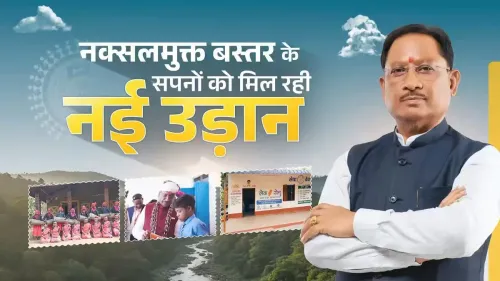
Bastar , historically the core of Maoist insurgency in India, is being declared as entering a new era of peace and development.
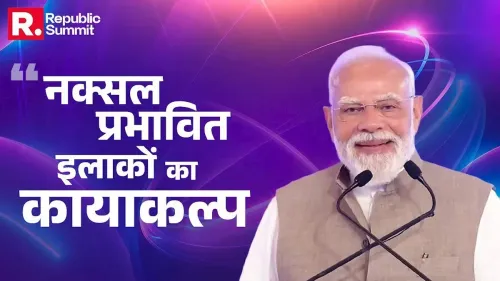
The Chief Minister credited PM Narendra Modi and Home Minister Amit Shah for visionary leadership and effective guidance in the anti-Naxal campaign.
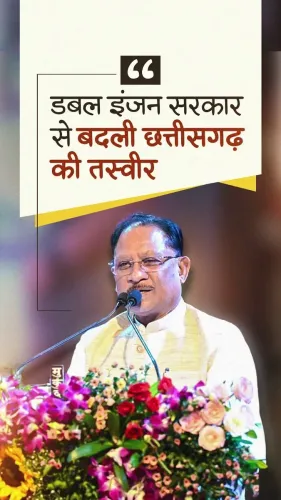
The 'double engine' BJP government model — aligning Centre and state policy — is cited as central to the security breakthrough.
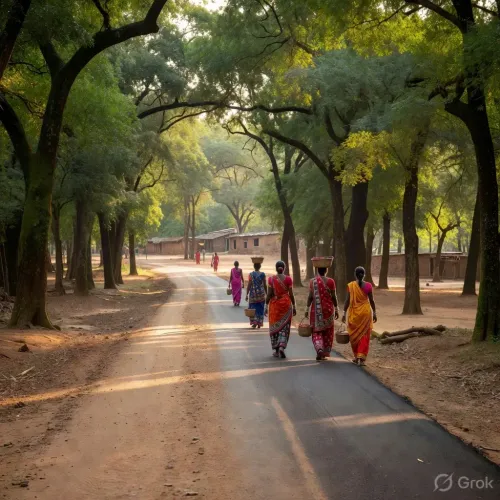
Tribal communities in Bastar are the primary intended beneficiaries of expanded roads, telecom, and civic infrastructure in cleared areas.
Future focus will be on formal assembly resolutions and rollout of livelihood and infrastructure projects in newly secured Bastar blocks.
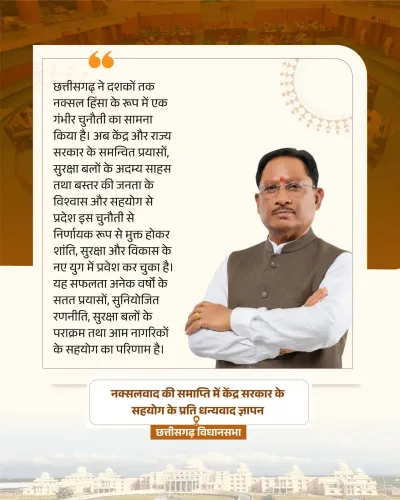
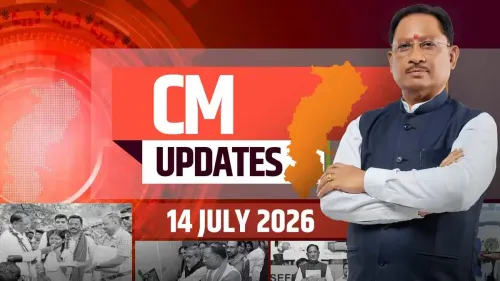
Chhattisgarh Chief Minister Vishnu Deo Sai on Tuesday, 14 July 2026 moved a formal expression of gratitude in the Chhattisgarh Legislative Assembly, acknowledging the contributions of the Union Government and security forces in what he described as a decisive campaign against Naxalism — and declared that Bastar is now moving toward a new era of peace, security, development, and trust.
Context
Posting on X in Hindi, CM Sai wrote: 'दशकों तक नक्सलवाद की चुनौती झेलने वाला बस्तर आज शांति, सुरक्षा, विकास और विश्वास के नए युग की ओर अग्रसर है' — 'Bastar, which endured the challenge of Naxalism for decades, is today moving toward a new era of peace, security, development, and trust.' He credited Prime Minister Narendra Modi's 'visionary leadership' and Union Home Minister Amit Shah's 'effective guidance', alongside the 'indomitable courage, dedication, and sacrifice' of security personnel, for paving the path to this decisive success.
The Chief Minister said the assembly proceeding on 14 July 2026 was used specifically to formally thank the Centre and the armed forces for their 'invaluable contribution' to the historic anti-Naxal campaign — an unusual legislative step that underscores the political significance the BJP government attaches to the security gains in Bastar.
Policy Backdrop
Since 2014, the Union Home Ministry has pursued an integrated Left Wing Extremism (LWE) policy combining coordinated security operations, surrender-and-rehabilitation schemes, and an infrastructure push across 90 of the worst-affected districts in central and eastern India. Chhattisgarh, recaptured by the BJP in the 2023 assembly elections, has since aligned its state machinery fully with this central framework — what the party calls the 'double engine government' model.
Bastar, a cluster of districts in southern Chhattisgarh, has historically been the heartland of Maoist insurgency. Over the past decade, the region has seen a sustained reduction in Naxal-related incidents and fatalities as central paramilitary forces and state police expanded road networks, established forward operating bases, and ran civic action programmes to reconnect tribal communities with mainstream governance.
A similar security-plus-development template has been applied in neighbouring Odisha, Jharkhand, and pockets of Andhra Pradesh, but Bastar has remained the most symbolic and contested theatre of the LWE campaign.
Stakeholders and Impact
The primary beneficiaries of improved security conditions are the tribal communities of Bastar — populations that bore the heaviest burden of insurgent violence, displacement, and developmental exclusion over several decades. Restored access to roads, telecommunications, schools, and health infrastructure has been the stated metric of success by both state and central administrations.
Security forces — including personnel from the Central Reserve Police Force (CRPF), District Reserve Guard (DRG), and Chhattisgarh Police — have sustained significant casualties over the years. CM Sai's assembly tribute directly acknowledges their sacrifice as a political and moral debt the state recognises formally.
For the BJP, the framing of Bastar's transformation is also an electoral and ideological statement: that coordinated governance between a BJP-led Centre and a BJP-led state can resolve long-standing security crises that previous administrations could not.
What's Next
Attention will now turn to whether the Chhattisgarh Assembly formalises its gratitude through a resolution, and how quickly the state translates security gains into visible livelihood, road, and telecom projects in newly cleared Bastar blocks. CM Sai expressed confidence that Bastar will attain 'new heights of prosperity, self-respect, and self-reliance' — a benchmark against which the 'double engine' government's delivery will be measured in the months ahead.
Point of View
Which remains the harder and less visible part of LWE policy. The broader pattern — security gains credited to central-state BJP alignment — is being replicated across the LWE belt, making Bastar a template the party intends to showcase nationally.
NationPress
13 Oct 2026
Frequently Asked Questions
What did Chhattisgarh CM Vishnu Deo Sai say about Bastar in the assembly?
CM Vishnu Deo Sai moved a formal expression of gratitude in the Chhattisgarh Legislative Assembly on 14 July 2026, thanking the Union Government and security forces for their role in achieving decisive success against Naxalism and bringing Bastar into the mainstream of development.
Is Bastar free from Naxalism?
The Chhattisgarh government has described Bastar as entering a new era of peace and security, citing a sustained reduction in Naxal-related incidents, though the region has historically been the core of Maoist insurgency and the transition to full normalcy is an ongoing process.
What is the 'double engine government' in the context of Chhattisgarh?
The 'double engine government' refers to the political alignment between the BJP-led Union Government and the BJP-led Chhattisgarh state government, enabling coordinated resource allocation and operational planning for anti-Naxal security and development programmes.
What role did Amit Shah play in anti-Naxal operations in Chhattisgarh?
As Union Home Minister, Amit Shah has overseen India's integrated Left Wing Extremism policy since the BJP came to power, coordinating central paramilitary deployments, surrender-and-rehabilitation schemes, and infrastructure programmes across affected states including Chhattisgarh.
What development projects are planned for Bastar after Naxal clearance?
The Chhattisgarh government has indicated focus on roads, telecommunications, and livelihood projects in newly cleared Bastar blocks, though specific project details and timelines are yet to be formally announced following the assembly proceedings.