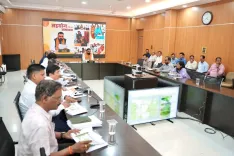
CM Sai Approves 58% Honorarium Hike for Chhattisgarh Nagar Sainiks

Synopsis
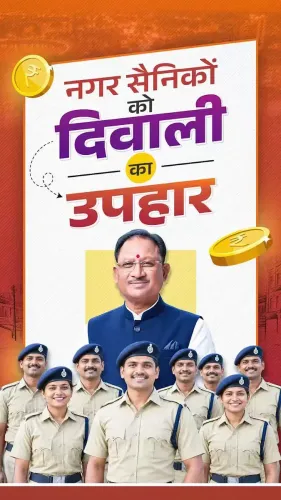
Chhattisgarh Chief Minister Vishnu Deo Sai has announced a monthly honorarium increase of over 58% for approximately 7,900 nagar sainiks, the state's auxiliary municipal security and disaster-response personnel, marking what the government calls a historic welfare decision under its sushasan agenda.
Key Takeaways
58% honorarium hike announced for Chhattisgarh nagar sainiks on 22 October 2026 .
Approximately 7,900 nagar sainiks and their families are set to benefit from the revision.
CM Vishnu Deo Sai framed the decision as recognition of the force's dedication in public safety and disaster response.
The announcement aligns with the BJP government's stated sushasan (good governance) agenda since taking office in December 2023 .
Nagar sainiks serve as auxiliary municipal security and first-responder support across urban and semi-urban Chhattisgarh .
Formal rollout — including budget provisions and government orders — remains the key next step to watch.
They hold the line during floods, fires, and civic emergencies — yet for years, Chhattisgarh's nagar sainiks did it on an honorarium that barely reflected the risk. On Thursday, 22 October 2026, Chhattisgarh Chief Minister Vishnu Deo Sai announced a historic revision: a monthly honorarium increase of more than 58% for the state's auxiliary municipal security and disaster-response force.
What the 58% hike means for 7,900 families
The decision covers approximately 7,900 nagar sainiks across the state and, by extension, their households. CM Sai framed the move as an act of recognition, stating in his post that 'unke samarpan aur kartavyanishtha ka samman karte hue' (honoring their dedication and sense of duty), the government had resolved to bring about the increase. The revision is the largest single honorarium jump for this cadre in recent memory, and the administration has positioned it squarely within its sushasan (good governance) agenda.
Nagar sainiks occupy a distinctive but often overlooked space in India's public-safety ecosystem. Deployed by urban local bodies, they assist with crowd management, disaster relief, and routine civic security — functions that swell sharply whenever the state faces natural calamity. Chhattisgarh, a central Indian state prone to flooding in its river plains and occasional industrial emergencies in its mining belt, relies on this workforce as a first-responder buffer well beyond their nominal role.
BJP's welfare pitch in Chhattisgarh's post-2023 political landscape
Vishnu Deo Sai took charge as Chief Minister in December 2023 after the BJP swept back to power in the state assembly elections, ending the Congress government's five-year tenure. Since then, the administration has repeatedly signalled welfare for frontline and auxiliary government workers as a governance priority. The nagar sainik honorarium hike fits that pattern — a tangible, quantifiable benefit that directly touches thousands of households in semi-urban and urban Chhattisgarh.
The broader policy context matters: across Indian states, periodic revisions to auxiliary-force honorariums tend to lag behind inflation for years before a corrective jump arrives. A revision exceeding 58% in a single decision, if implemented as announced, would represent a meaningful catch-up. The rollout — including any supplementary budget provisions or formal government orders — will be the next test of how quickly the benefit reaches beneficiaries.
For the nagar sainiks themselves, the promise is simple: the state sees what they do, and it is starting to pay accordingly.
Point of View
Honorarium-based forces have historically been easy to overlook precisely because they fall outside regular pay-commission structures; a jump of this magnitude is designed to close that gap visibly and quickly. For the BJP in Chhattisgarh, connecting a tangible welfare number to its sushasan brand strengthens the argument that the party's governance translates into household-level economic relief. The real test will be whether a formal budget instrument follows the announcement or whether implementation stalls — a pattern that has undercut similar pledges in other states.
NationPress
23 Oct 2026
Frequently Asked Questions
What is the nagar sainik honorarium hike announced in Chhattisgarh?
Chhattisgarh Chief Minister Vishnu Deo Sai announced a monthly honorarium increase of more than 58% for nagar sainiks — the state's auxiliary municipal security and disaster-response personnel — on 22 October 2026.
How many nagar sainiks will benefit from this hike in Chhattisgarh?
Approximately 7,900 nagar sainiks across Chhattisgarh and their families are expected to benefit from the revised monthly honorarium.
Who are nagar sainiks and what do they do?
Nagar sainiks are auxiliary personnel deployed by urban local bodies in India. In Chhattisgarh, they assist with public safety, crowd management, and disaster relief operations alongside regular civic administration.
When did Vishnu Deo Sai become Chief Minister of Chhattisgarh?
Vishnu Deo Sai was sworn in as Chief Minister of Chhattisgarh in December 2023, after the BJP won the state assembly elections.
What is the sushasan agenda the Chhattisgarh government refers to?
'Sushasan' means good governance in Hindi. The Sai government uses the term to describe its policy framework focused on welfare, accountability, and efficient administration for citizens and frontline workers in Chhattisgarh.