CM Sai: Land Surveys Begin in Abujhmad for First Time
Synopsis
Chhattisgarh Chief Minister Vishnu Deo Sai announced on 22 June 2026 that land surveys are underway in Abujhmad — a Maoist-affected forest region in Bastar — for the first time since Independence, to formally recognise ancestral land rights of tribal families.
Key Takeaways
Land surveys are being conducted in Abujhmad , Bastar, for the first time since India's Independence.
The region was inaccessible to regular administration for decades due to Maoist insurgency .
The surveys aim to give tribal families — primarily Gond communities — formal recognition of their ancestral land rights.
The Forest Rights Act, 2006 provides the legislative basis for granting individual and community land titles in such areas.
Chief Minister Vishnu Deo Sai framed the initiative as part of a transition 'from conflict to confidence' in Abujhmad .
Similar land-rights drives in Odisha , Jharkhand , and Andhra Pradesh have been used as development tools in other LWE-affected tribal belts.
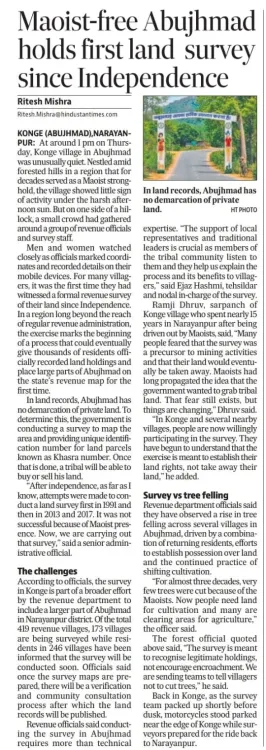
Chhattisgarh Chief Minister Vishnu Deo Sai announced on Monday, 22 June 2026 that land surveys are being conducted in the remote Abujhmad region for the first time since Independence, marking what he described as a historic step toward securing ancestral land rights for tribal families long cut off from formal administration by Maoist violence.
Context
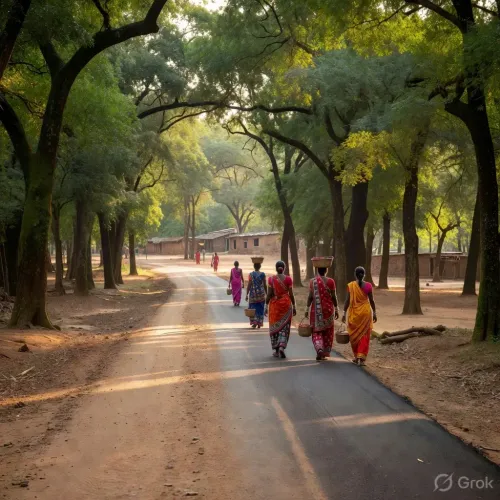
Abujhmad is a densely forested, hilly stretch in the Bastar division of southern Chhattisgarh, historically outside the reach of the state's revenue and administrative machinery. Decades of Left-Wing Extremism rendered routine governance — including land demarcation, record-keeping, and rights recognition — virtually impossible in the region's villages. Tribal communities, predominantly Gond and related groups, have lived on and cultivated ancestral land without formal documentation.
Chief Minister Sai stated that the surveys mark a new chapter: 'From conflict to confidence, Abujhmad is marching towards a future of peace, dignity and inclusive development.' The announcement signals that security conditions have improved sufficiently to allow revenue officials and survey teams to operate in villages that were previously inaccessible.
Policy Backdrop
The constitutional and legislative framework for tribal land rights in such areas rests on several pillars. The Forest Rights Act, 2006 — formally the Scheduled Tribes and Other Traditional Forest Dwellers (Recognition of Forest Rights) Act — empowers tribal and forest-dwelling families to claim individual and community titles over land they have traditionally occupied and cultivated. Abujhmad's exclusion from regular revenue surveys had effectively denied its residents the evidentiary base needed to file or process such claims.
The Panchayats (Extension to Scheduled Areas) Act, 1996 (PESA) extended self-governance provisions to tribal areas including parts of Bastar, but its implementation in Abujhmad remained limited due to the security situation. Post-2000, after Chhattisgarh was carved out as a separate state, successive governments announced special development packages for Left-Wing Extremism (LWE) districts, focusing on roads, schools, and rehabilitation. Land titling now emerges as the next frontier in that effort.
Across other LWE-affected states — Odisha, Jharkhand, and Andhra Pradesh — similar survey and rights-recognition drives have been pursued as part of a broader doctrine linking development to lasting peace in conflict-affected tribal belts.
Stakeholders and Impact
The most direct beneficiaries are the tribal families of Abujhmad's villages, who stand to receive formal recognition of ancestral land they have farmed and inhabited for generations. A legal land title unlocks access to institutional credit, government welfare schemes, and legal protection against displacement — all of which have been historically out of reach for these communities.
The exercise also carries broader administrative significance: bringing Abujhmad's villages into the revenue record system for the first time integrates them into the state's planning and resource-allocation framework. For the Bharatiya Janata Party government in Raipur, completing this process would represent a tangible governance milestone in one of the country's most challenging administrative terrains.
What's Next
The immediate markers to watch are the pace and coverage of the ongoing surveys — how many villages are being mapped, how many families are being enumerated, and whether land titles are being issued under the Forest Rights Act or state revenue mechanisms. Linked infrastructure and livelihood schemes for the region will indicate whether the land survey is part of a wider development push or a standalone administrative measure.
If the surveys proceed without disruption and title distribution follows, Abujhmad could become a reference case for integrating long-excluded tribal territories into mainstream governance — a model with implications for similar pockets across central India's tribal heartland.
Point of View
Planting the revenue state in territory that insurgency had effectively hollowed out for decades. Chief Minister Sai, himself a tribal leader from Chhattisgarh, is deploying this initiative as proof that the BJP's dual security-and-development doctrine is producing tangible results in Bastar. Whether the surveys translate into actual title distribution at scale will determine whether this becomes a genuine governance breakthrough or a symbolic gesture ahead of future electoral cycles.
NationPress
20 Sept 2026
Frequently Asked Questions
What is Abujhmad and why has it never had land surveys before?
Abujhmad is a remote, forested hilly region in the Bastar division of Chhattisgarh that remained outside formal revenue administration for decades because of entrenched Maoist insurgency and difficult terrain, making it impossible for state officials to conduct surveys or maintain land records.
What does the Abujhmad land survey mean for tribal families?
The surveys will help tribal families obtain formal documentation of their ancestral land, enabling them to apply for titles under the Forest Rights Act, 2006, and access institutional credit, government schemes, and legal protection against displacement.
What is the Forest Rights Act and how does it apply to Abujhmad?
The Forest Rights Act, 2006, grants tribal and forest-dwelling communities the right to claim titles over land they have traditionally occupied; Abujhmad's tribal families were previously unable to exercise this right because the absence of revenue surveys left them without the evidentiary records required to file claims.
Who is Vishnu Deo Sai?
Vishnu Deo Sai is the Chief Minister of Chhattisgarh, a BJP leader who took office in December 2023; he previously served as a Union Minister and has represented tribal constituencies in the state throughout his political career.
Is the Abujhmad land survey part of a larger anti-Naxal strategy?
Successive governments across central India have linked land titling and development schemes to reducing tribal alienation in Maoist-affected areas; similar survey and rights-recognition efforts have been undertaken in other Left-Wing Extremism zones in Odisha, Jharkhand, and Andhra Pradesh as part of this broader approach.