CM Sai: Mahatari Vandan Yojana now reaches Bastar women
Synopsis
Chief Minister Vishnu Dev Sai says the Mahatari Vandan Yojana has transferred over ₹18,000 crore to women across Chhattisgarh in 28 instalments and is now being extended to women in the formerly Naxal-affected Bastar region to bring them into the development mainstream.
Key Takeaways
The Mahatari Vandan Yojana is a direct-benefit-transfer scheme for women introduced by the Chhattisgarh BJP government after the December 2023 elections.
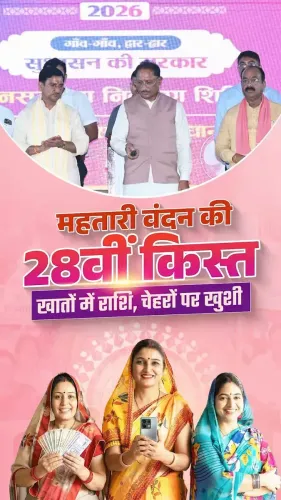
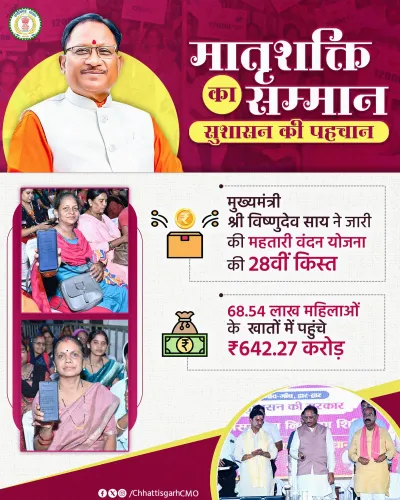
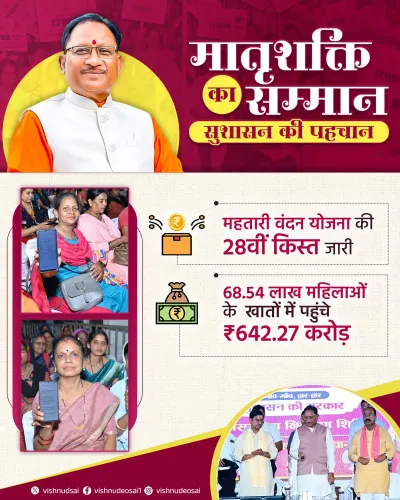
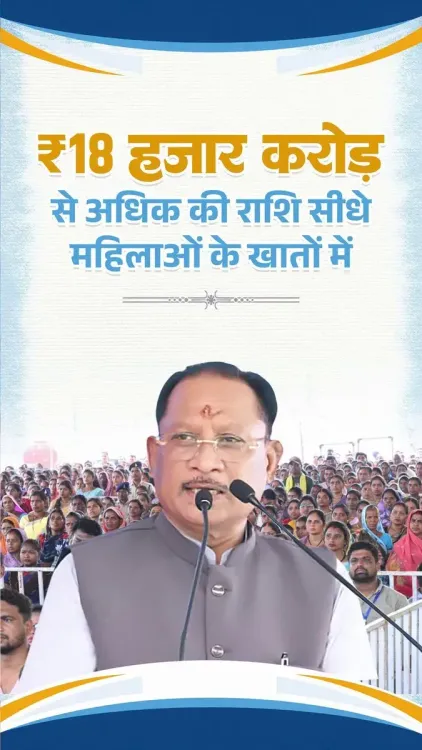
CM Vishnu Dev Sai stated that more than ₹18,000 crore has been transferred through 28 instalments into the accounts of women across the state.
The scheme is now being extended to women in Bastar , a region historically affected by Naxalite insurgency.
The expansion is framed as integrating Bastar women into the 'development mainstream' following security gains in the region.
Direct cash-transfer schemes for women are part of a broader pattern across central Indian states, including Madhya Pradesh and Jharkhand .
The Chief Minister's Office of Chhattisgarh on Thursday, 2 July 2026 quoted Chief Minister Vishnu Dev Sai describing the Mahatari Vandan Yojana as a campaign of honour, confidence, and self-reliance for women, and announced that beneficiaries in the formerly Naxal-affected Bastar region are now being brought into the scheme.
Context
Speaking through the official CMO account, CM Sai stated — translated from Hindi — that 'Mahatari Vandan Yojana matrashakti ke samman, aatmavishwas aur aatmanirbharta ka sashakt abhiyan hai' ('The Mahatari Vandan Yojana is a powerful campaign for the honour, self-confidence, and self-reliance of maternal power'). He added that through 28 instalments, more than ₹18,000 crore has been directly transferred into the bank accounts of mothers and sisters across the state. The post was shared under the hashtags #MahatariVandanYojana, #NariShakti, and #WomenEmpowerment.
Policy Backdrop
The Mahatari Vandan Yojana is a direct-benefit-transfer scheme introduced by the BJP government in Chhattisgarh following its return to power after the December 2023 assembly elections. The scheme provides monthly financial assistance to women in the state and has been positioned as a flagship welfare initiative of the Sai government. Direct cash transfers to women have been a recurring tool across several Indian states, with neighbouring Madhya Pradesh and Jharkhand running comparable programmes.
The inclusion of Bastar marks a notable policy step. The region in southern Chhattisgarh has for decades been the epicentre of Left Wing Extremism in India, and successive central and state governments have paired security operations with targeted welfare delivery in these districts since the 2010s. The current government has intensified both security and development efforts in Bastar, and the extension of the Mahatari Vandan Yojana to women there signals a push to integrate the region into mainstream welfare infrastructure.
Stakeholders and Impact
The primary beneficiaries are women enrolled in the scheme across Chhattisgarh, with the Bastar expansion specifically targeting women in communities that were previously cut off from government services due to insurgency. For these women, access to direct bank transfers represents both financial inclusion and a formal acknowledgement of citizenship entitlements long denied by conflict. Tribal communities in Bastar's forested districts stand to gain the most from this integration.
From a governance standpoint, the announcement reinforces the state government's narrative of post-conflict normalisation in Bastar. By linking welfare delivery to security gains, the administration is signalling that cleared areas are being converted into development zones — a message aimed at both residents and political audiences ahead of future electoral cycles.
What's Next
Observers will watch for the rollout of the scheme in additional Naxal-cleared pockets beyond Bastar and for any supplementary budget provisions in the next Chhattisgarh state assembly session to fund expanded coverage. The pace of enrolment of Bastar women — and whether logistical challenges such as banking access in remote tribal areas are addressed — will determine how quickly the stated integration goal translates into actual disbursements on the ground.
Point of View
Reinforcing the BJP government's counter-insurgency narrative. By anchoring the announcement to a cumulative disbursement figure, CM Sai is building a quantifiable record of delivery ahead of future electoral cycles. The move also fits a wider national pattern of using direct-benefit transfers to women as a tool for both social inclusion and political consolidation in conflict-affected areas. Whether the scheme reaches the most remote tribal households in Bastar will be the real test of its stated intent.
NationPress
2 Jul 2026
Frequently Asked Questions
What is the Mahatari Vandan Yojana in Chhattisgarh?
The Mahatari Vandan Yojana is a direct-benefit-transfer scheme launched by the Chhattisgarh government after the December 2023 elections that provides monthly financial assistance directly into the bank accounts of women in the state.
How much money has been transferred under Mahatari Vandan Yojana?
According to CM Vishnu Dev Sai, more than ₹18,000 crore has been transferred through 28 instalments into the accounts of women across Chhattisgarh as of July 2026.
Why is the Mahatari Vandan Yojana being extended to Bastar?
The Chhattisgarh government says that with Bastar increasingly free from Naxalite influence, women in the region are now being enrolled in the scheme to bring them into the development mainstream.
Who announced the Bastar expansion of Mahatari Vandan Yojana?
Chief Minister Vishnu Dev Sai made the announcement through the official Chief Minister's Office account on X on 2 July 2026.
Is Mahatari Vandan Yojana similar to schemes in other states?
Yes, comparable direct cash-transfer programmes for women exist in neighbouring Madhya Pradesh and Jharkhand, reflecting a broader pattern of state-level women-support initiatives across central India.