CM Vishnu Deo Sai Vows to Expand Health Infrastructure Across Chhattisgarh
Synopsis
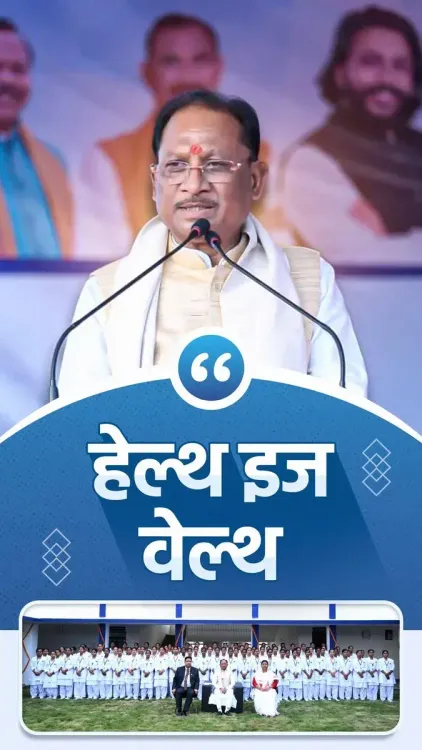
Chhattisgarh Chief Minister Vishnu Deo Sai on 15 November 2026 pledged continuous expansion of health infrastructure across the state, invoking the BJP's 'double engine' governance model to signal Centre-state alignment in delivering citizen healthcare.
Key Takeaways
CM Vishnu Deo Sai posted on 15 November 2026 reaffirming the government's health infrastructure expansion drive in Chhattisgarh.
He stated that every citizen being healthy is essential to building a 'healthy Chhattisgarh'.
The post invokes the BJP's signature 'double engine government' framing, stressing Centre-state policy alignment.
Sai has led Chhattisgarh since the BJP's December 2023 assembly election victory .
Chhattisgarh's dispersed rural and tribal populations make last-mile health delivery a persistent governance challenge.
Specific projects and budgetary allocations are expected to be detailed in upcoming state budget and health-department announcements.
A healthy Chhattisgarh demands healthy citizens — and that is the stated mission driving the state government's push to deepen health infrastructure across every corner of the state. Chhattisgarh Chief Minister Vishnu Deo Sai reaffirmed this commitment on Sunday, 15 November 2026, pledging continuous expansion of health facilities under what he calls the 'double engine' approach to governance.
Posting on X, CM Sai wrote: 'स्वस्थ छत्तीसगढ़ के निर्माण के लिए प्रत्येक नागरिक का स्वस्थ होना आवश्यक है।' — 'For building a healthy Chhattisgarh, it is essential that every citizen is healthy.' He added that his government is 'continuously expanding health infrastructure in the state' with that resolve.
'Double Engine' Governance and What It Means for Chhattisgarh's Health Push
The phrase 'double engine government' is a fixture of BJP political communication, used to signal that a state under BJP rule is pulling in the same direction as the BJP-led central government. Since the party's decisive victory in the 2023 Chhattisgarh assembly elections, Chief Minister Sai has repeatedly deployed the framing to underscore alignment between state initiatives and central health schemes.
The practical implication: state health programmes are positioned to draw on central funding streams and national policy frameworks simultaneously, aiming for faster rollout of hospitals, primary health centres, and ancillary infrastructure in a state where rural populations remain spread across challenging terrain.
Why Health Infrastructure Remains Unfinished Business in Chhattisgarh
Chhattisgarh, a central Indian state carved out in 2000, covers forested, tribal-majority districts where last-mile healthcare delivery has historically lagged. The state's demographic realities — dispersed villages, tribal communities, and undulating geography — make infrastructure investment a consistent policy priority for any government in Raipur.
The current administration has framed health facility expansion as both a welfare imperative and a governance deliverable, keeping it visible in official communication well into its third year in office. Sunday's post is consistent with that sustained emphasis, even as specific projects and timelines remain to be detailed in forthcoming budget and health-department announcements.
The next concrete test of that resolve will come in the state's budget cycle — where allocations for new facilities, upgrades, and staffing will tell citizens exactly how the pledge translates into rupees on the ground.
Point of View
But its timing — nearly three years into the administration — signals an intent to keep health infrastructure as a visible political deliverable ahead of future electoral cycles. The 'double engine' framing is a deliberate attempt to credit both state and central leadership simultaneously, making it harder for the opposition to draw a wedge between Raipur and New Delhi. The real test of the commitment is not the rhetoric but the upcoming budget line items, where allocations for rural health centres and tribal-district facilities will reveal how deep the resolve actually runs. Chhattisgarh's structural challenges — terrain, tribal demographics, sparse connectivity — mean any genuine health push requires sustained multi-year capital, not just a single cycle of announcements.
NationPress
15 Nov 2026
Frequently Asked Questions
What did Chhattisgarh CM Vishnu Deo Sai say about health in his latest post?
CM Vishnu Deo Sai said that every citizen being healthy is essential for building a healthy Chhattisgarh, and that his 'double engine' government is continuously expanding health infrastructure across the state.
What does 'double engine government' mean in Chhattisgarh?
'Double engine government' is BJP terminology for a state where both the central government and the state government are run by the BJP, implying coordinated and faster policy delivery.
When did Vishnu Deo Sai become Chief Minister of Chhattisgarh?
Vishnu Deo Sai became Chief Minister of Chhattisgarh in December 2023 , following the BJP's victory in the state assembly elections.
What are the main health challenges in Chhattisgarh?
Chhattisgarh faces significant last-mile healthcare challenges due to its large tribal population, dense forests, dispersed rural settlements, and difficult terrain, which make reaching primary health infrastructure complex.
What health schemes is the Chhattisgarh government focusing on?
The Chhattisgarh government under CM Sai is focusing on expanding health infrastructure by aligning state programmes with central health schemes, though specific new projects or timelines have not yet been officially detailed.