CM Sai Backs 'Har Ghar Munga' Drive to Fight Malnutrition
Synopsis
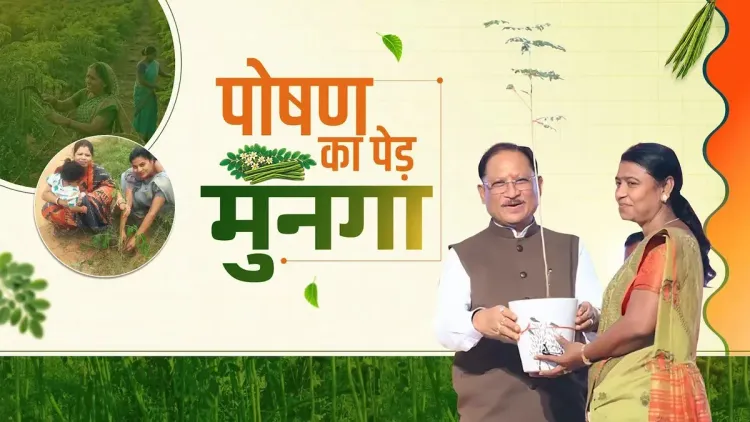
Chhattisgarh CM Vishnu Deo Sai is backing the 'Har Ghar Munga' campaign, urging every household to plant Moringa as a low-cost, locally available solution to child malnutrition in the state's rural and tribal communities.
Key Takeaways
CM Vishnu Deo Sai publicly promoted the 'हर घर मुनगा-घर-घर मुनगा' campaign on 29 September 2026 , calling for mass household Moringa planting.
Moringa (drumstick) is rich in iron, calcium, vitamins A and C, and protein — nutrients critical for addressing child and maternal malnutrition.
Chhattisgarh has a significant tribal population and persistent challenges of undernutrition, making community-level nutrition drives especially relevant.
The campaign emphasises janbhagidari (public participation) over centralised distribution, asking families to grow their own nutritional resource.
The initiative aligns with India's national POSHAN Abhiyan (2018) , which promotes locally available nutritious foods to fight malnutrition.
Real impact will depend on household participation rates and subsequent tracking of nutrition indicators across the state's districts.
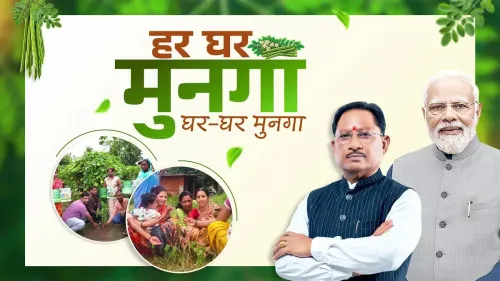
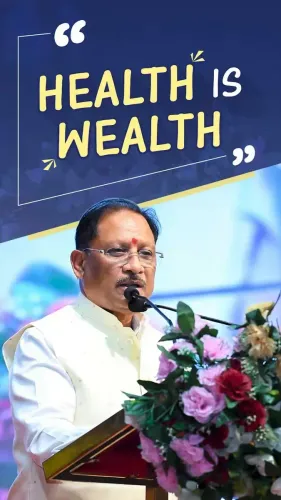
A drumstick tree in every courtyard — that is the deceptively simple idea Chhattisgarh Chief Minister Vishnu Deo Sai is betting on to fight one of the state's most stubborn public-health challenges. On 29 September 2026, CM Sai used his official X account to amplify the state's 'हर घर मुनगा-घर-घर मुनगा' ('A Moringa at every home — Moringa in every home') campaign, calling on citizens to plant Moringa — locally known as Munga — in their own backyards as a direct, low-cost weapon against malnutrition.
'Har Ghar Munga': What the Campaign Is Actually Asking Families to Do
The logic is disarmingly practical. Moringa (Moringa oleifera), the drumstick tree, grows with minimal effort in Indian home gardens and is already a staple of Chhattisgarhi kitchens. Its leaves pack dense concentrations of iron, calcium, vitamins A and C, and protein — nutrients that are precisely what malnourished children and mothers in the state's rural and tribal belts are missing. CM Sai's post frames the tree not as a government handout but as a household asset: 'Munga, which grows easily in our homes and courtyards, can become a source of better nutrition for the family.'
The campaign's core ask is janbhagidari — public participation. Rather than centralised food distribution alone, the drive pushes families to cultivate the plant themselves, embedding nutrition at the source rather than at the supply chain.
Why Chhattisgarh Needs This — and Why Moringa Specifically
Chhattisgarh has a significant tribal population and has historically recorded some of the country's more acute child malnutrition figures. The challenge is not simply caloric — it is micronutrient deficiency in communities where market access is limited and dietary diversity is low. That is exactly the gap Moringa can fill cheaply and immediately.
The state initiative dovetails with India's POSHAN Abhiyan, launched in 2018, which explicitly promotes community-level use of locally available nutritious foods — including drumstick leaves — as a complement to centralised nutrition programmes. Chhattisgarh's household-cultivation push takes that national framework and translates it into a backyard-level action: plant the tree, feed the family, reduce dependence on supply chains that do not always reach the last mile.
Across India, states with heavy malnutrition burdens have run similar indigenous-plant campaigns, recognising that sustainable nutrition security is built in home gardens as much as in government kitchens. The Munga drive fits squarely in that pattern — and its emphasis on tribal and rural households gives it a sharper targeting edge than generic awareness drives.
The Measure That Will Matter: Participation, Not Just Planting
Campaigns like this live or die on follow-through. The real test for 'हर घर मुनगा' is whether household participation translates into sustained dietary change — and eventually into measurable improvements in child nutrition indicators across Chhattisgarh's blocks and districts. CM Sai's post is a public nudge, but the harder work is the ground-level mobilisation in villages where awareness of Moringa's nutritional value may still be limited.
If the state can marry the campaign's community-ownership ethos with robust tracking of planting rates and nutrition outcomes, it could become a replicable model for other states wrestling with the same problem — a quiet, green answer to a crisis that statistics alone have never solved.
Point of View
It also serves as a visible, tangible health-welfare signal aimed at the state's large rural and tribal electorate. The alignment with the Centre's POSHAN Abhiyan gives the initiative federal legitimacy while letting the state claim a locally adapted, culturally resonant identity. Whether this translates into measurable malnutrition reduction will ultimately determine if the model earns replication — or remains a well-intentioned awareness exercise.
NationPress
29 Sept 2026
Frequently Asked Questions
What is the 'Har Ghar Munga' campaign in Chhattisgarh?
'Har Ghar Munga' is a Chhattisgarh state campaign that encourages every household to plant a Moringa (drumstick) tree in their home garden as a locally available, low-cost source of nutrition to help combat malnutrition, especially among children and mothers.
Why is Moringa (Munga) promoted for fighting malnutrition?
Moringa leaves are rich in iron, calcium, vitamins A and C, and protein — micronutrients that are commonly deficient among malnourished children and women in rural and tribal communities. The plant grows easily in home gardens with minimal effort or cost.
How does this campaign connect to India's POSHAN Abhiyan?
India's POSHAN Abhiyan, launched in 2018, promotes community-level use of locally available nutritious foods including drumstick leaves to tackle malnutrition. Chhattisgarh's Munga campaign directly extends this national framework at the household level.
Who launched the Har Ghar Munga campaign in Chhattisgarh?
The campaign is being promoted by the Chhattisgarh state government under Chief Minister Vishnu Deo Sai, who publicly called on citizens to plant Moringa in their courtyards as part of a collective effort toward a healthier, well-nourished state.
What is Chhattisgarh's malnutrition situation?
Chhattisgarh has a significant tribal population and has historically faced acute challenges of child malnutrition and micronutrient deficiency, particularly in rural and remote areas where dietary diversity and market access are limited.