CM Sai releases book on Bastar's anti-Naxal struggle in Raipur
Synopsis
Chhattisgarh Chief Minister Vishnu Deo Sai released 'Tera Raj Nahin Aayega Re', a book documenting Bastar's four-decade fight against Naxalism, at a Raipur ceremony on 14 June 2026. Co-authored by Rajiv Ranjan Prasad and Rachna Naidu, the work chronicles security-force sacrifices and tribal communities' hopes for peace.
Key Takeaways
Chhattisgarh Chief Minister Vishnu Deo Sai released the book 'Tera Raj Nahin Aayega Re' in Raipur on 14 June 2026 .
The book is co-authored by Rajiv Ranjan Prasad and Rachna Naidu and documents the anti-Naxal struggle in Bastar .
Legislative Assembly Speaker Dr.
Raman Singh — former three-term Chief Minister — presided over the event; Deputy CM Vijay Sharma was also present.
The book covers the courage of security forces, soldiers' sacrifices, and the pain and hopes of Bastar's tribal communities .
CM Sai said the book will factually document the 'Double Engine government's' resolve and decisive efforts in the region.
Bastar recorded some of the highest security-force fatalities in India during over four decades of Left-Wing Extremist activity.
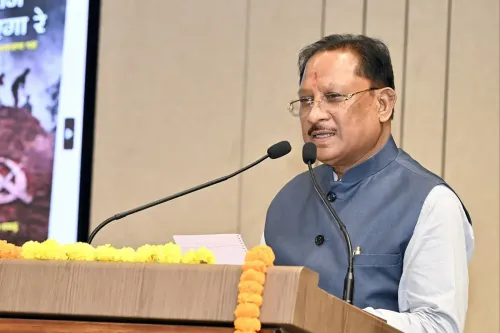
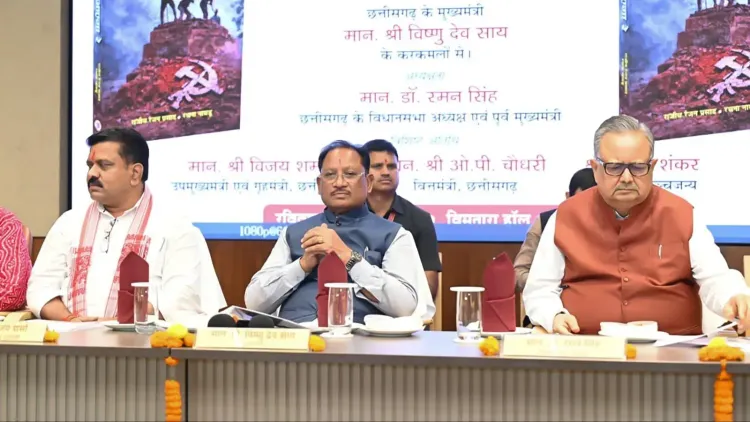
Chhattisgarh Chief Minister Vishnu Deo Sai on Sunday, 14 June 2026, presided over the release of a new book chronicling the decades-long fight against Naxalism in Bastar, at an event held in Raipur in the presence of Legislative Assembly Speaker Dr. Raman Singh.
The book, titled 'Tera Raj Nahin Aayega Re' ('Your reign shall not come'), is co-authored by Shri Rajiv Ranjan Prasad and Sushri Rachna Naidu. Deputy Chief Minister Shri Vijay Sharma and several other dignitaries were also present at the launch ceremony.
Context
In his post on X, CM Sai described the book as a 'powerful document' (sashakt dastaavez) of the prolonged struggle against Naxalism in Bastar, the courage of security forces, the sacrifices of soldiers, and the pain, patience, and hopes of the local tribal community. He expressed confidence that the work would inform future generations about how Bastar moved from an era of violence and fear toward a path of peace, development, and trust.
Sai also noted that the book would factually present the resolve and decisive efforts of the 'Double Engine government' — a phrase used by the Bharatiya Janata Party (BJP) to describe the coordinated action of the BJP-led state and Union governments.
Policy Backdrop
Bastar, the southern region of Chhattisgarh, remained a core stronghold of Left-Wing Extremist (Naxalite) activity for over four decades, recording among the highest security-force fatalities in the country for many years. From 2003 onward, successive BJP administrations in Chhattisgarh pursued a dual-track response combining intensified counter-insurgency operations with targeted development schemes in affected districts.
After 2014, the Union government expanded its National Policy and Action Plan on Left-Wing Extremism, stressing simultaneous security action and accelerated infrastructure delivery — roads, schools, and welfare programmes — to reduce the appeal of insurgent groups in states including Chhattisgarh. Speaker Dr. Raman Singh, who chaired Sunday's event, himself served as Chief Minister of Chhattisgarh for three consecutive terms (2003–2018) and was a central figure in shaping that early policy response.
Stakeholders and Impact
The book's stated focus on tribal communities in Bastar places their long-marginalised voices at the centre of the anti-Naxal narrative — a framing that carries both symbolic and political weight as the state government continues surrender-and-rehabilitation programmes in remaining Left-Wing Extremism-affected pockets. Security-force veterans and their families are also acknowledged as primary stakeholders in a work that documents military sacrifice alongside civilian suffering.
For the ruling BJP, the publication serves as a documented account of governance continuity across state and central administrations, reinforcing the party's counter-insurgency credentials ahead of ongoing operations in the region.
What's Next
The government is expected to continue rolling out infrastructure and rehabilitation schemes in residual Naxal-affected areas of Chhattisgarh, with official documentation — including literary and archival projects such as this book — forming part of the broader narrative of a security-to-development transition. Whether the book will be incorporated into state educational or awareness programmes remains to be seen, but its high-profile launch signals official endorsement at the highest level of the state government.
Point of View
Himself a former three-term CM — signals that the BJP is institutionalising its counter-insurgency narrative through cultural and literary channels, not just security operations. Framing the book as a record of the 'Double Engine government's' resolve ties state-level gains directly to the Union government's support, a familiar electoral-political alignment. The emphasis on tribal pain and hope alongside military sacrifice suggests a deliberate effort to broaden the story beyond security optics toward a governance-and-reconciliation arc. This pattern of documenting the Bastar transition is consistent with the administration's strategy of converting operational gains on the ground into durable political capital.
NationPress
19 Sept 2026
Frequently Asked Questions
What is the book 'Tera Raj Nahin Aayega Re' about?
'Tera Raj Nahin Aayega Re' is a book documenting the decades-long struggle against Naxalism in Bastar, Chhattisgarh, including the courage of security forces, the sacrifices of soldiers, and the experiences of local tribal communities. It is co-authored by Rajiv Ranjan Prasad and Rachna Naidu.
Who released the book in Raipur on 14 June 2026?
Chhattisgarh Chief Minister Vishnu Deo Sai released the book at an event in Raipur, in the presence of Legislative Assembly Speaker Dr. Raman Singh and Deputy Chief Minister Vijay Sharma.
What is the significance of Bastar in the context of Naxalism?
Bastar is the southern region of Chhattisgarh that remained a core stronghold of Left-Wing Extremist (Naxalite) activity for over four decades, recording among the highest security-force fatalities in India for many years.
What does 'Double Engine government' mean in this context?
The term 'Double Engine government' refers to the coordination between the BJP-led Chhattisgarh state government and the BJP-led Union government, emphasising aligned policy and resource deployment — particularly in counter-insurgency and development programmes in Naxal-affected areas.
Who is Dr. Raman Singh and why was he at the book launch?
Dr. Raman Singh is a senior BJP leader who served as Chief Minister of Chhattisgarh for three consecutive terms from 2003 to 2018 and currently serves as Speaker of the Chhattisgarh Legislative Assembly. He presided over the book launch in his capacity as Speaker.