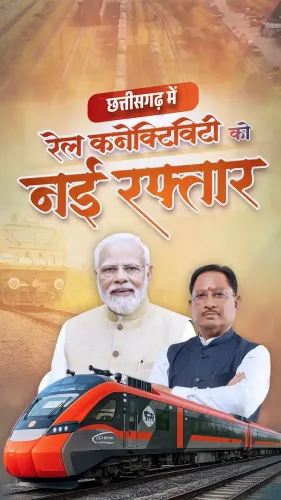
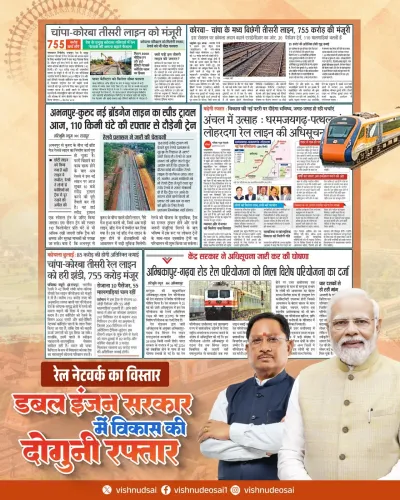
CM Sai thanks PM Modi for ₹755 cr Champa-Korba rail line
Synopsis
Chhattisgarh CM Vishnu Deo Sai has thanked PM Narendra Modi and Railway Minister Ashwini Vaishnaw for sanctioning the ₹755 crore Champa-Korba Third Rail Line Project, set to boost coal freight capacity, passenger services, and industrial growth in the mineral-rich state.
Key Takeaways
The Centre has approved the ₹755 crore Champa-Korba Third Rail Line Project in Chhattisgarh.
CM Vishnu Deo Sai publicly thanked PM Narendra Modi and Railway Minister Ashwini Vaishnaw on 17 June 2026 .
The project will add a third track on the existing Champa-Korba section to raise coal freight throughput and ease passenger congestion.
It aligns with the PM Gati Shakti National Master Plan (2021) and earlier Railway Budget allocations for Chhattisgarh's coal belt corridors.
Key beneficiaries include coal miners, power utilities, rail passengers, and industrial units in the Korba region.
Next steps include a Gazette sanction notification, tendering by South East Central Railway , and land acquisition along the alignment.
Chhattisgarh Chief Minister Vishnu Deo Sai on Wednesday, 17 June 2026, publicly thanked Prime Minister Narendra Modi and Union Railway Minister Ashwini Vaishnaw after the Centre approved the ₹755 crore Champa-Korba Third Rail Line Project, calling it a decisive step toward energy security and regional economic growth in the state.
Context
Posting on X in Hindi, CM Sai conveyed gratitude on behalf of the people of Chhattisgarh — 'प्रदेशवासियों की ओर से हार्दिक आभार' (heartfelt thanks on behalf of the people of the state) — for the sanction of the project. He described the approval as a move that would give 'new momentum to Chhattisgarh's development and the country's energy security.' The post directly tagged both @narendramodi and @AshwiniVaishnaw, signalling a coordinated political acknowledgement of the Centre's decision.
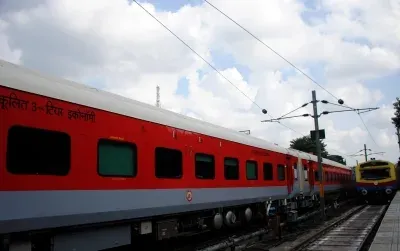
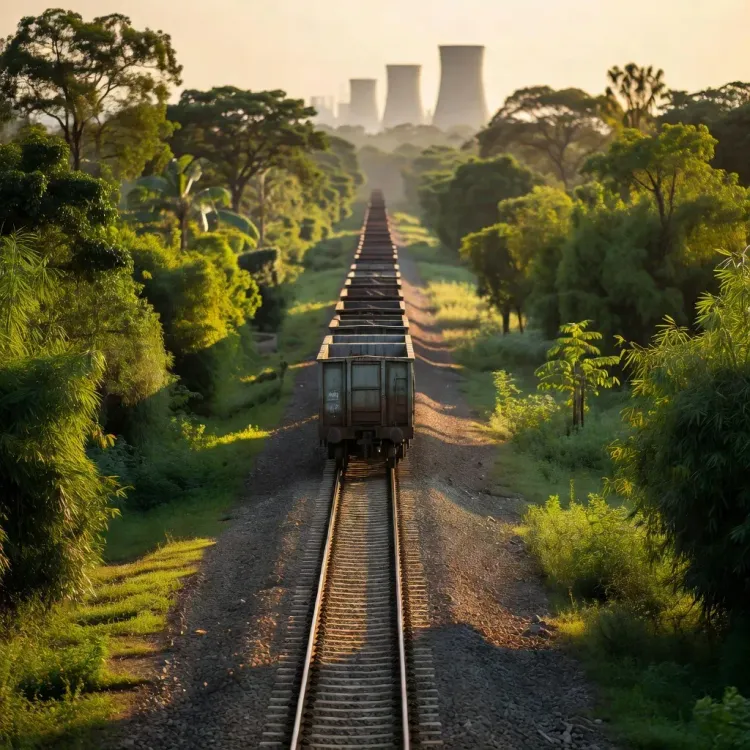
The Champa-Korba corridor in central Chhattisgarh is one of the country's most critical coal-evacuation routes, linking the coal-rich Korba district — home to some of India's largest thermal power plants and open-cast mines — to the broader rail network at Champa. Adding a third line on this section is intended to dramatically raise freight throughput without disrupting passenger services on the existing two tracks.
Policy Backdrop
The project fits within a wider Central Government push to decongest mineral-belt rail corridors. Railway Budget allocations for 2022-23 and 2023-24 earmarked funds for multiple third-line and doubling projects across Chhattisgarh's coal belts to speed up evacuation and reduce logistics costs. The PM Gati Shakti National Master Plan (2021) specifically identified critical rail links in mineral districts for multi-modal logistics optimisation, and the Champa-Korba section has long featured in those planning documents.
Chhattisgarh's rail network also serves as a feeder to the broader freight corridor ecosystem. Successive central governments have treated capacity addition in coal-producing states as a core pillar of national energy security, and this sanction continues that policy lineage under the current administration.
Stakeholders and Impact
The most immediate beneficiaries are coal mining companies and power utilities dependent on the Korba belt, which supplies coal to thermal plants across central and western India. A higher-capacity third line reduces wagon turnaround time and eases the chronic congestion that has historically led to coal shortages at distant power stations.
Rail passengers on the Champa-Korba route also stand to gain: with freight and passenger traffic separated more effectively across three lines, delays caused by slow-moving coal rakes are expected to fall. Industrial units in the region — including aluminium smelters and cement plants that depend on efficient rail logistics — are another key stakeholder group that could see input-cost reductions once the line is operational.
CM Sai framed the project's significance broadly, stating it would strengthen 'coal transport capacity, expand passenger facilities, and provide new strength to industrial development and the regional economy' — linking it explicitly to the twin goals of a 'Viksit Chhattisgarh' (Developed Chhattisgarh) and 'Viksit Bharat' (Developed India).
What's Next
The formal project sanction notification in the Official Gazette and the tendering schedule by the South East Central Railway zone will be the next procedural milestones to watch. Alignment finalisation and land acquisition in the Champa-Korba belt will determine the construction timeline. Any supplementary allocation in the next Union Railway Budget could also accelerate the project's execution phase.
With Chhattisgarh's coal output central to India's power generation capacity, the pace at which this third-line project moves from sanction to ground-breaking will be closely watched by energy planners and state government officials alike.
Point of View
Tagging both the Prime Minister and the Railway Minister, follows a well-established BJP playbook of attributing development wins to the Central leadership while reinforcing the 'double-engine government' narrative. More substantively, the project addresses a genuine logistics bottleneck: Korba's coal output is critical to thermal power capacity across multiple states, and rail congestion there has real consequences for national energy supply. Watchers should track whether this sanction translates to expedited tendering, or joins the queue of approved-but-delayed rail projects in mineral-belt states.
NationPress
18 Sept 2026
Frequently Asked Questions
What is the Champa-Korba Third Rail Line Project?
The Champa-Korba Third Rail Line Project is a ₹755 crore Central Government-approved initiative to add a third track on the existing Champa-Korba railway section in Chhattisgarh, aimed at increasing coal freight capacity and improving passenger services in the region.
Why is the Champa-Korba rail corridor important for India's energy security?
The Korba district in Chhattisgarh is one of India's largest coal-producing regions, supplying fuel to thermal power plants across central and western India. The existing rail corridor is a key evacuation route, and adding a third line will reduce congestion and improve coal supply reliability to power stations.
Who approved the Champa-Korba Third Rail Line Project?
The project was approved by the Central Government. Chhattisgarh CM Vishnu Deo Sai credited Prime Minister Narendra Modi and Union Railway Minister Ashwini Vaishnaw with the sanction in his post on 17 June 2026 .
What is the PM Gati Shakti plan and how does it relate to this project?
The PM Gati Shakti National Master Plan , launched in 2021 , is a Central Government framework for integrated multi-modal infrastructure development. It specifically identifies critical rail links in mineral districts — including Chhattisgarh's coal belt — for logistics optimisation, providing the policy foundation for projects like the Champa-Korba third line.
Who benefits from the Champa-Korba Third Rail Line?
The primary beneficiaries are coal mining companies , thermal power utilities , rail passengers on the Champa-Korba route, and industrial units such as aluminium smelters and cement plants in the Korba region that rely on efficient rail logistics to reduce input costs.