CM Sai Thanks PM Modi for 250 MBBS Seats in 5 New CG Colleges
Synopsis
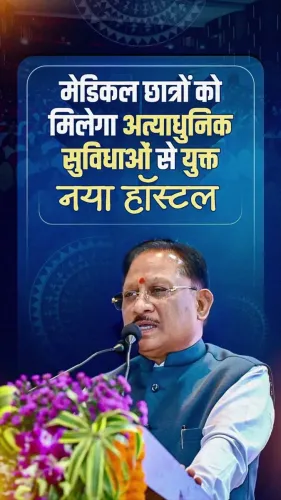
Chhattisgarh has received central approval for 250 new MBBS seats across five government medical colleges. CM Vishnu Deo Sai thanked PM Modi and Health Minister J.P. Nadda, calling it a historic step in expanding medical education in the state.
Key Takeaways
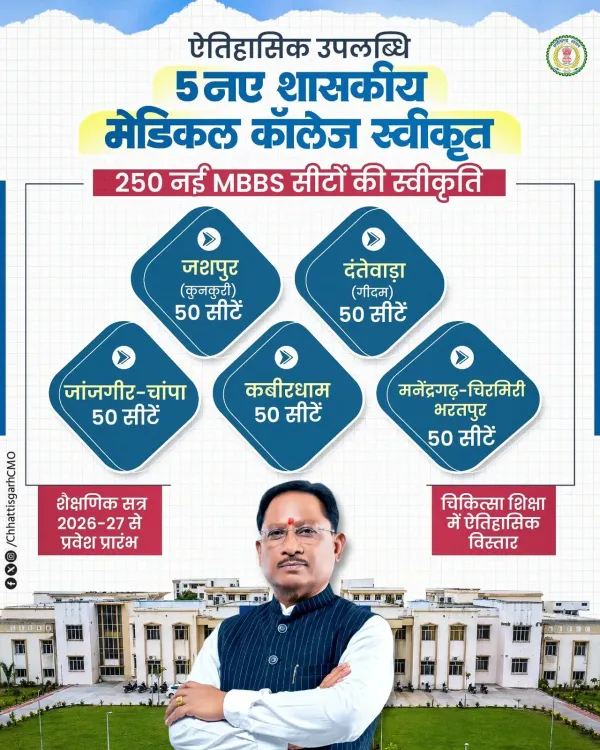
250 new MBBS seats have been approved for Chhattisgarh across five new government medical colleges .
Chief Minister Vishnu Deo Sai publicly credited Prime Minister Narendra Modi and Union Health Minister J.P.
Nadda for the approval.
The expansion aligns with the central government's goal of increasing India's total MBBS capacity from approximately 51,000 to over 1,00,000 seats since 2014.
The Pradhan Mantri Swasthya Suraksha Yojana (PMSSY) and the National Medical Commission Act, 2019 form the policy backbone for such approvals.
Chhattisgarh, with a large tribal and rural population, has historically faced significant doctor shortages — making this expansion particularly consequential.
Construction timelines, faculty recruitment, and first-admission schedules for the five colleges remain to be announced.
The Chief Minister's Office of Chhattisgarh announced on Monday, 13 July 2026 that the state has received approval for 250 new MBBS seats across five new government medical colleges, crediting coordinated efforts between the state and central governments under what the ruling party calls the 'double engine' model.
What Was Announced
The post, shared by the official CMO handle, stated: 'चिकित्सा शिक्षा में नई क्रांति' ('A new revolution in medical education') — announcing that Chhattisgarh has secured sanction for 250 MBBS seats in five new government medical colleges. Chief Minister Vishnu Deo Sai publicly thanked Prime Minister Narendra Modi and Union Health Minister J.P. Nadda for what the CMO described as a 'historic achievement.'Context
Chhattisgarh, a central Indian state formed in 2000, has historically faced acute shortages of doctors and healthcare infrastructure, particularly in its tribal and rural hinterlands. The state's first government medical college was established in Raipur in 1963, with only incremental additions over subsequent decades. The gap between healthcare demand and trained medical professionals has remained a persistent challenge for successive governments. The expansion of MBBS seats aligns with a broader national push since 2014 to roughly double India's total MBBS capacity — from approximately 51,000 seats to over 1,00,000 seats — by establishing new government colleges in states with identified doctor shortages.Policy Backdrop
The approvals are consistent with the framework of the Pradhan Mantri Swasthya Suraksha Yojana (PMSSY), a central scheme launched in 2003 and significantly expanded post-2014 to fund new government medical colleges and tertiary care hospitals in underserved states. The scheme has been a primary vehicle for correcting regional imbalances in medical education across India. The National Medical Commission Act, 2019, which replaced the earlier Medical Council of India, also streamlined the regulatory process for approving new medical colleges and increasing annual seat intake, enabling faster execution of such expansions. States governed by the same party as the centre — including Madhya Pradesh and Uttar Pradesh — have seen accelerated infrastructure clearances and funding releases under this model, a pattern now extending to Chhattisgarh under Chief Minister Sai's administration, which took office in December 2023.Stakeholders and Impact
The most immediate beneficiaries are medical aspirants from Chhattisgarh, who currently face intense competition for a limited number of government MBBS seats within the state. With 250 additional seats across five new institutions, more students from the state — including those from tribal and rural communities — may gain access to affordable medical education without relocating to other states. For rural patients, the long-term implication is significant: doctors trained in government colleges within the state are more likely to serve in local postings, addressing the chronic shortage of qualified physicians in Chhattisgarh's interior districts. The state health department will now face the task of operationalising these colleges, including construction timelines, faculty recruitment, and readiness for first admissions.What's Next
The key milestones to watch include the rollout of construction or infrastructure upgrades at the five designated sites, the recruitment of faculty meeting National Medical Commission norms, and the timeline for first admissions. Any supplementary funding announcements in upcoming central health budgets will determine how quickly these colleges become operational. The CMO's announcement marks the approval stage; the pace of on-ground execution will be the true measure of this expansion's impact.Point of View
Reinforcing party unity while signalling administrative momentum. The timing, coming less than three years into CM Sai's tenure, positions the Chhattisgarh government as an active beneficiary of central health policy rather than a passive recipient. Structurally, the approval fits into a decade-long pattern of using medical college expansion as both a public health intervention and a political signal in states with historically underserved populations. The real test will be whether the five colleges move from sanction to operationalisation at a pace that matches the scale of the announcement.
NationPress
13 Jul 2026
Frequently Asked Questions
How many MBBS seats has Chhattisgarh been approved for in 2026?
Chhattisgarh has received approval for 250 new MBBS seats distributed across five new government medical colleges, as announced by the Chief Minister's Office on 13 July 2026.
Which scheme funds new government medical colleges in India?
The Pradhan Mantri Swasthya Suraksha Yojana (PMSSY) , launched in 2003 and expanded significantly after 2014, is the primary central scheme used to fund new government medical colleges in underserved states like Chhattisgarh.
Who approved the new medical colleges in Chhattisgarh?
The approval came from the central government. Chief Minister Vishnu Deo Sai thanked Prime Minister Narendra Modi and Union Health Minister J.P. Nadda for facilitating the sanction.
What is the 'double engine government' referred to in the Chhattisgarh CMO post?
'Double engine government' ( डबल इंजन सरकार ) is a phrase used by the BJP to describe states where both the state government and the central government are run by the same party, implying faster policy execution and fund releases.
When did Chhattisgarh get its first government medical college?
Chhattisgarh's first government medical college was established in Raipur in 1963 , with only incremental additions over the following decades before the current wave of expansion.