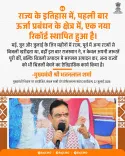
CM Saini Backs Fast-Track Courts for Paper Leak Cases

Synopsis
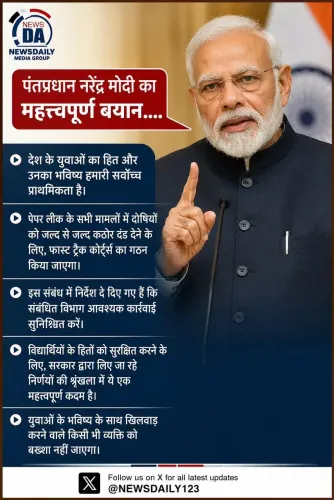
Haryana Chief Minister Nayab Singh Saini on 23 July 2026 endorsed the central government's decision to form fast-track courts for paper leak offences, saying the move will restore trust among millions of hardworking students and send a clear message that those who compromise youth futures will face strict punishment.
Key Takeaways
CM Nayab Singh Saini publicly backed the Centre's decision to establish fast-track courts specifically for paper leak and examination malpractice cases.
He thanked PM Narendra Modi for prioritising youth futures, calling the move a signal that offenders 'will not be spared under any circumstances.' The announcement builds on the Public Examinations (Prevention of Unfair Means) Act, 2024 , which already introduced strict penalties for exam fraud at the national level.
Multiple high-profile paper leaks since 2022 — including in national entrance and state recruitment exams — have made examination integrity a major political and governance issue.
Haryana , with its high density of government-job aspirants, is among the states where credible enforcement would have significant social impact.
Implementation timelines and early conviction rates will determine whether the fast-track court framework delivers meaningful deterrence.
Haryana Chief Minister Nayab Singh Saini on Thursday, 23 July 2026, expressed strong support for the central government's decision to establish fast-track courts for paper leak offences, calling it a firm message that those who tamper with the futures of young aspirants will not be spared.
Posting on X in Hindi, CM Saini thanked Prime Minister Narendra Modi for giving 'the highest priority to the future of youth.' He wrote: 'Papar leak jaise aparadhon par fast track courts ke gathan aur doshiyon ko kathor dand dilaane ka nirnay' — ('The decision to constitute fast-track courts for crimes like paper leaks and to ensure strict punishment for the guilty') — would, he said, strengthen the trust of millions of hardworking students.
Context
The statement comes amid a sustained national conversation about the integrity of competitive examinations in India. Multiple high-profile paper leaks — spanning national entrance tests and state-level recruitment drives since 2022 — have eroded confidence in the examination ecosystem, affecting lakhs of aspirants who spend years preparing for a single opportunity.
CM Saini framed the fast-track court mechanism as a symbol of the government's 'unwavering resolve' to protect a transparent and fair system, and as a mark of respect for honest talent and diligent students.
Policy Backdrop
The central government enacted the Public Examinations (Prevention of Unfair Means) Act, 2024, which introduced stringent penalties and dedicated investigative mechanisms to tackle malpractice in national-level recruitment and entrance examinations. The proposed fast-track courts represent the next layer of that enforcement architecture — expediting trials so that deterrence is credible, not merely legislative.
This legislative trajectory reflects a broader pattern of combining statutory action with accelerated judicial processes to dismantle organised rackets that profit from compromising merit-based selection for government jobs and higher education seats.
Stakeholders and Impact
The primary beneficiaries of effective enforcement are India's millions of competitive exam aspirants — students preparing for government recruitment tests, medical entrance examinations, and civil services. For many families, especially in states like Haryana with a strong tradition of government-job aspirations, a single leaked paper can invalidate years of preparation and financial sacrifice.
Organised paper-leak networks, coaching mafias, and corrupt examination officials stand to face faster legal consequences if the fast-track court framework is operationalised efficiently across states. Civil society groups advocating exam reform have long demanded precisely this kind of judicial speed.
What's Next
Attention will now turn to the implementation timelines for fast-track courts across states, and whether Haryana issues any state-specific notifications or rules in alignment with the central decision. Conviction rates in pending paper-leak cases — and the conduct of subsequent examination cycles — will be the real test of whether the measure delivers the deterrence CM Saini has promised on behalf of the government.
If fast-track courts become operational and yield early convictions, the political and policy dividend for the BJP-led government could be significant, reinforcing its positioning as a protector of youth opportunity ahead of future electoral cycles.
Point of View
Which has historically been the missing link in India's anti-corruption enforcement chain. For the BJP, this messaging serves a dual purpose: it reassures an anxious aspirant class and pre-empts Opposition narratives that the party failed students during the NEET and recruitment exam controversies. The real measure of success, however, will be operational — how quickly courts are constituted and whether they produce convictions that the public can see.
NationPress
23 Jul 2026
Frequently Asked Questions
What are fast-track courts for paper leak cases in India?
Fast-track courts are specially designated judicial benches designed to hear and decide cases at an accelerated pace. In the context of paper leaks, they would hear criminal cases against accused individuals — including exam officials, middlemen, and organised networks — faster than ordinary courts, making punishment more certain and timely.
What is the Public Examinations (Prevention of Unfair Means) Act, 2024?
The Public Examinations (Prevention of Unfair Means) Act, 2024 is a central law that introduced strict penalties, including imprisonment and heavy fines, for malpractices such as paper leaks, impersonation, and tampering in national-level recruitment and entrance examinations. It also set up dedicated investigative mechanisms to probe such offences.
Why did CM Nayab Singh Saini praise PM Modi on paper leak courts?
CM Saini praised PM Modi for the government's decision to establish fast-track courts for paper leak offences, saying it prioritises the futures of millions of hardworking students and sends a clear message that those who compromise youth opportunities will face strict punishment.
Which exams have been affected by paper leaks in India?
Since 2022 , several high-profile examinations have been affected, including the NEET medical entrance test and various state-level government recruitment exams. These incidents triggered widespread protests and demands for systemic reform of India's examination infrastructure.
What happens next after the fast-track court decision for paper leaks?
The key steps to watch include the formal notification and operationalisation of fast-track courts across states, any Haryana-specific rules that follow, and the progress of pending paper-leak cases. Conviction rates in early trials will be the clearest indicator of whether the mechanism achieves its stated deterrence goals.