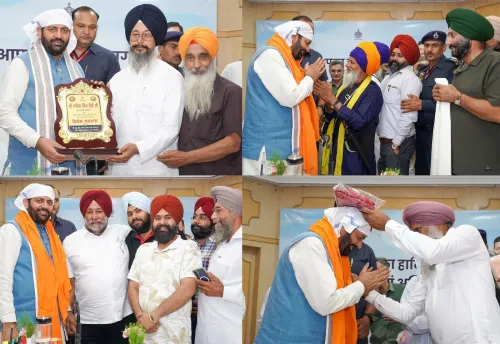
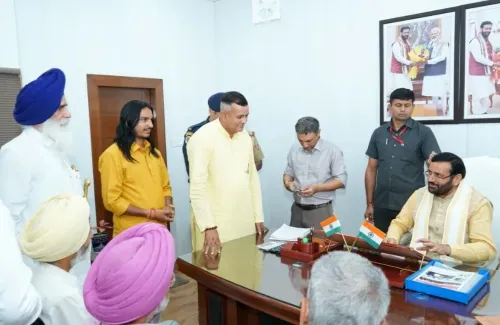
CM Saini pledges govt jobs for 121 families hit by 1984 riots
Synopsis
Haryana Chief Minister Nayab Singh Saini has announced government employment for 121 families affected by the 1984 anti-Sikh riots, framing the move as a state duty to restore dignified livelihoods — days before the 42nd anniversary of the violence.
Key Takeaways
121 families affected by the 1984 anti-Sikh riots are to receive government jobs under the Haryana government's rehabilitation drive.
CM Nayab Singh Saini described the measure as a duty of his administration to provide a 'dignified life' to riot-affected families.
The announcement came on 24 October 2026 , days before the 42nd anniversary of the riots on 31 October.
Employment-based rehabilitation goes beyond one-time ex-gratia payments, offering affected families stable, long-term economic standing.
The Nanavati Commission (2005) had earlier prompted central government compensation packages, but full rehabilitation has remained a long-standing demand.
Rollout details — departments, timelines, and post grades — are yet to be formally notified by the Haryana government.
Forty-two years after the violence that scarred thousands of Sikh families across northern India, Haryana Chief Minister Nayab Singh Saini has declared it his government's duty to restore dignity to those still living in its shadow — announcing government employment for 121 families affected by the 1984 anti-Sikh riots.
Posting on Saturday, 24 October 2026, Saini wrote in Hindi: '1984 ke dangon se prabhavit 121 parivaaron ko sarkari naukri dekar sammanjanaka jeevan ka avsar dena hamari sarkar ka kartavya hai' — 'It is our government's duty to give 121 families affected by the 1984 riots the opportunity to lead a dignified life by providing them government employment.'The wounds of 1984 and decades of reckoning
The 1984 anti-Sikh riots erupted in the aftermath of Prime Minister Indira Gandhi's assassination on 31 October 1984, unleashing targeted violence primarily in Delhi and parts of northern India that killed thousands. Haryana, which borders Delhi and holds a significant Sikh population, counted among the states where families bore lasting economic and social devastation.
Successive central and state governments have attempted rehabilitation over four decades — ex-gratia payments, housing assistance, and employment provisions have all been deployed at various points. The Nanavati Commission report of 2005 prompted a fresh round of central government compensation and relief commitments, yet advocates for riot-affected communities have long argued that full rehabilitation remains incomplete.
A targeted employment push in Haryana
What makes Saini's announcement specific is the number: 121 families, each to receive a government job as a pathway to economic independence. Employment — rather than a one-time payment — represents a qualitatively different form of rehabilitation, offering stable income and, crucially, formal social standing within the state machinery.
Haryana has been one of several states to periodically extend employment and welfare packages to riot-affected Sikh families, but the direct naming of a headcount signals an intent to track and close the commitment. The rollout details — which departments, which timeline, which grade of posts — remain to be formally notified.
Saini's political calculation and the Sikh electorate
Chief Minister Saini, who took office in March 2024, leads a state with a politically engaged Sikh community concentrated in districts such as Ambala, Kurukshetra, and Panchkula. Rehabilitating 1984 riot survivors carries both a moral weight and an unmistakable electoral resonance ahead of future state cycles. The BJP has consistently sought to position itself as the party that delivers for communities historically neglected in the post-1984 accountability framework.
The announcement lands in the final week of October — days before the 42nd anniversary of the riots on 31 October — a timing that amplifies its commemorative dimension.
Government jobs for 121 families will not close the chapter on 1984. But for those families, a payslip from the state is a tangible signal that the reckoning, however delayed, has not been entirely abandoned.
Point of View
The Haryana government is making a verifiable, trackable promise — which raises the political stakes if delivery lags. Coming days before the 42nd anniversary of the riots, the timing is calibrated to resonate with Haryana's Sikh electorate. The deeper question is whether this represents a new, comprehensive policy framework or a targeted gesture ahead of the commemorative cycle.
NationPress
25 Oct 2026
Frequently Asked Questions
What did Haryana CM Nayab Singh Saini announce for 1984 riot victims?
CM Nayab Singh Saini announced that his government will provide government jobs to 121 families affected by the 1984 anti-Sikh riots , calling it the administration's duty to give them a dignified life.
What were the 1984 anti-Sikh riots?
The 1984 anti-Sikh riots were widespread communal violence that broke out following the assassination of Prime Minister Indira Gandhi on 31 October 1984 , resulting in thousands of deaths primarily targeting Sikhs in Delhi and northern India, including parts of Haryana.
Has the government provided relief to 1984 riot victims before?
Yes. Central and state governments have offered rehabilitation packages since the mid-1980s, including ex-gratia payments and housing assistance. The Nanavati Commission report of 2005 prompted a fresh round of central government relief measures.
Why are government jobs considered significant rehabilitation for riot victims?
Unlike one-time cash payments, a government job provides stable, long-term income and formal social standing, addressing both the economic and dignitary dimensions of rehabilitation for families who lost breadwinners in 1984.
When did Nayab Singh Saini become Haryana Chief Minister?
Nayab Singh Saini assumed office as Chief Minister of Haryana in March 2024 . He is a leader of the Bharatiya Janata Party (BJP) .