CM Saini urges Haryana to ditch plastic bags on July 3
Synopsis
Haryana Chief Minister Nayab Singh Saini marked International Plastic Bag Free Day on 3 July 2026 by urging citizens to replace plastic carry bags with paper or cloth alternatives, framing the individual switch as a meaningful step toward a clean, green and plastic-free future.
Key Takeaways
Nayab Singh Saini , Chief Minister of Haryana , posted his appeal on 3 July 2026 , coinciding with International Plastic Bag Free Day .
He called on citizens to use paper or cloth bags in place of plastic carry bags for both household use and market visits.
The Central government banned 19 single-use plastic items nationwide from 1 July 2022 under the amended Plastic Waste Management Rules.
The Plastic Waste Management Rules were first notified in 2016 , establishing extended producer responsibility across states.
Key stakeholders include urban households , retail traders , and municipal bodies responsible for enforcement in Haryana.
Monsoon-season enforcement drives are expected to follow, as plastic waste is a leading cause of urban drain blockages in Indian cities.
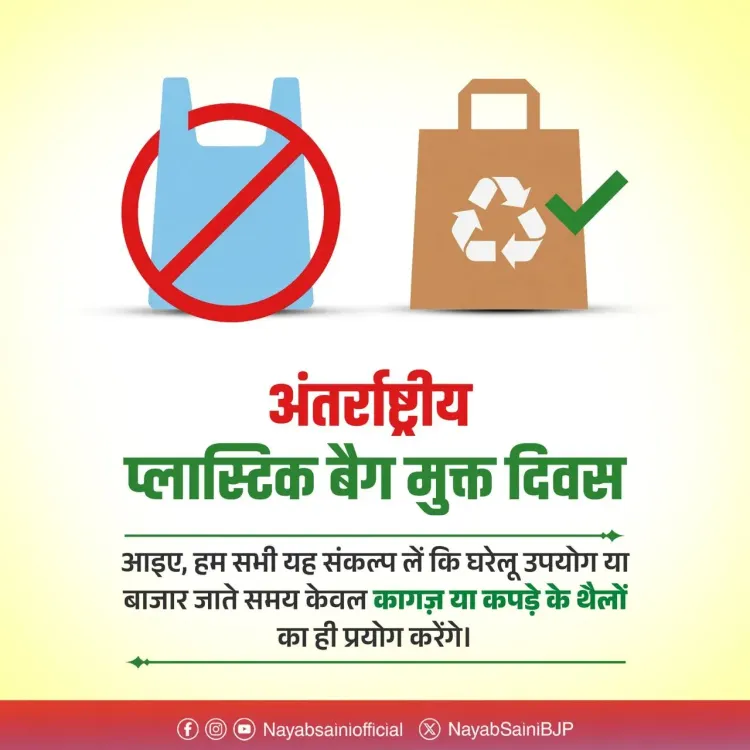
Haryana Chief Minister Nayab Singh Saini on Friday, 3 July 2026, marked International Plastic Bag Free Day by calling on citizens across the state to replace plastic carry bags with paper or cloth alternatives — both at home and while shopping in markets.
In his post, Saini wrote: 'अंतर्राष्ट्रीय प्लास्टिक बैग मुक्त दिवस के अवसर पर आइए, हम सभी यह संकल्प लें...' ('On the occasion of International Plastic Bag Free Day, let us all resolve that whether for household use or while going to the market, we will use paper or cloth bags instead of plastic bags.')
He added that 'this small effort of ours will prove to be a major contribution towards environmental protection and will play an important role in building a clean, green and plastic-free future.'
Context
International Plastic Bag Free Day is observed every year on 3 July to spotlight the environmental damage caused by single-use plastic bags and to promote sustainable alternatives. The observance is recognised globally and has gained traction in India as governments at both the central and state levels intensify their push against plastic waste.
Saini, who took office as Haryana's Chief Minister in March 2024, leads a BJP-governed state that borders Delhi — one of India's most pollution-stressed urban corridors. Public messaging by state leaders on designated environment days has become a recurring tool to reinforce civic compliance with waste-reduction norms.
Policy Backdrop
The Central government notified the Plastic Waste Management Rules in 2016, establishing extended producer responsibility and state-level enforcement mechanisms. Building on that framework, a nationwide ban on 19 identified single-use plastic items came into force on 1 July 2022 under amended rules — covering items such as plastic carry bags below a specified thickness, cutlery, straws, and wrapping films.
Indian states have progressively tightened restrictions on plastic carry bags through executive orders and municipal bylaws since the mid-2010s. These measures align with India's commitments under the Swachh Bharat Mission and international sustainable-development targets on marine litter and waste reduction.
Stakeholders and Impact
Urban households, retail traders, and municipal bodies in Haryana are the primary audiences for Saini's appeal. For traders, the shift away from plastic bags carries a cost implication — paper and cloth bags are more expensive per unit — making sustained public messaging important to normalise the transition.
Municipal bodies bear the enforcement burden: monitoring market compliance, organising collection drives, and penalising repeat violators. Awareness campaigns tied to calendar observances such as International Plastic Bag Free Day help municipalities amplify outreach without additional budgetary spend.
What's Next
State-level enforcement drives typically intensify ahead of the monsoon season, when clogged drains — often blocked by plastic waste — cause urban flooding. Haryana's municipal and pollution-control authorities are expected to ramp up market inspections in the weeks following the July observance.
Nationally, the focus will remain on tightening extended producer responsibility targets for plastic packaging and raising the minimum thickness threshold for permissible carry bags. How effectively state governments like Haryana translate high-visibility public pledges into ground-level enforcement will determine whether India's plastic-reduction targets remain on track.
Point of View
Allowing a state executive to reinforce federal policy without committing to new, verifiable enforcement targets. For a BJP-governed state keen to project a 'green' image alongside its development narrative, such messaging serves a dual purpose: it signals environmental seriousness to urban, educated voters while avoiding the friction that stricter enforcement action against traders would generate. The real test will be whether the rhetorical push on 3 July translates into measurable compliance data from Haryana's municipal bodies before the monsoon.
NationPress
3 Jul 2026
Frequently Asked Questions
What is International Plastic Bag Free Day and when is it observed?
International Plastic Bag Free Day is a global observance held every year on 3 July to highlight the environmental harms of single-use plastic bags and encourage the use of sustainable alternatives such as cloth or paper bags.
What did Haryana CM Nayab Singh Saini say on Plastic Bag Free Day 2026?
Nayab Singh Saini urged citizens to resolve to use paper or cloth bags instead of plastic carry bags — whether at home or while shopping — saying the small individual effort would make a major contribution to building a clean, green and plastic-free future.
Is plastic banned in Haryana?
Under the Central government's amended Plastic Waste Management Rules , 19 single-use plastic items have been banned across India since 1 July 2022 , and this applies in Haryana. State and municipal authorities are responsible for enforcement within the state.
What is India's single-use plastic ban?
India banned 19 categories of single-use plastic items — including thin carry bags, plastic cutlery, straws, and wrapping films — from 1 July 2022 under the amended Plastic Waste Management Rules, which also mandate extended producer responsibility for plastic packaging.
Why do Indian leaders post about environment days?
Public messaging on designated environment days is a recognised tool for state governments to reinforce compliance with waste-reduction laws, align with national missions like Swachh Bharat , and signal environmental commitment to citizens without requiring new legislative action.