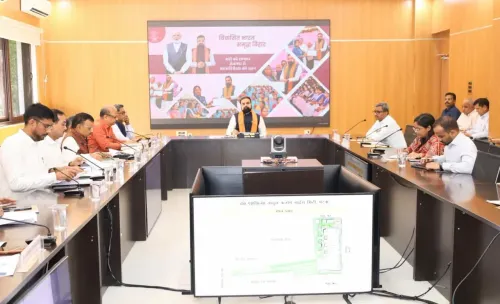
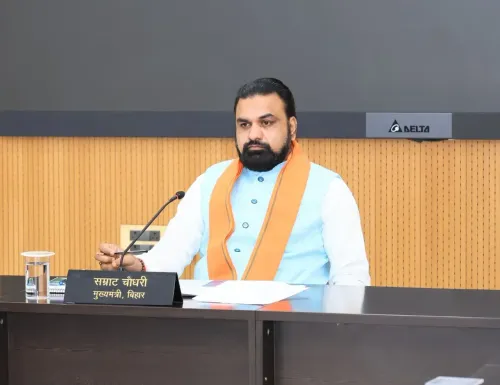
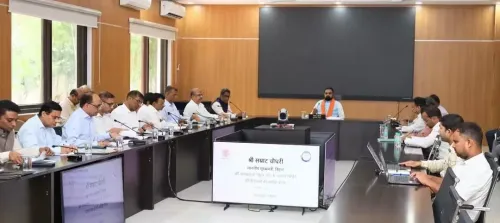
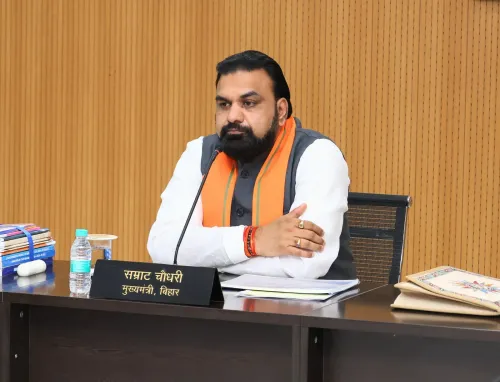
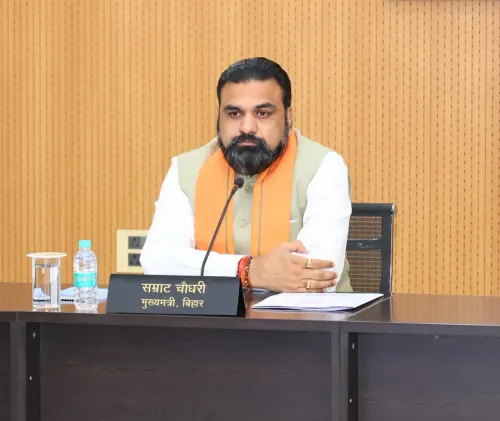
CM Samrat Choudhary extends Bihar's 7th Finance Commission to 2027

Synopsis
Bihar CM Samrat Choudhary announces three cabinet decisions: extending the Seventh State Finance Commission to March 2027, simplifying local body and scholarship processes, and presenting audit reports to the legislature — reinforcing the state's governance and accountability framework.
Key Takeaways
Bihar cabinet has extended the Seventh State Finance Commission 's term to 31 March 2027 , ensuring continuity in fiscal devolution recommendations for local bodies.
Administrative processes for local bodies (Panchayati Raj institutions and urban local bodies) are being streamlined to cut delivery bottlenecks.
Procedures governing Bihar government scholarship schemes will be simplified, targeting faster disbursement for students.
Various audit reports will be formally presented before the Bihar Legislature (Vidhan Mandal) , strengthening legislative financial oversight.
CM Samrat Choudhary framed the decisions under the banner of 'good governance, transparency and accountability.' State Finance Commissions are constitutionally mandated under Article 243-I of the Indian Constitution, introduced by the 73rd Constitutional Amendment .
Three decisions. One clear signal. Bihar Chief Minister Samrat Choudhary on Wednesday, 18 November 2026, announced a cluster of cabinet approvals aimed squarely at tightening governance — extending a key constitutional body's mandate, simplifying welfare delivery, and strengthening legislative oversight of public money.
Posting on X in Hindi, the Chief Minister declared: 'An important decision in the direction of strengthening good governance, transparency and accountability — the government has approved extending the term of the Seventh State Finance Commission to 31 March 2027, simplifying processes related to local bodies and scholarship schemes, and tabling various audit reports in the legislature.'
Why the Seventh State Finance Commission extension matters
State Finance Commissions are not optional — they are constitutionally mandated under Article 243-I, introduced by the 73rd Constitutional Amendment, to periodically review and recommend how state funds flow down to panchayats and urban local bodies. Bihar has constituted successive commissions since the 1990s. Extending the Seventh Commission's term to March 2027 ensures this fiscal devolution architecture stays intact and functional rather than lapsing into a gap period that could stall recommendations on local body funding.
For the state's vast network of Panchayati Raj institutions and urban local bodies, continuity of a functioning finance commission is directly tied to how predictably funds reach the ground level — from road repair budgets in gram panchayats to sanitation grants in municipal boards.
Scholarship processes simplified, red tape reduced
The second strand of the cabinet package targets scholarship schemes — student welfare programmes administered by the Bihar government. Procedural complexity has historically been a friction point, causing delays in disbursement that fall hardest on students from economically weaker sections who depend on timely payouts. Streamlining these procedures is a direct intervention in that last-mile problem.
The same logic applies to the simplification of administrative processes for local bodies. Fewer procedural hurdles mean faster clearances, faster spending, and faster delivery of civic services — the unglamorous plumbing of governance that determines whether a scheme actually reaches a beneficiary.
Audit reports headed to the Bihar Vidhan Mandal
The third decision — presenting various audit reports before the Bihar Legislature — may be the most structurally significant. Tabling audit findings in the Vidhan Mandal is a standard legislative oversight mechanism, but its value lies in regularity and completeness. By formally placing these reports before lawmakers, the government opens its expenditure record to scrutiny, reinforcing the accountability framework that underpins any claim to transparent governance.
Taken together, the three moves mirror a pattern visible across several Indian states: using institutional housekeeping — commission extensions, procedural rationalisations, audit disclosures — to signal administrative seriousness without waiting for a flagship launch or a budget cycle.
The next test will be in the Vidhan Mandal session itself, where the quality and candour of those tabled audit reports will reveal how deep the accountability commitment actually runs.
Point of View
While audit tabling and procedural simplification give the government a defensible transparency record. For CM Samrat Choudhary, anchoring his public messaging around 'good governance' rather than welfare announcements reflects a BJP-aligned administrative identity built on process and accountability. The real indicator will be follow-through: whether simplified scholarship procedures translate to measurably faster disbursements, and whether the tabled audit reports are substantive enough to invite genuine legislative scrutiny.
NationPress
18 Nov 2026
Frequently Asked Questions
What is the Seventh State Finance Commission of Bihar?
The Seventh State Finance Commission is a constitutional body set up under Article 243-I of the Indian Constitution to recommend how state funds should be devolved to local bodies such as panchayats and urban local bodies in Bihar. Its term has now been extended to 31 March 2027 .
Why did Bihar extend the State Finance Commission term?
The Bihar cabinet extended the Seventh State Finance Commission's term to ensure continuity in fiscal devolution recommendations, preventing a gap period that could disrupt funding flows to Panchayati Raj institutions and urban local bodies across the state.
What scholarship schemes are being simplified by the Bihar government?
The Bihar cabinet has approved simplification of procedural requirements for state-administered scholarship schemes that benefit students, particularly those from economically weaker sections, aiming to reduce delays in disbursement.
What audit reports will be tabled in the Bihar Vidhan Mandal?
The Bihar cabinet has approved the presentation of various audit reports before the Bihar Legislature (Vidhan Mandal) as part of the state's legislative financial oversight mechanism. Specific details of which reports will be tabled have not yet been disclosed.
What is Article 243-I and why does it matter for Bihar?
Article 243-I, introduced by the 73rd Constitutional Amendment, mandates every state to constitute a Finance Commission every five years to review and recommend fiscal transfers to local bodies. It is the legal backbone of Bihar's State Finance Commission and directly governs how funds reach panchayats and urban local bodies.