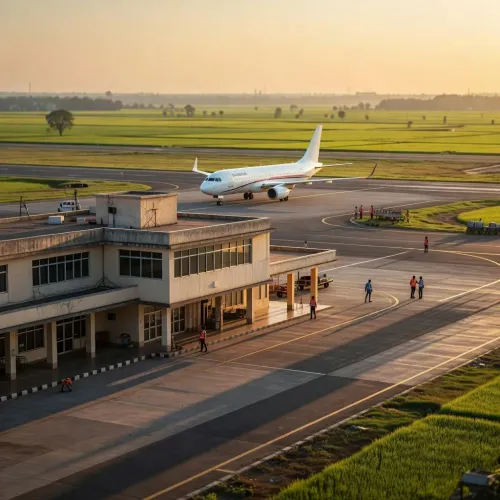
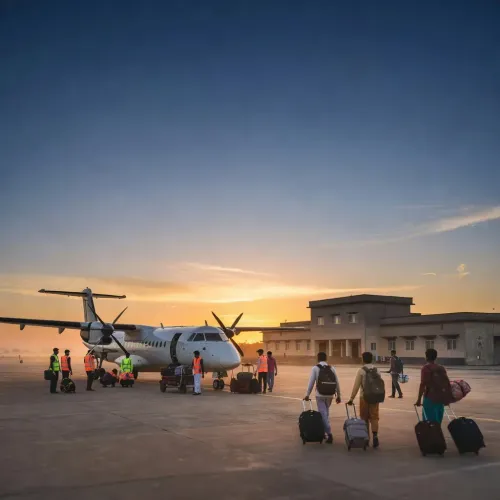
CM Samrat Choudhary Flags Off Gaya–Bangkok International Flight

Synopsis
Bihar CM Samrat Choudhary flagged off the first international flight linking Gaya Ji to Bangkok on October 26, 2026, opening a direct air corridor for Buddhist pilgrims and positioning Bodh Gaya as an accessible global heritage destination.
Key Takeaways
Bihar CM Samrat Choudhary presided over the flag-off of the first international flight between Gaya Ji and Bangkok on October 26, 2026 .
Gaya is adjacent to Bodh Gaya , one of Buddhism's holiest sites, drawing pilgrims primarily from Thailand and Southeast Asia.
The new route eliminates the need for Buddhist pilgrims to transit through Delhi or Kolkata to reach the Buddhist circuit.
The launch builds on years of airport upgrades at Gaya under the UDAN scheme (launched 2016 ), which targets regional airport development.
The route aligns with the Ministry of Civil Aviation 's push to make tier-2 heritage-city airports international gateways.
Passenger traffic and load factor data in coming months will determine whether additional Southeast Asian cities are added to Gaya's international network.
A Buddhist pilgrimage city in the heart of Bihar just got a direct runway to Southeast Asia. Bihar Chief Minister Samrat Choudhary on Monday, October 26, 2026, presided over the flag-off ceremony for the first-ever international flight connecting Gaya Ji to Bangkok, Thailand — a route that could reshape how the world's Buddhist faithful reach one of their most sacred destinations.
Gaya Ji's moment on the global aviation map
Gaya, the city that sits adjacent to Bodh Gaya — where the Buddha is said to have attained enlightenment — has long drawn pilgrims from Thailand, Myanmar, Sri Lanka, and across Southeast Asia. Until now, those travellers had to route through major metros like Delhi or Kolkata. A direct Gaya–Bangkok connection collapses that detour entirely.
Bangkok is not just Thailand's capital; it is the primary aviation gateway for Buddhist Southeast Asia. Millions of Thai pilgrims undertake the Buddhist circuit — Bodh Gaya, Sarnath, Kushinagar, Lumbini — every year. A non-stop link makes Gaya airport the front door of that circuit rather than an afterthought on an already-long journey.
Riding the UDAN arc — and stepping beyond it
India's UDAN (Ude Desh ka Aam Naagrik) scheme, launched in 2016, was designed to bring regional airports like Gaya's into the national aviation mainstream. The work of upgrading terminals, extending runways, and adding domestic capacity has been incremental but consistent. Today's flag-off represents the next logical leap: from domestic connectivity to a live international route.
This move fits a broader Ministry of Civil Aviation push to activate tier-2 city airports as international gateways, particularly at religious heritage sites. Gaya airport has received infrastructure upgrades in recent years specifically oriented toward the Buddhist circuit tourism market. A Bangkok route is the most commercially natural first step — Thailand's Buddhist population runs into the tens of millions, and government-to-government tourism ties between India and Thailand have been deepening steadily.
What this means for Bihar's tourism economy
Bihar holds an extraordinary concentration of Buddhist, Hindu, and Jain heritage — yet it has historically punched below its weight in international tourist arrivals. Direct international air access is one of the most reliable levers for changing that calculus. Fewer layovers mean fewer drop-offs; easier access translates directly into longer stays and higher spending in the local economy.
The tourism sector, local hospitality businesses, and the Buddhist pilgrimage infrastructure around Bodh Gaya are the immediate beneficiaries. Passenger load factors and occupancy data in the months ahead will quickly tell whether this route has the organic demand to sustain and expand — and whether other Southeast Asian cities, from Colombo to Yangon, follow Bangkok onto the Gaya timetable.
One direct flight does not transform a regional economy overnight. But it does open a door that has been latched for decades — and today, in Gaya Ji, that door swung open.
Point of View
Not just heritage brochures. For CM Samrat Choudhary, the optics are strong: delivering tangible infrastructure on a pilgrimage-economy promise ahead of what remains a competitive electoral cycle in Bihar. The move also reinforces New Delhi's 'Act East' tourism diplomacy, using religious soft power to deepen India-ASEAN ties in a domain — Buddhist heritage — where India holds an unmatched natural advantage. Whether the route generates the passenger volume to sustain and scale is the real test, and the numbers over the next two to three quarters will define the policy verdict.
NationPress
26 Oct 2026
Frequently Asked Questions
What is the new flight between Gaya and Bangkok?
It is the first direct international flight connecting Gaya Ji airport in Bihar to Bangkok, Thailand , flagged off on October 26, 2026 by Bihar CM Samrat Choudhary. The route gives Buddhist pilgrims a non-stop air link to one of India's holiest Buddhist sites.
Why is Gaya Ji important for Buddhist pilgrims?
Gaya Ji is located next to Bodh Gaya , the site where the Buddha is believed to have attained enlightenment under the Bodhi Tree. It is one of the four most sacred sites in Buddhism and draws millions of pilgrims — particularly from Thailand, Myanmar, and Sri Lanka — every year.
What is the UDAN scheme and how does it relate to Gaya airport?
The UDAN (Ude Desh ka Aam Naagrik) scheme was launched in 2016 to improve air connectivity at regional and underserved airports across India, including in Bihar. Gaya airport has received incremental upgrades under this framework, eventually enabling it to handle international routes like the new Bangkok service.
Who flagged off the Gaya-Bangkok flight?
Bihar Chief Minister Samrat Choudhary presided over and flagged off the inaugural Gaya–Bangkok international flight ceremony on October 26, 2026 .
Will more international routes be added from Gaya airport?
No additional routes have been officially announced yet. Aviation analysts are watching passenger load data on the Bangkok route closely; strong demand could prompt services to other Buddhist-majority cities such as Colombo, Yangon, or Kathmandu.