CM Samrat Choudhary extends Jivitputrika Vrat wishes
Synopsis
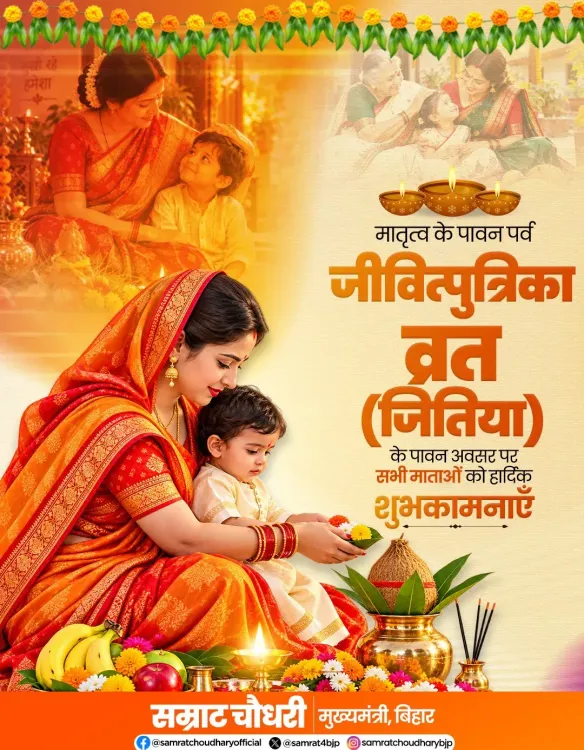
Bihar Chief Minister Samrat Choudhary marked Jivitputrika Vrat (Jitiya) on October 3, 2026, with a warm message honouring mothers who observe the rigorous fast for their children's long life, wishing all families happiness, peace, and prosperity.
Key Takeaways
Bihar CM Samrat Choudhary posted Jivitputrika Vrat (Jitiya) greetings on October 3, 2026 .
Jivitputrika Vrat is a rigorous nirjala (no food, no water) fast observed by mothers for the longevity of their children.
The festival is especially significant in Bihar, Jharkhand, and parts of Uttar Pradesh .
Choudhary's message invoked themes of maternal love, sacrifice, and the unbreakable bond between mother and child.
He wished all mothers and children happiness, peace, and prosperity on the occasion.
On the morning of Jivitputrika Vrat (Jitiya) — the deeply revered fast that mothers observe without food or water to pray for the long life of their children — Bihar Chief Minister Samrat Choudhary extended heartfelt greetings to mothers across the state and beyond.
In his post, the Chief Minister wrote: 'ममता, त्याग और संतान की दीर्घायु की कामना का पावन पर्व जीवित्पुत्रिका व्रत (जितिया) के अवसर पर सभी माताओं को हार्दिक शुभकामनाएं।' — 'On the auspicious occasion of Jivitputrika Vrat (Jitiya), the sacred festival of love, sacrifice, and a mother's prayer for her child's long life, I extend heartfelt greetings to all mothers.'
The fast that defines Bihar's maternal devotion
Jivitputrika Vrat, popularly known as Jitiya, is one of the most demanding and emotionally resonant festivals observed predominantly in Bihar, Jharkhand, and parts of Uttar Pradesh. Mothers observe a rigorous nirjala fast — no food, no water — across a full day and night, in prayer for the health, prosperity, and longevity of their children. The festival follows the lunar calendar and falls in the month of Ashwin.
CM Choudhary added that 'the sacred bond of love between a mother and her child must remain unbroken always, and may happiness, peace, and prosperity fill the lives of all mothers and their children.' The sentiment struck at the heart of what Jitiya represents: an act of pure selfless devotion, with no material ask — only a mother's wish that her child outlives her sorrows.
Why the occasion carries weight in Bihar's public life
For a state with deep rural roots and a strong tradition of folk festivals, Jitiya is not a peripheral observance — it is central to the social and spiritual fabric of millions of households. Political leaders in Bihar routinely mark the occasion, but Choudhary's message, posted early on Saturday, October 3, 2026, was among the first to circulate widely, underscoring the festival's place in mainstream public discourse.
The Chief Minister's note closed with a collective wish: that every mother and child live in 'sukh, shanti evam samridhi' — 'happiness, peace, and prosperity.' In a state where mothers are often the invisible load-bearers of family resilience, that three-word blessing carries a weight beyond ceremony.
Point of View
Particularly women in rural households. Chief Minister Choudhary's early-morning post signals the BJP's continued effort to stay embedded in Bihar's folk-festival calendar, a space where political capital and community trust are built quietly. In a state where women's voter turnout has consistently risen, acknowledging a festival centred entirely on maternal sacrifice is a soft but deliberate act of outreach. The message is ceremonial in form but politically textured in its timing and reach.
NationPress
3 Oct 2026
Frequently Asked Questions
What is Jivitputrika Vrat or Jitiya?
Jivitputrika Vrat, commonly called Jitiya, is a strict nirjala fast — no food or water — observed by mothers, primarily in Bihar, Jharkhand, and parts of Uttar Pradesh, for the long life and well-being of their children. It falls in the Hindu month of Ashwin.
When is Jitiya 2026?
In 2026, Jivitputrika Vrat (Jitiya) falls on October 3 , as observed by Bihar Chief Minister Samrat Choudhary's greetings posted that morning.
Who is Samrat Choudhary?
Samrat Choudhary is the Chief Minister of Bihar and a senior leader of the Bharatiya Janata Party (BJP). He leads the state government and regularly engages with public occasions through social media.
What did Bihar CM Samrat Choudhary say on Jitiya 2026?
CM Choudhary extended heartfelt greetings to all mothers, praying that the sacred bond between mother and child remain unbroken and that all families be blessed with happiness, peace, and prosperity.
Why do mothers observe Jitiya fast?
Mothers observe the Jitiya fast as an act of selfless devotion and sacrifice, praying specifically for the longevity, health, and prosperity of their children. It is considered one of the most demanding fasts in the Hindu calendar.