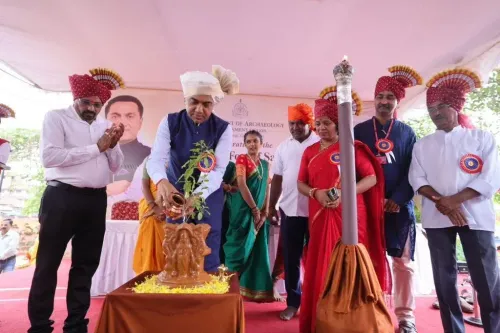
CM Sawant Flags Saptakoteshwar Temple Revival in Goa Heritage Push

Synopsis
Goa Chief Minister Pramod Sawant has highlighted the revival of the ancient Shree Saptakoteshwar Temple — displaced during Portuguese colonial rule — as a flagship example of the state's ongoing historical and cultural heritage restoration effort.
Key Takeaways
CM Pramod Sawant announced Goa's active restoration of historical and cultural heritage on 22 November 2026 .
The Shree Saptakoteshwar Temple in Narve, Goa , is a central project in this initiative.
The temple dates to the Kadamba period and was relocated in the 16th century to protect it from Portuguese colonial demolitions.
Goa has pursued temple conservation as a cultural policy priority since liberation in 1961 .
Specific funding, scope, and timelines for the revival have not yet been officially disclosed.
Stakeholders include Goan devotees, heritage conservationists, and the state's tourism sector.
A thousand years of Goan devotion are being written back into stone. Goa Chief Minister Pramod Sawant announced on Sunday, 22 November 2026 that the state is actively restoring and preserving its historical and cultural heritage, citing the revival of the iconic Shree Saptakoteshwar Temple as a centrepiece of that effort.
A Temple Displaced by Colonial History
The Shree Saptakoteshwar Temple, dedicated to Lord Shiva, is one of Goa's most storied shrines. Its origins trace back to the Kadamba period — a dynasty that ruled the region over a millennium ago — making it among the oldest living institutions of Goan Hindu identity. When Portuguese colonial authorities tightened their grip in the 16th century, the deity was relocated from its original seat to Narve in a bid to protect it from demolition, a fate that befell dozens of temples across the territory.
That act of preservation by devotees centuries ago now frames CM Sawant's current initiative as a continuation of an interrupted story — not a new chapter, but a reclamation.
Goa's Post-Liberation Temple Conservation Arc
Since Goa's liberation in 1961, successive state administrations have periodically backed the restoration of pre-colonial temples as a point of cultural policy. The layered heritage of the state — blending indigenous Hindu traditions with Portuguese colonial architecture — has made such conservation both politically resonant and genuinely complex. Structures that survived colonial rule often did so in compromised or relocated forms, requiring not just physical repair but historical reconstruction.
Under BJP leadership in Panaji, these efforts have been framed as part of a broader civilisational revival — aligning with national conversations about reclaiming pre-colonial identity. The Saptakoteshwar project fits neatly into that arc.
What the Revival Means Beyond the Shrine
Heritage conservationists, Goan devotees, and the tourism sector all have stakes in this initiative. For pilgrims, the temple carries deep spiritual weight that transcends its physical structure. For conservationists, it represents a test case for how the state balances authenticity with restoration. And for Goa's tourism economy, a fully revived heritage site at this scale adds a credible cultural anchor to a destination often reduced to its beaches.
The specific scope, funding envelope, and project timeline have not been officially detailed, and the precise milestones remain to be disclosed — likely through future assembly sessions or tourism department statements.
Goa is making a pointed argument: that its identity runs far deeper than the colonial layer visible to the casual traveller, and the stones of Narve are the evidence.
Point of View
Suggesting a deliberate alignment of state and central cultural messaging. Whether substantive restoration funding follows the announcement will determine if this is governance or optics.
NationPress
22 Nov 2026
Frequently Asked Questions
What is the Shree Saptakoteshwar Temple and where is it located?
The Shree Saptakoteshwar Temple is an ancient Shiva temple located in Narve, Goa . It originated during the Kadamba period over a thousand years ago and was relocated to its current site in the 16th century after Portuguese colonial authorities threatened Hindu shrines in the region.
Why was the Saptakoteshwar Temple relocated during Portuguese rule?
During the 16th century , Portuguese colonial authorities in Goa demolished or seized many Hindu temples. Devotees relocated the Saptakoteshwar deity to Narve to protect it from destruction, preserving the temple's spiritual and cultural continuity.
What is Goa CM Pramod Sawant's heritage policy in 2026?
CM Pramod Sawant has stated that the Goa government is restoring and preserving the state's historical and cultural heritage, with the revival of the Shree Saptakoteshwar Temple highlighted as a key initiative. Specific project details are yet to be formally disclosed.
How long has Goa supported temple restoration since liberation?
Since Goa's liberation in 1961 , successive state administrations have periodically backed the restoration of pre-colonial temples as a cultural policy priority, recognising the displacement and damage caused during Portuguese colonial rule.
What is the significance of the Kadamba period for Goa's heritage?
The Kadamba dynasty ruled Goa over a millennium ago and is credited with establishing many of the region's foundational Hindu institutions and temple traditions. Sites linked to this era are considered among the oldest layers of Goa's indigenous cultural identity.