CM Sawant Pays Tribute on Chieftains' Uprising Commemoration Day
Synopsis
Goa Chief Minister Pramod Sawant on 15 July 2026 paid tribute to the chieftains and martyrs of the 1583 Cuncolim Revolt on Chieftains' Uprising Commemoration Day, honouring one of the earliest acts of organised resistance against Portuguese colonial rule in Goa.
Key Takeaways
CM Pramod Sawant marked Chieftains' Uprising Commemoration Day on 15 July 2026 with a tribute on social media.
The Cuncolim Revolt of 1583 was an early organised uprising by local chieftains against Portuguese colonial authorities in South Goa .
Cuncolim village in Salcete taluka, South Goa , remains the historic site associated with the revolt.
Goa was under Portuguese administration for over four centuries until liberation on 19 December 1961 .
BJP -led governments in Goa have consistently supported commemorations that highlight indigenous anti-colonial resistance distinct from the 1947 national movement.
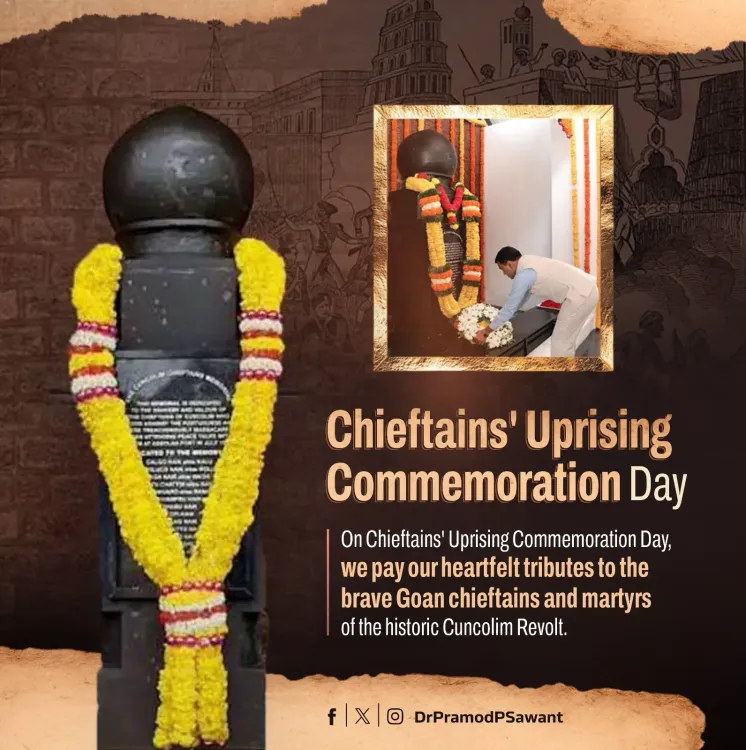
Goa Chief Minister Pramod Sawant on Wednesday, 15 July 2026, paid tribute to the chieftains and martyrs of the Cuncolim Revolt, honouring their resistance against Portuguese colonial rule on Chieftains' Uprising Commemoration Day.
Context
In his post, CM Sawant wrote: 'On Chieftains' Uprising Commemoration Day, we pay our heartfelt tributes to the brave Goan chieftains and martyrs of the historic Cuncolim Revolt. Their extraordinary courage and supreme sacrifice continue to inspire generations of Goans.'
The Cuncolim Revolt of 1583 stands as one of the earliest recorded acts of organised resistance against Portuguese colonial authority in Goa. Local chieftains of Cuncolim, a village in South Goa's Salcete taluka, rose against the colonial administration and faced severe reprisals, cementing their place in Goan historical memory.
Policy Backdrop
Goa experienced over four centuries of Portuguese administration — a colonial arc that ended only on 19 December 1961, when the territory was integrated into the Indian Union. This history sets Goa apart from most Indian states, whose anti-colonial narratives are anchored to the 1947 independence movement.
State governments in India have periodically commemorated pre-independence regional revolts to foreground local agency within broader national histories. BJP-led administrations in Goa have supported such observances as part of cultural and historical outreach, positioning events like the Cuncolim Revolt as foundational chapters in the story of Goan resistance.
Stakeholders and Impact
For Goan residents and local historians, the commemoration affirms a distinct regional identity rooted in indigenous resistance that predates the national freedom movement by nearly four centuries. The Cuncolim chieftains are remembered not only as political actors but as cultural symbols of defiance.
Scholars of Goan history note that such commemorations help bring lesser-known episodes of anti-colonial struggle into public consciousness, particularly for younger generations who may be more familiar with the 1961 liberation narrative than with the earlier revolts of the Portuguese era.
What's Next
Going forward, attention will be on whether the Goa government moves to formalise or expand commemorations — including possible development of memorial sites at Cuncolim or the incorporation of the revolt's history into state education materials. Such steps would signal a deeper institutional commitment to preserving Goa's pre-liberation heritage beyond annual tributes.
Point of View
Pre-1947 anti-colonial tradition. By publicly marking events like the 1583 revolt, the administration signals that Goa's freedom struggle began centuries before national independence — a narrative that resonates with regional pride. This also reflects a broader pattern of state governments investing in local historical memory as a form of cultural governance. The consistency of such commemorations suggests they are becoming a routine instrument of political identity-building in Goa rather than one-off gestures.
NationPress
13 Oct 2026
Frequently Asked Questions
What is the Cuncolim Revolt?
The Cuncolim Revolt was a 1583 uprising by local chieftains in Cuncolim village, South Goa, against Portuguese colonial authorities. It is considered one of the earliest organised acts of resistance against Portuguese rule in Goa and is commemorated annually on Chieftains' Uprising Commemoration Day.
When is Chieftains' Uprising Commemoration Day observed?
Chieftains' Uprising Commemoration Day is observed on 15 July, as marked by the Goa government. It honours the chieftains and martyrs of the 1583 Cuncolim Revolt.
Who were the Cuncolim chieftains?
The Cuncolim chieftains were local leaders of Cuncolim village in Salcete taluka, South Goa, who rose against Portuguese colonial administration in 1583. They faced severe reprisals and are remembered as early symbols of Goan resistance.
How long was Goa under Portuguese rule?
Goa was under Portuguese rule from 1510 until 19 December 1961, when Indian armed forces integrated the territory into the Indian Union — a period of over four centuries.
Why does Goa commemorate pre-1947 revolts separately from national Independence Day?
Because Goa was under Portuguese administration until 1961, its anti-colonial history is distinct from the British-era national freedom movement. Events like the Cuncolim Revolt predate 1947 by nearly four centuries and reflect a uniquely Goan experience of resistance that state commemorations seek to preserve.