CM Bhajan Lal Sharma greets nine states on Foundation Day
Synopsis
On 1 November 2026, Rajasthan CM Bhajan Lal Sharma greeted residents of nine states — including Karnataka, Kerala, and Tamil Nadu — on their Foundation Day, invoking the Ek Bharat Shreshtha Bharat vision of unity in diversity as India's core national strength.
Key Takeaways
Nine states — Andhra Pradesh, Chhattisgarh, Haryana, Karnataka, Kerala, Madhya Pradesh, Delhi, Punjab and Tamil Nadu — mark their Foundation Day on 1 November .
Rajasthan CM Bhajan Lal Sharma extended wishes in Hindi, calling India's diversity its 'greatest strength'.
He invoked Ek Bharat Shreshtha Bharat , the 2015 Ministry of Culture initiative for cross-state cultural integration.
The occasion traces back to the States Reorganisation Act of 1956 , which redrawn India's map along linguistic lines.
State leaders across parties issue similar messages annually, making 1 November an informal national unity moment.
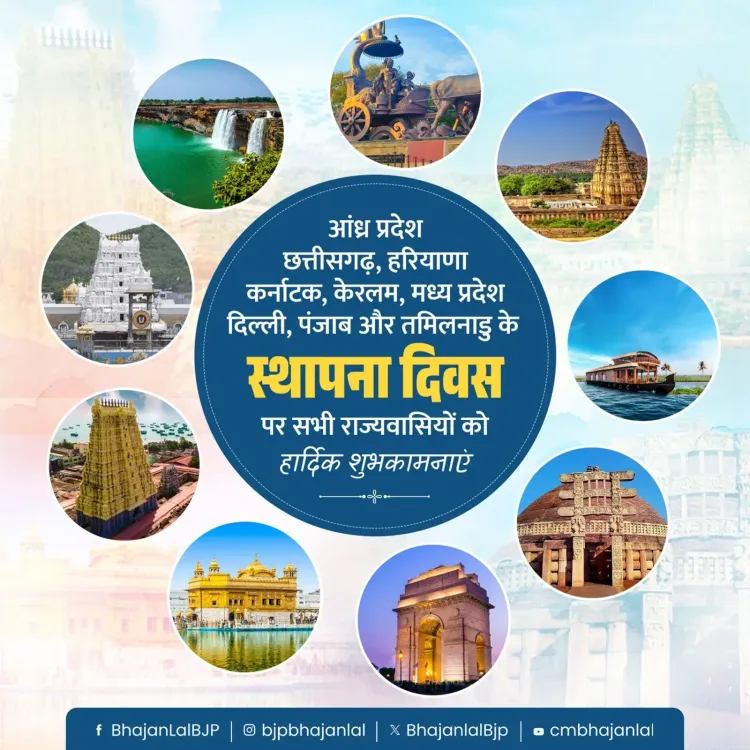
Nine Indian states marked their annual Foundation Day on 1 November 2026, and Rajasthan Chief Minister Bhajan Lal Sharma opened the morning with warm wishes for the residents of Andhra Pradesh, Chhattisgarh, Haryana, Karnataka, Kerala, Madhya Pradesh, Delhi, Punjab and Tamil Nadu — a sweep of states that together account for a vast share of India's population, languages, and landscapes.
Writing in Hindi, CM Sharma extended 'haardik shubhkamnaaen' (heartfelt good wishes) to all nine states and invoked the idea that India's diversity and rich cultural heritage are its greatest strength. 'May all states establish new dimensions of progress, harmony, and prosperity,' he wrote, calling on each to keep alive the spirit of 'Ek Bharat — Shreshtha Bharat' (One India — Excellent India).
Why November 1 is India's unofficial States Day
The date carries deep constitutional memory. The States Reorganisation Act of 1956 redrew India's internal map along linguistic lines, and 1 November became the birth date for several of the newly carved states — Karnataka, Kerala, Madhya Pradesh and Andhra Pradesh among them. Chhattisgarh and other later additions chose to commemorate their own formation days on the same calendar anchor. Each year, chief ministers and governors across the country mark the occasion with public messages, state functions, and cultural programmes.
'Ek Bharat — Shreshtha Bharat' and the unity-in-diversity theme
CM Sharma's message explicitly invoked the Ek Bharat Shreshtha Bharat scheme, a 2015 initiative by the Ministry of Culture designed to promote national integration through cross-state cultural exchanges, language learning, and tourism. The programme pairs states with each other in rotating cycles, encouraging citizens to discover the food, arts, and traditions of a different region. By anchoring his Foundation Day greetings to the scheme, Sharma aligned the seasonal ritual with the BJP's long-running narrative of 'unity in diversity' as an active national project rather than a passive inheritance.
Point of View
But the explicit invocation of Ek Bharat Shreshtha Bharat signals how the BJP continues to embed its national-integration branding into even routine ceremonial messaging. By tying the 1956 States Reorganisation legacy to a 2015 Modi-era scheme, CM Sharma frames cultural diversity not as a historical given but as an ongoing, policy-driven project. The message also serves a subtle intra-party purpose: a Rajasthan CM reaching out to states like Kerala and Tamil Nadu — where the BJP has historically thin roots — reinforces a pan-India posture at a time when the party is focused on expanding its southern footprint.
NationPress
1 Nov 2026
Frequently Asked Questions
Why is 1 November celebrated as Foundation Day in several Indian states?
The States Reorganisation Act of 1956 redrew India's internal boundaries along linguistic lines, with many newly formed states coming into existence on 1 November of that year. States like Karnataka, Kerala, Madhya Pradesh and Andhra Pradesh trace their modern form to that date, making 1 November their annual Foundation Day.
Which nine states did CM Bhajan Lal Sharma wish on Foundation Day 2026?
CM Sharma extended greetings to Andhra Pradesh, Chhattisgarh, Haryana, Karnataka, Kerala, Madhya Pradesh, Delhi, Punjab and Tamil Nadu on their Foundation Day on 1 November 2026.
What is Ek Bharat Shreshtha Bharat?
Ek Bharat Shreshtha Bharat is a government initiative launched in 2015 by the Ministry of Culture. It pairs Indian states with each other to promote national integration through cross-state cultural exchanges, language learning, and tourism programmes.
Who is Bhajan Lal Sharma?
Bhajan Lal Sharma is the Chief Minister of Rajasthan and a senior leader of the Bharatiya Janata Party (BJP).
What does 'Ek Bharat — Shreshtha Bharat' mean in English?
The phrase translates to 'One India — Excellent India'. It is the name of a cultural integration scheme and a broader political slogan used to emphasise national unity across India's diverse states.