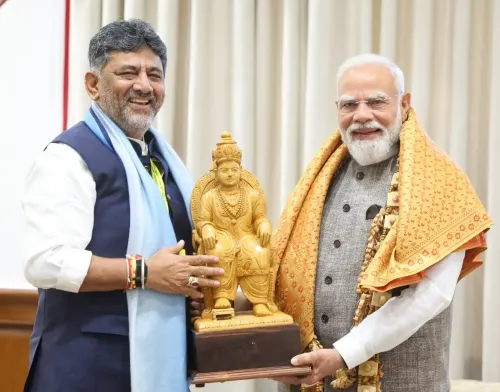
CM Shivakumar Meets FM Sitharaman on Karnataka's Fiscal Priorities
Synopsis
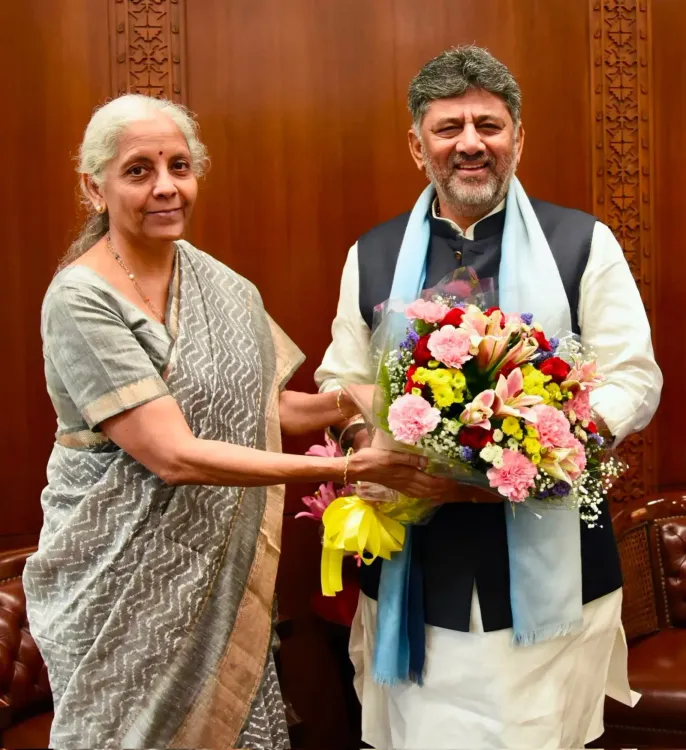
Karnataka Chief Minister D.K. Shivakumar met Union Finance Minister Nirmala Sitharaman in New Delhi on June 11, 2026, seeking central support for the state's infrastructure, urban development, investment, and welfare priorities under the framework of cooperative federalism.
Key Takeaways
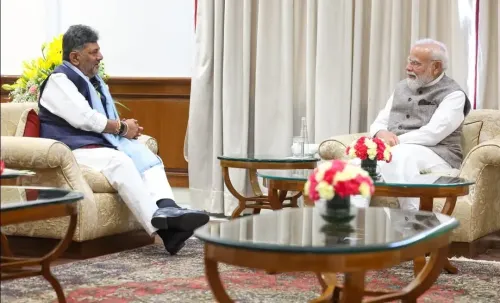
Shivakumar called on Union Finance Minister Nirmala Sitharaman in New Delhi on June 11, 2026 .
Discussions covered infrastructure, urban development, investment, and welfare initiatives as Karnataka's key fiscal priorities.
The Chief Minister sought Union Government support to accelerate Karnataka's growth and its contribution to India's economy.
The meeting falls within the framework of cooperative federalism , a standard channel for state-Centre fiscal alignment.
Karnataka has historically pursued central funding under AMRUT and the Smart Cities Mission for Bengaluru -centric infrastructure.
Outcomes may be reflected in future Union Budget or Karnataka state budget announcements.
The Chief Minister's Office of Karnataka announced on Thursday, June 11, 2026, that Chief Minister Shri D.K. Shivakumar called on Union Finance Minister Smt. Nirmala Sitharaman in New Delhi, holding what the office described as 'constructive discussions' on the state's fiscal priorities and development agenda.
Context
The meeting centred on Karnataka's push for central support across four broad areas: infrastructure, urban development, investment, and welfare initiatives. The Chief Minister's Office stated that these priorities are aimed at 'accelerating Karnataka's growth and strengthening its contribution to India's economic progress through cooperative federalism.'
Such meetings between state chief ministers and the Union Finance Minister form an established channel within India's federal structure, allowing states to flag funding gaps, seek scheme extensions, and align development plans with central budgetary allocations.
Policy Backdrop
Karnataka is one of India's largest contributors to national GDP, driven primarily by the technology and services sectors concentrated in Bengaluru. The state has historically sought central assistance for urban infrastructure under programmes such as AMRUT and the Smart Cities Mission, both of which have been active since 2015.
The 15th Finance Commission, which set the tax devolution and grant framework for states for the period 2021–2026, defines the broader fiscal architecture within which Karnataka negotiates resource transfers from the Centre. As that cycle draws to a close, consultations with the Finance Minister carry added significance for the state's medium-term planning.
Stakeholders and Impact
The discussions directly concern Karnataka's residents, infrastructure developers, and urban local bodies, particularly those in Bengaluru, where demand for metro expansion, road connectivity, and civic services continues to outpace existing funding. Welfare schemes discussed in such meetings often determine the pace of benefit delivery to rural and semi-urban populations across the state.
Karnataka's position as a high-revenue, high-expenditure state means that any additional central grants or scheme approvals carry multiplier effects for both public investment and private economic activity in the region.
What's Next
The outcomes of this meeting are likely to surface in subsequent Union Budget announcements or Karnataka's own state budget, particularly in the form of project approvals, revised devolution figures, or new scheme inclusions. Observers will watch for follow-up signals from the Finance Ministry regarding the specific infrastructure and welfare asks raised by CM Shivakumar.
With Finance Commission consultations for the post-2026 cycle expected to intensify, this engagement is part of a broader pattern of state governments positioning their priorities early in the central planning calendar.
Point of View
A face-to-face engagement with the Finance Minister is a visible assertion of the state's fiscal claims at the highest level. The emphasis on 'cooperative federalism' in the official readout is a deliberate framing choice, positioning Karnataka as a collaborative partner rather than an adversarial claimant — a posture that typically yields better traction in New Delhi. Whether the discussions translate into concrete allocations will be the real test of this diplomatic groundwork.
NationPress
26 Oct 2026
Frequently Asked Questions
Why did Karnataka CM Shivakumar meet Finance Minister Nirmala Sitharaman?
CM D.K. Shivakumar met Finance Minister Nirmala Sitharaman in New Delhi on June 11, 2026, to seek the Union Government's support for Karnataka's priorities in infrastructure, urban development, investment, and welfare schemes.
What did Karnataka ask for in the meeting with the Finance Minister?
Karnataka sought central support for key infrastructure and urban development projects, investment facilitation, and welfare initiatives aimed at accelerating the state's growth within the cooperative federalism framework.
What is cooperative federalism in the Indian context?
Cooperative federalism refers to the collaborative relationship between India's central and state governments in planning, funding, and implementing development programmes, often facilitated through Finance Commission frameworks and direct ministerial consultations.
How does the 15th Finance Commission affect Karnataka?
The 15th Finance Commission set the tax devolution shares and grant frameworks for states, including Karnataka, for the period 2021–2026, determining how much central revenue Karnataka receives for its development programmes.
What central schemes has Karnataka sought funding for previously?
Karnataka has sought central assistance under programmes such as AMRUT and the Smart Cities Mission since 2015, primarily for urban infrastructure projects in and around Bengaluru.