CM Shivakumar Lays Out Nine Governance Principles for Karnataka Officers
Synopsis
Chief Minister DK Shivakumar on June 15 issued nine governance principles to Karnataka's senior bureaucracy, calling for unified 'Team Karnataka' functioning, positive citizen response, and social justice in officer transfers under the #GuaranteeSarkara banner.
Key Takeaways
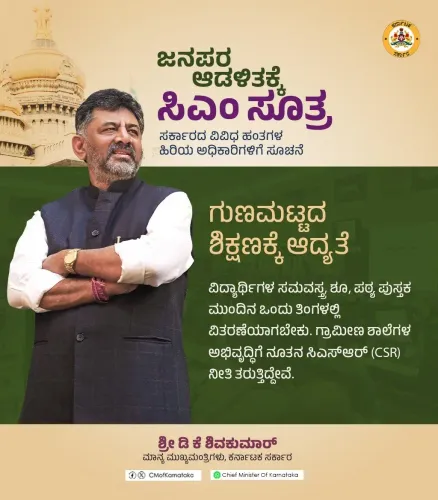
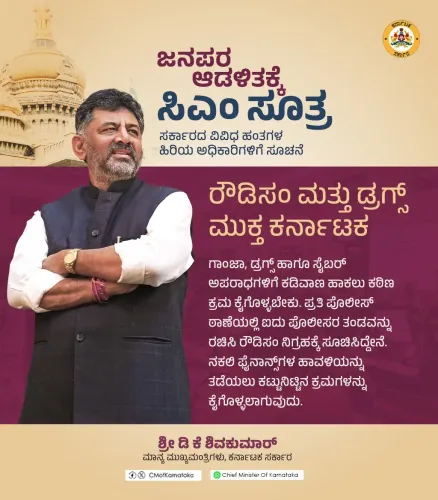
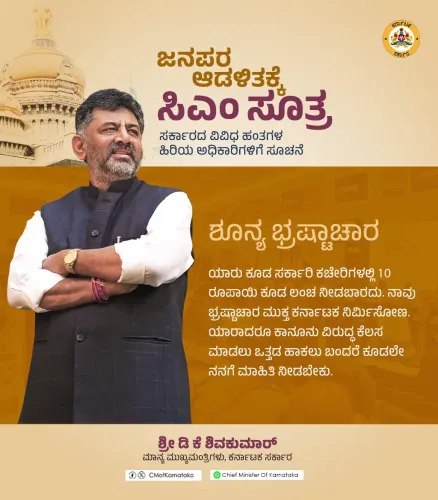
The Chief Minister's Office of Karnataka shared CM DK Shivakumar's 'nava sutras' — nine principles — for people-centric governance on June 15, 2026 .
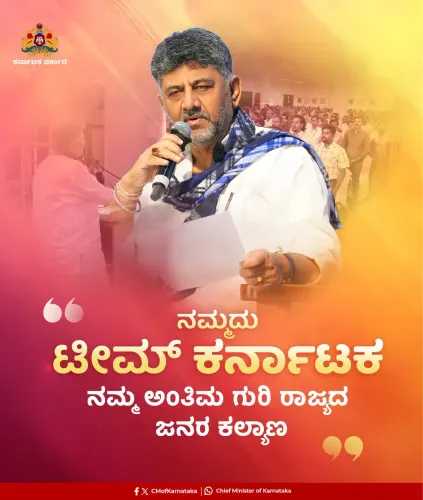
Officials across all levels of the state government were directed to function as 'Team Karnataka' and respond positively to citizens with problems.
The government committed to upholding social justice in the transfer and posting of officers.
The directives were issued under the #GuaranteeSarkara branding, the Congress government's umbrella framework for its welfare and administrative promises.
The Karnataka Congress government has been in office since May 2023 , when it won the state assembly elections on a platform of five flagship welfare guarantees.
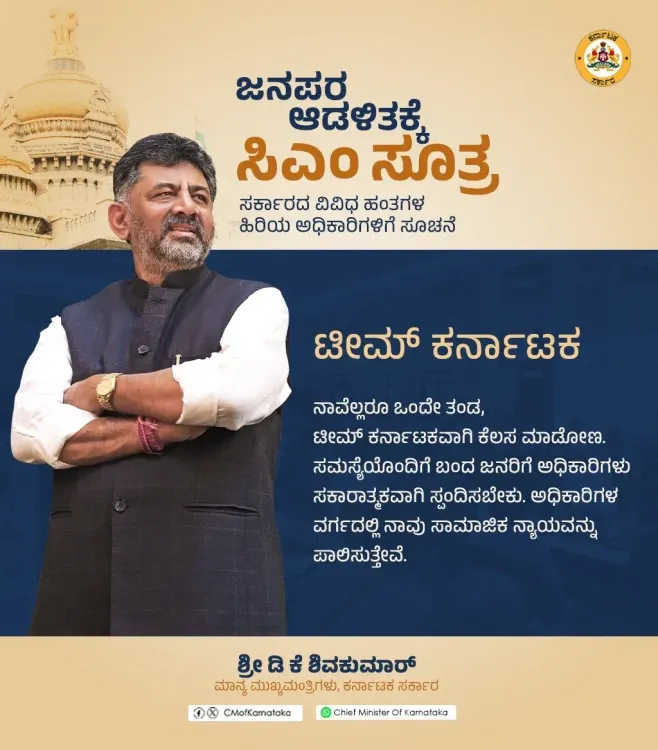
The Chief Minister's Office of Karnataka on Monday, June 15, 2026, shared a set of governance directives issued by Chief Minister DK Shivakumar to senior officials across various levels of the state administration, framing them as 'nava sutras' — nine guiding principles — for people-centric governance.
Context
The post, written in Kannada, outlines instructions from the Chief Minister to the bureaucracy under the banner of 'Team Karnataka' (Team Karnataka). The core directive, as stated in the post, reads: 'Naveḷḷarū ondē taṇḍa, Ṭīm Karnāṭakavāgi kelasa māḍōṇa' — 'We are all one team; let us work as Team Karnataka.' Officials are specifically asked to respond positively to citizens who approach them with problems.
The post also states that the government will uphold social justice in the transfer and posting of officers — a pointed signal on how personnel decisions will be framed under this administration. The communication was tagged with #GuaranteeSarkara, the Congress government's umbrella branding for its welfare and administrative commitments.
Policy Backdrop
The Karnataka Congress government, which came to power after the May 2023 assembly elections, built its campaign around five flagship welfare guarantees covering direct benefit transfers and social equity. Since taking office, the administration has issued multiple circulars directing officials to prioritise grievance redressal and maintain accountability at the ground level.
The emphasis on 'Team Karnataka' is consistent with the government's broader effort to project a unified administrative identity and reduce departmental silos that often delay service delivery. The explicit mention of social justice in officer transfers touches on a politically significant issue in Karnataka, where representation of backward classes, Scheduled Castes, and Scheduled Tribes in senior postings has been a recurring demand from community groups.
Stakeholders and Impact
The directives are addressed to senior bureaucrats across various tiers of the Karnataka government. For ordinary citizens — particularly those navigating district-level offices for land records, welfare scheme enrolments, or grievance filings — the instruction to officials to respond 'positively' signals an intent to make public offices more accessible and less adversarial.
The social justice clause in officer transfers is likely to be closely watched by community organisations and opposition parties alike. Any follow-through in the form of government orders or transfer lists will determine whether the stated principles translate into measurable change.
What's Next
The immediate test for these 'nava sutras' will be whether the Chief Minister's Office issues formal government orders codifying the principles into departmental performance metrics or grievance redressal timelines. Observers will track whether the social justice commitment in officer postings results in verifiable representation data in forthcoming transfer seasons. The #GuaranteeSarkara branding suggests the government intends to keep these directives in the public eye as part of its ongoing accountability narrative ahead of future electoral cycles.
Point of View
A tactic that works better as political messaging than as structural reform. The social justice clause on officer transfers is the sharpest edge of the directive: it signals that the Congress government intends to use personnel policy as a lever for representation, which will generate both political capital among marginalised communities and friction within the IAS-IPS establishment. Anchoring these principles under #GuaranteeSarkara ties routine administrative instructions to the government's electoral brand, keeping the 2023 mandate visible in day-to-day governance communication. Whether the 'nava sutras' produce measurable outcomes or remain aspirational slogans will depend entirely on whether follow-up government orders with enforceable timelines are issued.
NationPress
16 Sept 2026
Frequently Asked Questions
What are DK Shivakumar's nava sutras for Karnataka governance?
CM DK Shivakumar issued nine guiding principles — called 'nava sutras' — to senior Karnataka officials on June 15, 2026, emphasising unified 'Team Karnataka' functioning, positive response to citizens, and social justice in officer transfers.
What is GuaranteeSarkara in Karnataka?
GuaranteeSarkara is the branding used by the Karnataka Congress government for its welfare guarantees and administrative commitments, introduced after the party's victory in the May 2023 state assembly elections.
What did Karnataka CM say about officer transfers and social justice?
CM Shivakumar stated that the government will uphold social justice in the transfer and posting of officers, signalling that representation of marginalised communities will be a factor in personnel decisions.
Who are the senior officials addressed in Karnataka CM's governance directive?
The directives were addressed to senior bureaucrats across various tiers of the Karnataka state administration, instructing them to respond positively to citizens and work as a unified team.
What is 'Team Karnataka' as mentioned by CM Shivakumar?
'Team Karnataka' is the collective identity invoked by CM Shivakumar to encourage all government officials to function as one cohesive unit focused on people-centric service delivery, rather than in departmental silos.