CM Shivakumar's Nine-Point Directive on Education Delivery
Synopsis
Karnataka CM D K Shivakumar has issued nine governance principles to senior officials, mandating distribution of uniforms, shoes and textbooks to government school students within one month and announcing a new CSR policy to fund rural school development under the state's Guarantee Sarkara agenda.
Key Takeaways
Chief Minister D K Shivakumar issued nine governance principles ( nava sootragalu ) to senior Karnataka government officials on 15 June 2026 .
Quality education has been declared the top priority under the directive.
Student uniforms, shoes and textbooks must be distributed to all eligible students within one month .
A new CSR policy is being introduced to direct corporate funds toward rural government school development.
The directive is part of the #GuaranteeSarkara framework launched after the 2023 Karnataka assembly elections .
Field-level compliance by district and block officials will be the key measure of the directive's effectiveness.
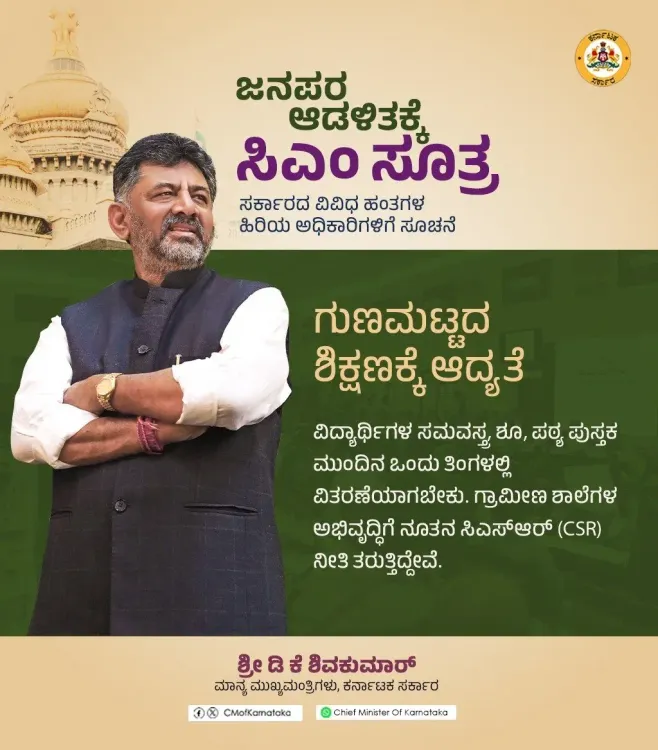
The Chief Minister's Office of Karnataka on Monday, 15 June 2026 published a set of nine governance principles issued by Chief Minister D K Shivakumar to senior officials across departments, with a sharp focus on improving education delivery in the state's government schools.
Context
The post, shared in Kannada, outlines what it calls 'nava sootragalu' (nine principles) for 'janapara aadalita' — people-centric governance. Among the most time-sensitive directives: student uniforms, shoes, and textbooks must be distributed to all eligible students within the next one month. The instructions were addressed to senior officials at various levels of the state government.
The Chief Minister's Office also announced that a new Corporate Social Responsibility (CSR) policy is being introduced specifically to channel corporate funds toward the development of rural schools across Karnataka.
Policy Backdrop
Karnataka has distributed free textbooks, uniforms, and shoes to government school students under centrally and state-funded schemes since the early 2000s, including under the Sarva Shiksha Abhiyan framework. Delays in distribution — particularly at the start of academic sessions — have been a recurring administrative challenge, prompting successive governments to issue time-bound instructions to field officials.
The Karnataka Congress government, which came to power after the 2023 assembly elections, has made direct welfare delivery a centrepiece of its governance agenda under its five guarantee promises, branded #GuaranteeSarkara. Education has been a consistent priority within that framework.
Stakeholders and Impact
The directives directly affect students enrolled in Karnataka's government schools, particularly those in rural areas who depend on state-supplied materials to attend school. Timely delivery of uniforms, shoes, and textbooks at the start of the academic year is widely seen as a key factor in reducing dropout rates and improving attendance.
The proposed CSR policy for rural schools could open a new funding channel for school infrastructure, supplementing the state budget. Corporate entities operating in Karnataka would potentially be directed or incentivised to route a portion of their mandatory CSR spending toward government school development, though the detailed framework has not yet been made public.
What's Next
The immediate watch point is whether the one-month deadline for distributing uniforms, shoes, and textbooks is met across all districts, including remote rural blocks. Field-level compliance will test the administrative machinery the Chief Minister's nine-point directive is designed to sharpen.
The rollout of the new CSR policy for rural schools will be closely tracked by education administrators and corporate affairs officials alike. If operationalised effectively, it could set a replicable model for other states seeking to leverage private capital for public school infrastructure without increasing fiscal pressure on the state exchequer.
Point of View
It could reduce fiscal strain while deepening the government's education narrative. The one-month deadline for materials distribution will serve as an early litmus test for the administration's ground-level machinery.
NationPress
15 Sept 2026
Frequently Asked Questions
What are DK Shivakumar's nine principles for governance in Karnataka?
The Chief Minister's Office of Karnataka released nine governance principles focused on people-centric administration, with education delivery — including timely distribution of uniforms, shoes and textbooks — highlighted as a top priority. The full list was shared with senior officials across government departments.
When will Karnataka government school students get uniforms and textbooks in 2026?
Chief Minister D K Shivakumar has directed that student uniforms, shoes and textbooks be distributed within one month of the directive issued on 15 June 2026 .
What is Karnataka's new CSR policy for rural schools?
The Karnataka government has announced it is formulating a new Corporate Social Responsibility (CSR) policy to channel corporate funds toward the development of rural government schools. Details of the policy framework have not yet been made public.
What is Guarantee Sarkara in Karnataka?
Guarantee Sarkara is the Karnataka Congress government's welfare delivery framework built around five guarantee promises made before the 2023 assembly elections , covering free electricity, cash transfers for women, free bus travel, unemployment allowance, and food security.
How does Karnataka fund free uniforms and textbooks for government school students?
Karnataka has provided free textbooks, uniforms and shoes to government school students through a combination of central schemes such as Sarva Shiksha Abhiyan and state budget allocations since the early 2000s. The new CSR policy aims to add a corporate funding channel specifically for rural school infrastructure.