CM Shivakumar Orders Ring Roads in All Karnataka Taluks
Synopsis
Karnataka CM D K Shivakumar has directed senior officials to construct ring roads and form a traffic grid in all taluks of the state under the government's #GuaranteeSarkara governance framework, scaling an urban congestion-relief model to every sub-district unit across Karnataka.
Key Takeaways
The Chief Minister's Office of Karnataka announced the directive on 15 June 2026 .
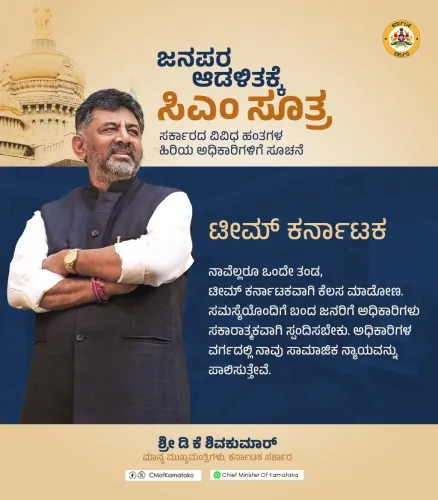
CM D K Shivakumar has issued nine principles for people-friendly governance to senior officials at all levels of government.
The Circular Road Scheme directs construction of ring roads and a traffic grid in all taluks of Karnataka to ease traffic movement.
Karnataka has more than 200 taluks , making this one of the most geographically expansive road connectivity directives in recent state history.
The announcement is tagged under #GuaranteeSarkara , the Karnataka Congress government's flagship governance branding.
The Karnataka PWD is expected to execute surveys, alignments, and construction under the directive.
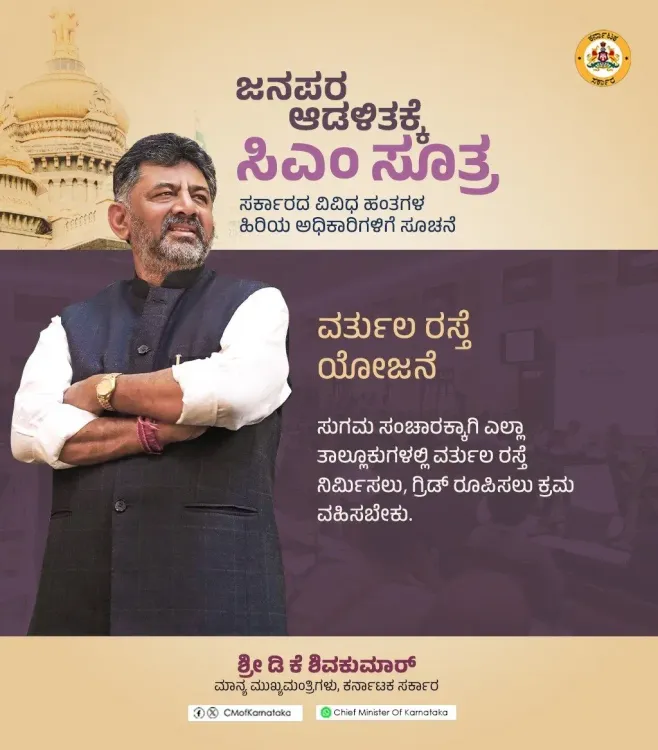
The Chief Minister's Office of Karnataka on Monday, 15 June 2026 announced that Deputy Chief Minister D K Shivakumar has directed senior officials across all levels of government to plan and construct circular (ring) roads in every taluk of the state, with the aim of building a comprehensive traffic grid for smoother movement.
Context
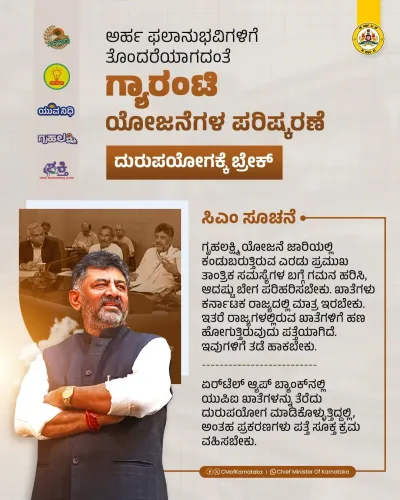
The post, shared under the hashtag #GuaranteeSarkara, outlines what it calls 'nine new principles for people-friendly governance' (ಜನಪರ ಆಡಳಿತಕ್ಕೆ ನವ ಸೂತ್ರಗಳು) issued by the Chief Minister to senior officials. Among these, the Circular Road Scheme (ವರ್ತುಲ ರಸ್ತೆ ಯೋಜನೆ) stands out as a major infrastructure directive: authorities have been instructed to take steps to construct ring roads and form a grid network in all taluks to enable smooth traffic movement.
Karnataka has more than 200 taluks, the sub-district administrative units that form the backbone of rural and semi-urban governance across the state.
Policy Backdrop
The directive carries the #GuaranteeSarkara tag, the branding used by the Karnataka Congress government for its flagship welfare and governance commitments that originated in the party's 2023 state election manifesto. The government has progressively extended this framework beyond welfare transfers into physical infrastructure.
The concept of ring roads as a congestion-relief tool is not new to Karnataka. The Bengaluru Peripheral Ring Road project, advanced during 2022-23, served as an urban model for decongesting traffic on arterial roads. The new directive scales that urban concept down to every taluk headquarters across the state, aiming to replicate the grid-based connectivity approach at a much wider geographic spread.
The Karnataka Public Works Department (PWD) is the state agency that would be responsible for executing such road construction and maintenance across districts and taluks.
Stakeholders and Impact
The most direct beneficiaries of the scheme would be daily commuters in taluk towns and surrounding villages, where the absence of bypass or ring roads forces all traffic — including heavy vehicles — through congested town centres. A grid-based circular road network could significantly reduce travel time and improve road safety at these choke points.
Taluk administrations and local PWD engineers will bear the immediate operational responsibility of conducting surveys, preparing alignments, and submitting proposals. The instruction to 'take steps' suggests this is an initiation directive rather than a project already under execution.
What's Next
The key milestones to watch are the issuance of technical circulars to PWD engineers at the district and taluk level, and whether funding for taluk ring roads finds a place in the next Karnataka state budget or annual road plan. Translating a governance directive of this scale — covering all taluks simultaneously — into on-ground construction will require detailed land acquisition plans, environmental clearances, and capital allocation. The pace at which the government moves from announcement to project sanction will be the true measure of the initiative's ambition.
Point of View
It allows the government to claim a tangible, constituency-level deliverable ahead of future electoral cycles, since ring roads touch every taluk and therefore every local legislator's base. The real test, however, lies in execution: translating a top-down instruction into land acquisition, budgetary allocation, and PWD capacity across hundreds of taluks is a formidable administrative challenge. Analysts will watch whether this becomes a funded line item in the next budget or remains a policy aspiration.
NationPress
14 Sept 2026
Frequently Asked Questions
What is the Karnataka Circular Road Scheme announced by CM Shivakumar?
The Karnataka Circular Road Scheme is a directive issued by CM D K Shivakumar instructing senior government officials to construct ring roads and form a traffic grid in every taluk of Karnataka to enable smoother movement of vehicles and reduce congestion in town centres.
How many taluks will get ring roads under this Karnataka scheme?
The directive covers all taluks of Karnataka, which number more than 200 sub-district administrative units spread across the state.
What is #GuaranteeSarkara and how does this road plan relate to it?
#GuaranteeSarkara is the Karnataka Congress government's branding for its flagship governance and welfare commitments that originated in the 2023 state election manifesto. The Circular Road Scheme is being announced under this banner, extending the framework into physical infrastructure.
Which department will build the ring roads in Karnataka taluks?
The Karnataka Public Works Department (PWD) is the state agency responsible for road construction and maintenance and is expected to execute surveys, alignments, and construction of the taluk ring roads.
Has Karnataka built ring roads before under a similar plan?
Yes. The Bengaluru Peripheral Ring Road project, advanced in 2022-23, served as an urban model for decongesting traffic. The new directive scales that concept to all taluks across the state.