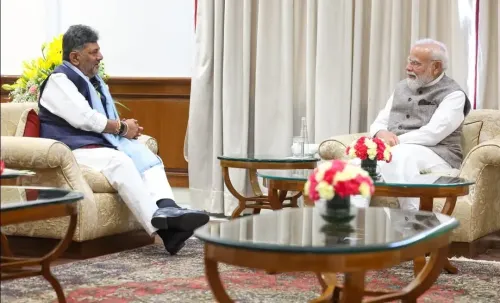
CM Shivakumar Reviews Coastal Tourism Plans with Senior Officials
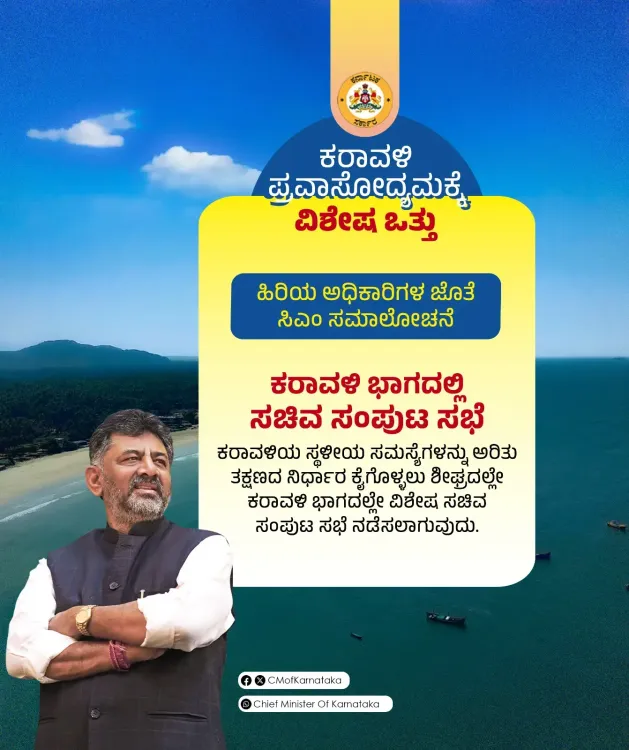
Synopsis
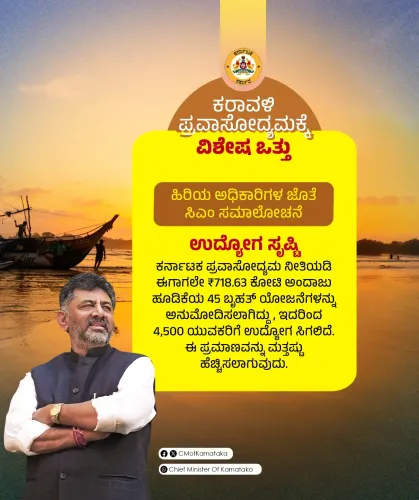
Chief Minister D K Shivakumar convened a review meeting with senior Karnataka officials on 20 June 2026 to map out future coastal tourism projects and evaluate their feasibility, signalling a focused push to develop the state's Arabian Sea coastline as an economic asset.
Key Takeaways
CM D K Shivakumar chaired a meeting with senior state officials on Friday, 20 June 2026 focused on coastal tourism development.
The meeting covered the 'roadmap and feasibility' of future coastal tourism plans, per the Chief Minister's Office.
Karnataka's coastal belt spans Uttara Kannada , Udupi , and Dakshina Kannada districts along the Arabian Sea .
The Karnataka Tourism Development Corporation (KTDC) , established in 1971 , is the nodal agency for implementing tourism infrastructure in the state.
Coastal communities, tourism operators, and local businesses are the primary stakeholders who stand to benefit from any resulting projects.
Detailed project reports and budgetary allocations are the expected next steps following this feasibility review.
Chief Minister D K Shivakumar chaired a high-level meeting with senior government officials on Friday, 20 June 2026, to deliberate on the development of coastal tourism in Karnataka, reviewing future project outlines and assessing their feasibility.
Context
The Chief Minister's Office of Karnataka shared details of the meeting on X, noting that CM Shivakumar held consultations with senior officials on the 'roadmap and feasibility of future plans' for coastal tourism development — ಭವಿಷ್ಯದ ಯೋಜನೆಗಳ ರೂಪುರೇಷೆ ಹಾಗೂ ಕಾರ್ಯಸಾಧ್ಯತೆ [the shape and viability of future plans]. The meeting signals a renewed push to unlock the economic potential of Karnataka's Arabian Sea coastline.
Karnataka's coast stretches across districts including Uttara Kannada, Udupi, and Dakshina Kannada, all of which hold significant beach, backwater, and heritage assets that successive governments have sought to develop for domestic and international visitors.
Policy Backdrop
Karnataka has a standing framework for tourism development rooted in its 2015 State Tourism Policy, which emphasised sustainable development of circuits including coastal areas. The Karnataka Tourism Development Corporation (KTDC), established in 1971, remains the primary state body responsible for translating such policy intent into on-ground infrastructure and promotion.
Periodic high-level reviews of this kind are a recurring feature of Karnataka's planning cycle. State governments have consistently looked to coastal tourism as a lever for economic diversification beyond the Bengaluru-centric information technology sector, with officials examining connectivity, amenities, and hospitality infrastructure as priority gaps.
Stakeholders and Impact
Coastal communities, small tourism operators, and local businesses across the three littoral districts stand to be most directly affected by any plans emerging from this review. Improved infrastructure and organised tourism circuits can generate livelihoods in hospitality, transport, and handicrafts for communities that have historically depended on fishing and agriculture.
Comparable coastal tourism planning exercises have been undertaken by other Indian maritime states seeking to capture a larger share of domestic leisure travel, which has grown sharply in the post-pandemic period. Karnataka's coastline competes with destinations in Goa, Kerala, and Maharashtra for visitor spending.
What's Next
The immediate next steps will likely include the preparation or revision of detailed project reports for identified coastal sites, followed by budgetary allocations either in a supplementary estimate or the next full state budget. Tourism department notifications and KTDC tender activity would serve as the clearest indicators of how quickly the plans move from the consultation stage to execution.
If the feasibility assessments yield actionable proposals, the outcome of this review could shape Karnataka's coastal tourism landscape for the coming years — with implications for both public infrastructure spending and private investment in the hospitality sector along the Karnataka coast.
Point of View
With CM Shivakumar as Deputy Chief Minister holding significant sway over infrastructure and development portfolios, to broaden Karnataka's economic geography beyond Bengaluru. Coastal tourism has long been identified as an underleveraged asset in the state's growth story, and convening a senior-official review signals that the administration is moving from aspiration to structured planning. The timing — mid-term in the government's tenure — suggests an intent to show tangible project pipelines before the next electoral cycle. Whether this translates into funded, executed projects or remains at the feasibility stage will be the real measure of political will.
NationPress
19 Sept 2026
Frequently Asked Questions
What did CM Shivakumar discuss in his coastal tourism meeting?
CM D K Shivakumar met senior Karnataka government officials on 20 June 2026 to discuss the roadmap and feasibility of future coastal tourism development projects in the state.
Which districts in Karnataka are covered under coastal tourism development?
Karnataka's coastal tourism belt primarily covers Uttara Kannada , Udupi , and Dakshina Kannada districts, all of which border the Arabian Sea and hold beach, backwater, and heritage assets.
What is the Karnataka Tourism Development Corporation?
The Karnataka Tourism Development Corporation (KTDC) is a state-owned body established in 1971 that is responsible for promoting and developing tourism infrastructure and projects across Karnataka.
What is Karnataka's tourism policy for coastal areas?
Karnataka formulated a state tourism policy in 2015 that aimed at the sustainable development of tourism circuits, including coastal areas, focusing on infrastructure, connectivity, and amenities.
What are the next steps after the Karnataka coastal tourism review meeting?
The expected next steps include preparation of detailed project reports for identified coastal sites and budgetary allocations in a supplementary estimate or the next state budget, followed by implementation through the KTDC.