CM Shivakumar unveils sweeping Karnataka govt school reforms
Synopsis
Chief Minister DK Shivakumar's office outlines a sweeping overhaul of Karnataka's government schools, announcing AI training from Class 6, recruitment of 15,000 teachers, 25,498 bilingual schools, science labs in 250 high schools, a 7.5% professional-course reservation for rural students, and the second phase of the Gramanubhava village-residency programme.
Key Takeaways
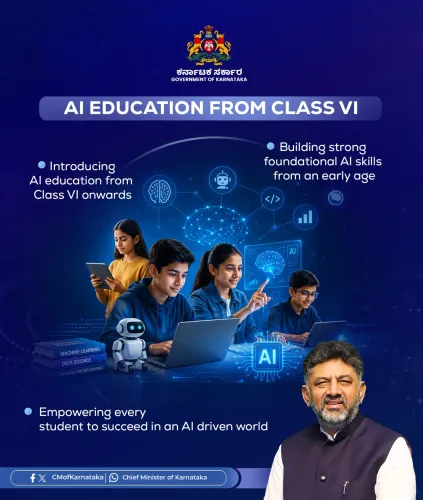
AI training from Class 6 will be introduced in Karnataka government schools, making it one of the earliest AI curricula in Indian public education.
The government has ordered recruitment of 15,000 school teachers to address staffing gaps across the state.
25,498 bilingual schools have been launched statewide to balance Kannada-medium instruction with multilingual access.
250 government high schools now have newly established science laboratories.
A 7.5 percent special reservation in professional college government seats (medicine, engineering) has been created for students who studied in rural government schools from Class 1 to PUC.
Phase 2 of Gramanubhava will take 2,500 students from Bengaluru and 10 city corporations on a one-day village residency to experience farming, horticulture, and rural livelihoods.
Government schools in Karnataka are not just classrooms — they are, according to Chief Minister DK Shivakumar, 'mines of talent' and the living roots of the Kannada language. On Sunday, 1 November 2026, the Chief Minister's Office of Karnataka laid out the most comprehensive public-school reform package the state has announced in recent years, bundling AI training, teacher recruitment, bilingual expansion, rural residency camps, and a new reservation quota into a single sweeping vision.
Three years of top ranks — and what the government credits
The statement opens with a striking claim: for three consecutive years, students from government schools have secured first place in both the SSLC (Class 10) and PUC (Class 12) examinations. The CM's Office frames this not as an accident but as proof that public schools, when invested in, outperform expectations. The language around this is pointed — 'ಕನ್ನಡ ಭಾಷೆಯ ನಿಜವಾದ ಬೇರುಗಳಿರುವುದು ಸರ್ಕಾರಿ ಶಾಲೆಗಳಲ್ಲಿ' ('the true roots of the Kannada language lie in government schools') — positioning public education as both an academic engine and a cultural guardian.
AI from Class 6, science labs in 250 schools, 15,000 new teachers
The headline policy announcements are specific and ambitious. The government says it will introduce Artificial Intelligence (AI) training from Class 6 onwards — an unusually early entry point by national standards. It has also ordered the recruitment of 15,000 school teachers, set up science laboratories in 250 government high schools, and launched skill-based education for Classes 6 to 8.
To fund infrastructure upgrades, the government says it is channelling CSR (Corporate Social Responsibility) funds to remodel schools under the Karnataka Public Schools banner. Across the state, 25,498 bilingual schools have been started — a figure that reflects Karnataka's long-running effort to balance Kannada-medium instruction with multilingual access.
The 7.5% reservation that could reshape rural students' professional futures
Perhaps the most consequential move for rural families is a 7.5 percent special reservation in government seats at professional colleges — covering medicine, engineering, and other vocational streams — exclusively for students who completed Classes 1 to 10 in rural government schools and then studied at a government PU college. It is a direct attempt to break the cycle where private-school students, concentrated in cities, corner the limited professional-course seats. Equal opportunity, the CM's Office says, must be structural, not aspirational.
Gramanubhava: when city classrooms meet village fields
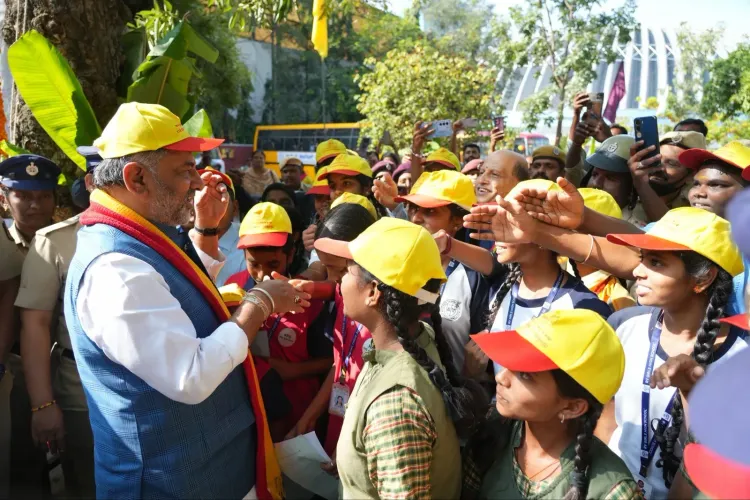
One of the more unusual elements of the package is 'Gramanubhava' (ಗ್ರಾಮಾನುಭವ), a student village-residency programme. In its second phase, 2,500 students from government schools under Bengaluru and 10 other city corporations will spend one day living in a village — farming, horticulture, animal husbandry, rural livelihoods and local culture all on the curriculum. Private schools have been asked to run their own version of the programme at their own cost.
The stated goal goes beyond tourism: to instil respect for farmers and labourers, to make students understand the mutual dependence of villages and cities, and to build awareness of sustainable living. In a state that is simultaneously one of India's most urbanised and most agrarian, bridging that gap from the school bench is a deliberate political and pedagogical choice.
Karnataka's public-school bet in a crowded education market
Karnataka has historically juggled competing pressures in education — private English-medium schools drawing middle-class enrolment away from government Kannada-medium institutions, chronic teacher vacancies, and infrastructure gaps in rural taluks. The combination of curricular modernisation (AI, skill education), cultural anchoring (Kannada identity, Gramanubhava), structural equity (the 7.5% reservation), and physical investment (labs, CSR refurbishment) signals a government trying to make the public-school brand genuinely competitive rather than a fallback option.
The recruitment of 15,000 teachers — if executed on schedule — would be one of the largest single-cycle additions to the state's teaching cadre in years. The funding pipeline, implementation timelines, and accountability mechanisms will determine whether these announcements become milestones or talking points.
Karnataka's government schools are being asked to carry a heavy load: produce toppers, train coders, grow farmers, and preserve a language — all at once. The students walking through those gates every morning are, if the Chief Minister's framing holds, nothing less than the future of Kannada itself.
Point of View
Teacher recruitment, and infrastructure — can reverse the prestige deficit that has long pushed middle-class families toward private institutions. The 7.5 percent professional-course reservation for rural government-school alumni is the sharpest structural intervention: it attempts to translate classroom equity into life-outcome equity, a move that will inevitably face scrutiny from private-school lobbies and legal challenges on reservation grounds. Framing government schools as custodians of the Kannada language adds a cultural-nationalist dimension to what is otherwise a socioeconomic equity argument, broadening the coalition the policy appeals to. The real test will come in implementation — whether the 15,000 teacher posts are filled quickly and whether AI training has the hardware and trainer pipeline to be more than a headline.
NationPress
1 Nov 2026
Frequently Asked Questions
What is the new AI training plan for Karnataka government schools?
The Karnataka government plans to introduce Artificial Intelligence training starting from Class 6 in government schools, making it one of the earliest AI education programmes in India's public school system. Detailed rollout timelines and training infrastructure are yet to be publicly confirmed.
What is the 7.5 percent reservation for rural government-school students in Karnataka?
Students who completed Classes 1 to 10 in rural government schools and then attended a government PU college will receive a 7.5 percent special reservation in government seats at professional colleges, including medical and engineering institutions, giving them a structural advantage in accessing higher education.
What is the Gramanubhava programme in Karnataka?
Gramanubhava is a student village-residency initiative that takes urban schoolchildren on a one-day stay in a village to experience farming, horticulture, animal husbandry, and rural culture. Phase 2 covers 2,500 students from government schools in Bengaluru and 10 other city corporations.
How many teachers is the Karnataka government recruiting for government schools?
The Karnataka government has issued orders for the recruitment of 15,000 school teachers for government schools, in what would be one of the largest single-cycle additions to the state's teaching cadre in recent years.
How many bilingual schools has Karnataka launched?
Karnataka has launched 25,498 bilingual schools across the state, as part of its effort to provide Kannada-medium instruction alongside multilingual access for students from diverse linguistic backgrounds.