CM Soren Orders IT Park Expansion, AI Readiness Push in Jharkhand

Synopsis
Jharkhand CM Hemant Soren has directed the IT and e-Governance Department to submit expansion plans for the state IT park, restructure JAP-IT for AI and data readiness, centralise departmental data, map shadow areas, and fast-track panchayat optical fibre rollout.
Key Takeaways
CM Hemant Soren chaired an IT and e-Governance Department review meeting on 22 July 2026 and issued multiple digital-infrastructure directives.
JAP-IT has been asked to restructure and build a new talent pool focused on AI and data technologies .
All state departments are to begin migrating data to the centralised State Data Centre .
Officials must map shadow areas with poor connectivity and submit a remediation plan, alongside completing optical fibre lines to panchayats on schedule.
The CM-DIP initiative is to be launched at the earliest, and the Jhar Pariyojna Portal is to be upgraded for better multi-department project monitoring.
A unified plan for GIS, satellite, and LiDAR survey needs across departments has also been sought.
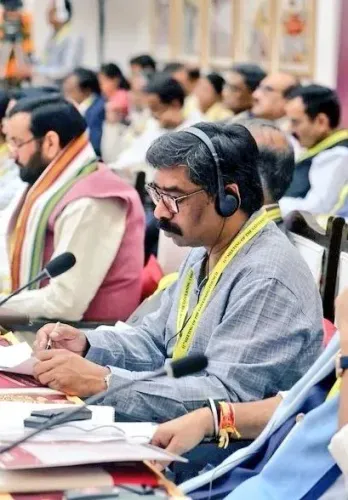
Jharkhand Chief Minister Hemant Soren on Wednesday, 22 July 2026, chaired a review meeting of the state's IT and e-Governance Department and issued a sweeping set of directives aimed at modernising the state's digital infrastructure, expanding its IT footprint, and future-proofing governance through artificial intelligence and data centralisation.
Context
Posting on X after the meeting, CM Soren listed directives covering IT park expansion, restructuring of the state's nodal IT agency, data centre consolidation, rural connectivity, and satellite-based mapping. Translated from Hindi, the post states: 'bazaar maang aur rajya ki asimit sambhavanaon ko dekhte' ('given market demand and the state's unlimited potential'), officials have been asked to submit a concrete plan to advance the IT Park.
He further directed that JAP-IT — the Jharkhand Agency for Promotion of Information Technology — carry out a restructuring exercise to build a fresh talent pool suited to future requirements in AI and data technologies.
Policy Backdrop
The directives build on the Jharkhand IT Policy 2015 and the national Digital India programme, which together laid the groundwork for IT parks, state data centres, and rural broadband expansion across the state. The instruction to migrate all departmental data to the State Data Centre reflects a broader push for secure, centralised data management that has gained urgency with rising cybersecurity concerns across Indian states.
CM Soren also called for the speedy launch of the CM-DIP (Chief Minister's Digital Infrastructure Programme), timely completion of optical fibre lines being laid to panchayats, and mapping of shadow areas — zones with poor or no connectivity — along with an actionable plan to address them. The Jhar Pariyojna Portal, the state's project-monitoring platform, is to be upgraded to handle current and future cross-departmental tracking needs.
Stakeholders and Impact
The directives touch multiple layers of Jharkhand's governance ecosystem. Rural panchayats stand to benefit most directly from the optical fibre push and shadow-area connectivity plans, which could improve access to digital public services for citizens in underserved regions. IT professionals and the state's emerging tech workforce would be affected by JAP-IT's planned restructuring and talent-pool development.
State government departments across sectors are expected to begin migrating data to the centralised facility, while agencies with mapping needs — including those requiring GIS, satellite, or LiDAR surveys — have been asked to consolidate their requirements and submit a unified plan.
What's Next
The immediate deliverables include action plans on IT Park expansion, JAP-IT restructuring, shadow-area mapping, and GIS/LiDAR requirements — all to be submitted to the department. Timelines and budgets for the CM-DIP launch and the panchayat-level fibre rollout will be closely watched as indicators of how quickly the state can translate these directives into on-ground progress.
If implemented at pace, the combined thrust on AI readiness, data centralisation, and rural connectivity could position Jharkhand alongside states that have made measurable gains in digital governance — and the next quarterly review will be the first real test of that ambition.
Point of View
Likely with an eye on governance optics ahead of future electoral cycles. The twin emphasis on AI-readiness and rural connectivity is a politically astute combination — it speaks to urban tech aspirations while addressing the rural service-delivery gaps that have historically dogged Jharkhand. However, the real test lies not in the directives but in JAP-IT's capacity to absorb a restructuring mandate while simultaneously executing on fibre rollouts and data migration. The pattern mirrors moves by several other Indian states, but Jharkhand's relatively constrained administrative bandwidth makes timely delivery a credible concern.
NationPress
22 Jul 2026
Frequently Asked Questions
What did Jharkhand CM Hemant Soren announce for the IT sector?
CM Hemant Soren directed the IT and e-Governance Department to submit plans for IT park expansion, restructure JAP-IT to build an AI-ready talent pool, centralise all departmental data at the State Data Centre, map shadow areas for connectivity, and upgrade the Jhar Pariyojna Portal.
What is JAP-IT and why is it being restructured?
JAP-IT, the Jharkhand Agency for Promotion of Information Technology, is the state's nodal body for IT and e-governance projects. CM Soren has asked it to restructure so it can build a new talent pool equipped to handle future requirements in AI and data technologies.
What is the Jhar Pariyojna Portal?
The Jhar Pariyojna Portal is Jharkhand's official platform for monitoring and tracking the progress of government schemes and projects across departments. CM Soren has directed that it be upgraded to better serve current and future multi-departmental monitoring needs.
What are shadow areas in the context of Jharkhand's IT plan?
Shadow areas refer to zones within Jharkhand that have poor or no digital connectivity. The IT department has been asked to map these areas and submit a plan to address the connectivity gaps, alongside completing optical fibre lines to panchayats.
What is CM-DIP in Jharkhand?
CM-DIP refers to a digital infrastructure programme announced by Chief Minister Hemant Soren. The department has been directed to begin its construction or launch process at the earliest; detailed scope and budget are yet to be made public.