CM Sukhu to form HP's first State Farmers Commission
Synopsis
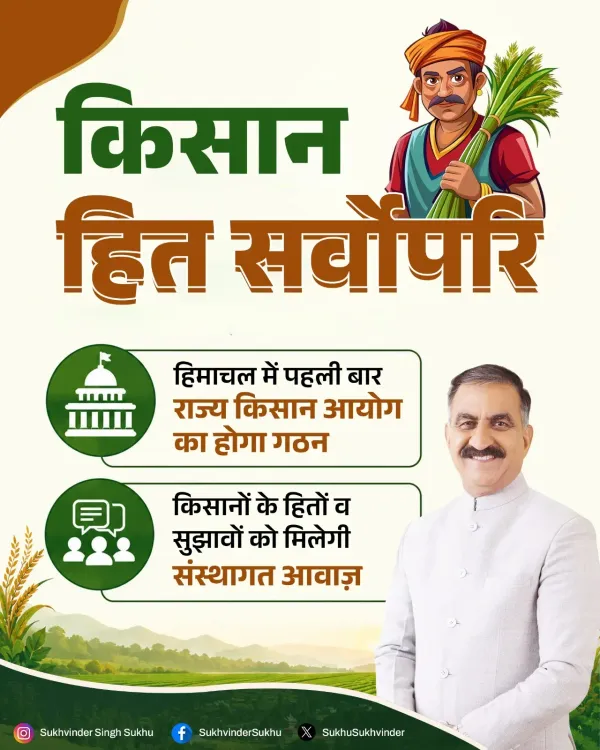
Himachal Pradesh CM Sukhvinder Singh Sukhu announced the formation of the state's first-ever State Farmers Commission under a dedicated state act, aiming to institutionalise direct farmer participation in agricultural policy formulation and implementation — a first for the hill state.
Key Takeaways
Himachal Pradesh will establish its first-ever State Farmers Commission under the Himachal Pradesh State Farmers Commission Act .
CM Sukhvinder Singh Sukhu made the announcement on 22 May 2026 via X.
The commission will give farmers direct participation in both the formulation and implementation of agricultural policies.
The move follows a national pattern of states institutionalising farmer representation after the 2020-21 farm laws debate.
The statutory framework gives the commission legal weight, distinguishing it from informal advisory bodies.
Formal notification of the commission's composition and operational rules is yet to be issued.
Himachal Pradesh Chief Minister Sukhvinder Singh Sukhu announced on Friday, 22 May 2026 that his government will establish the state's first-ever State Farmers Commission under the Himachal Pradesh State Farmers Commission Act, a move aimed at directly involving farmers in shaping and implementing agricultural policy.
Context
Posting in Hindi on X, CM Sukhu stated: 'किसानों की समस्याओं के समाधान, उनकी आय में वृद्धि और कृषि नीतियों में उनकी सीधी भागीदारी सुनिश्चित करना आज समय की आवश्यकता है' ['Resolving farmers' problems, increasing their income, and ensuring their direct participation in agricultural policies is the need of the hour today']. He added that the commission will ensure farmers' 'active participation' in both the formulation and execution of agricultural policies, making the agricultural system 'more empowered and farmer-friendly.'
The announcement marks the first time Himachal Pradesh will have a statutory body dedicated to institutionalising farmer representation in state-level policy decisions.
Policy Backdrop
The move draws on a long-standing demand in Indian agrarian policy circles. The landmark National Commission on Farmers, chaired by M.S. Swaminathan, submitted its report in 2006, recommending greater farmer involvement in policy formulation alongside income security measures — recommendations that remained only partially implemented at the national level.
Following the contentious farm laws debate of 2020-21, several Indian states moved to create dedicated farmer commissions or advisory councils to improve policy responsiveness. Himachal Pradesh's initiative fits squarely within this broader pattern, particularly significant given the state's predominantly smallholder and horticulture-based agricultural economy.
Stakeholders and Impact
Himachal Pradesh's farming community — largely composed of smallholders growing apples, vegetables, and other horticultural produce — stands to gain a formal institutional channel to raise concerns and shape policy. The state agriculture department will be a key implementing partner, and the commission's recommendations could influence budget allocations, input subsidies, and market access frameworks.
The statutory basis of the commission, grounded in the Himachal Pradesh State Farmers Commission Act, lends it legal weight beyond a purely advisory or informal consultative body, potentially making its recommendations harder for the executive to set aside without formal justification.
What's Next
The formal notification detailing the commission's composition, membership criteria, and operational rules is awaited. Observers will closely watch whether budgetary provisions for the commission's functioning are made in the next state budget or during the upcoming monsoon legislative session.
The first set of recommendations the commission produces — and whether the government acts on them — will be the true test of whether this body translates institutional intent into tangible change for Himachal Pradesh's farmers.
Point of View
While also addressing a genuine governance gap in a state where horticulture and smallholder farming are economic lifelines. By anchoring the body in legislation rather than executive order, the Congress government in Shimla is attempting to make farmer consultation a durable institutional norm rather than a discretionary gesture. This aligns with a broader Congress strategy of distinguishing its state governance record on farm welfare from the BJP's handling of the national farm laws controversy. The real measure of intent, however, will be the commission's independence, the profile of its members, and whether its recommendations carry binding or merely advisory force.
NationPress
20 Sept 2026
Frequently Asked Questions
What is the Himachal Pradesh State Farmers Commission?
It is a first-of-its-kind statutory body being established by the Himachal Pradesh government under the Himachal Pradesh State Farmers Commission Act to ensure farmers have direct participation in the formulation and implementation of agricultural policies in the state.
Who announced the Himachal Pradesh Farmers Commission?
Himachal Pradesh Chief Minister Sukhvinder Singh Sukhu announced the formation of the commission on 22 May 2026 through a post on X.
What will the Himachal Pradesh State Farmers Commission do?
The commission will provide a formal institutional channel for farmers to participate in shaping agricultural policy, with a focus on resolving farmers' problems and increasing their income.
Is this the first farmers commission in Himachal Pradesh?
Yes, according to CM Sukhu's announcement, this will be the first time a State Farmers Commission has been constituted in Himachal Pradesh.
What is the significance of the M.S. Swaminathan Commission for this announcement?
The National Commission on Farmers chaired by M.S. Swaminathan recommended in 2006 that farmers be given greater involvement in policy formulation and income security — principles that the new Himachal Pradesh body seeks to institutionalise at the state level.