CM Sukhu Pays Tribute to Raja Ram Mohan Roy on His Anniversary
Synopsis
Himachal Pradesh Chief Minister Sukhvinder Singh Sukhu on 27 September 2026 paid tribute to Raja Ram Mohan Roy, the Brahmo Samaj founder and 19th-century social reformer, honouring his fight against sati, child marriage, and caste discrimination.
Key Takeaways
CM Sukhvinder Singh Sukhu paid tribute to Raja Ram Mohan Roy on 27 September 2026 via a post on X.
Raja Ram Mohan Roy (1772–1833) was a Bengali social reformer who campaigned against sati, child marriage, and caste discrimination.
He founded the Brahmo Samaj in 1828 , a socio-religious reform movement that shaped Indian nationalist and progressive thought.
Roy's campaign against sati contributed to its legislative ban by the British colonial government in 1829 .
Indian political leaders across parties routinely mark Roy's anniversary as a signal of commitment to secular and progressive values.
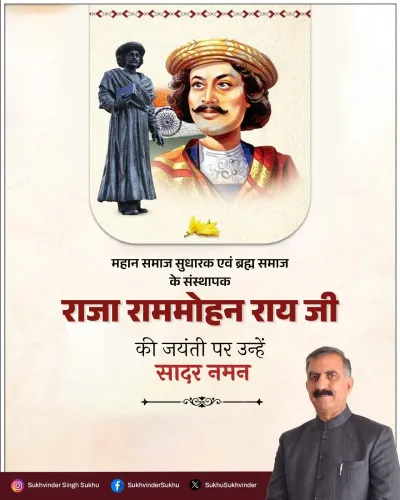
A reformer who took on sati, child marriage, and caste orthodoxy — and won — still commands reverence nearly two centuries after his death. On Sunday, 27 September 2026, Himachal Pradesh Chief Minister Sukhvinder Singh Sukhu paid homage to Raja Ram Mohan Roy, saluting the 19th-century reformer's enduring legacy on his anniversary.
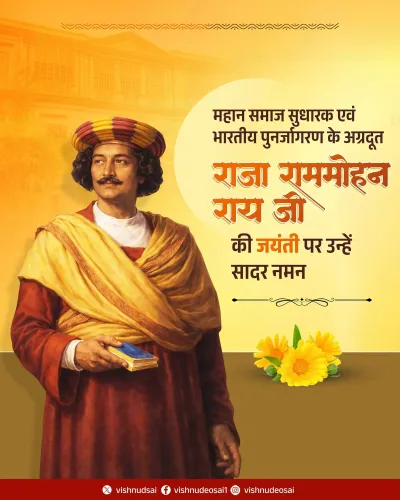
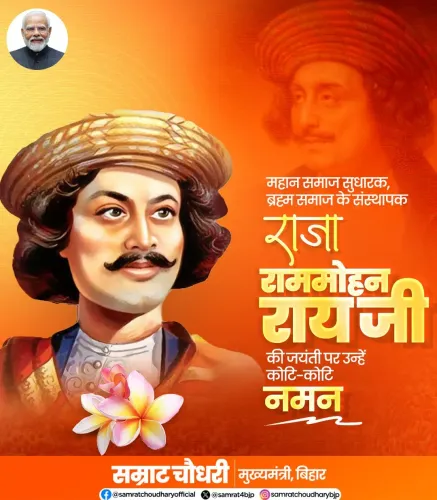
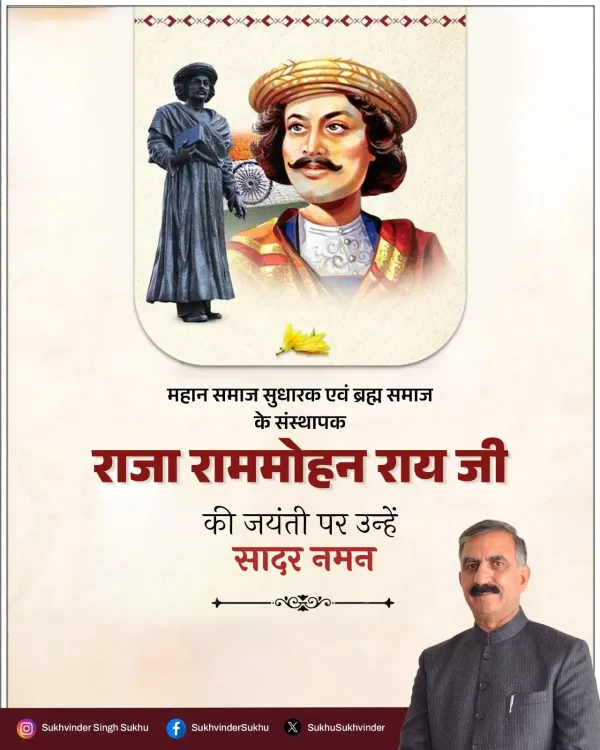
In his post on X, CM Sukhu wrote — 'Mahan samaj sudharak, Brahm Samaj ke sansthapak evam Bharatiya punarnjaagran ke agradoot Raja Ram Mohan Roy ji ki jayanti par sadar naman' — offering respectful salutations to the 'great social reformer, founder of the Brahmo Samaj, and pioneer of the Indian Renaissance.' He added that Roy's struggle against social evils and his reformist ideas would 'always be remembered.'
Who Was Raja Ram Mohan Roy
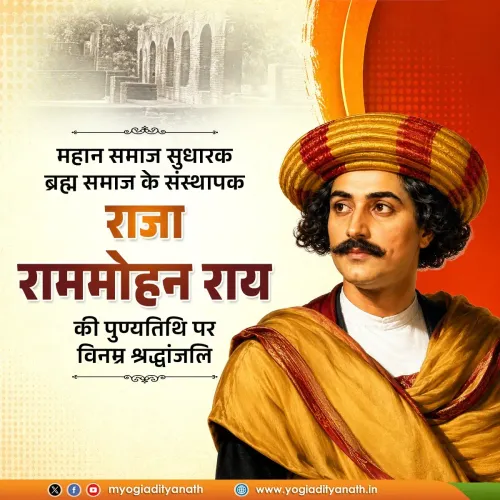
Born in 1772 in Bengal, Raja Ram Mohan Roy was among the most consequential figures of India's intellectual and social awakening. His campaigns against sati — the practice of widows being immolated on their husbands' funeral pyres — led directly to the British colonial government banning the practice in 1829, one of the landmark legislative moments of the 19th century.
Roy also fought child marriage and caste discrimination, championed the spread of Western scientific education, and promoted a monotheistic reading of Hinduism stripped of what he saw as superstition. His Brahmo Samaj, founded in 1828, became a crucible for later reformers and nationalists, shaping the intellectual climate from which figures like Rabindranath Tagore and Bal Gangadhar Tilak would emerge.
Why India's Leaders Keep Returning to Roy
Indian political leaders across party lines have long made a ritual of marking the anniversaries of 19th-century social reformers — and Roy sits near the top of that pantheon. The invocation carries a clear signal: a commitment to the secular, progressive values that Roy embodied at a time when challenging orthodoxy carried real personal risk.
For CM Sukhu, a leader of the Indian National Congress governing a hill state with its own deep traditions, the tribute aligns with the Congress's historical self-positioning as the inheritor of India's reform and Renaissance legacy. Such commemorations rarely carry direct policy announcements, but they anchor a public figure to a lineage of progressive thought — and on an occasion like this, the name alone does the work.
Point of View
Religion, and region — is a low-risk, high-resonance gesture that reinforces the party's secular and progressive self-image. At a moment when identity politics and social questions remain live fault lines in Indian public life, the choice of reformers to commemorate is itself a form of soft positioning. The tribute carries no direct policy freight, but its symbolism is deliberate and legible.
NationPress
27 Sept 2026
Frequently Asked Questions
Who was Raja Ram Mohan Roy?
Raja Ram Mohan Roy (1772–1833) was a Bengali social reformer widely regarded as the father of the Indian Renaissance. He founded the Brahmo Samaj in 1828 and led campaigns that contributed to the British colonial ban on sati in 1829.
What is Brahmo Samaj?
The Brahmo Samaj was a socio-religious reform movement founded by Raja Ram Mohan Roy in 1828 . It promoted monotheism, rejected idol worship and caste discrimination, and became a major influence on later Indian reform and nationalist thought.
Why did CM Sukhu pay tribute to Raja Ram Mohan Roy?
Himachal Pradesh CM Sukhvinder Singh Sukhu posted a tribute on 27 September 2026 to mark the anniversary of Raja Ram Mohan Roy , honouring his legacy as a social reformer who fought against sati, child marriage, and caste discrimination.
What did Raja Ram Mohan Roy do to end sati?
Raja Ram Mohan Roy campaigned vigorously against the practice of sati — the immolation of widows on their husbands' funeral pyres. His advocacy was a key factor in the British colonial government banning sati in 1829 .
What is Raja Ram Mohan Roy's connection to the Indian Renaissance?
Roy is often called the 'pioneer of the Indian Renaissance' because he introduced Western scientific and liberal ideas to Indian society, challenged religious orthodoxy, promoted English education, and laid intellectual groundwork for later reformers and nationalists.