CM Sukhu Reaffirms Himachal's Commitment to Old Pension Scheme
Synopsis
Chief Minister Sukhvinder Singh Sukhu reaffirmed on 24 October 2026 that Himachal Pradesh has delivered the Old Pension Scheme and will sustain it — a pointed signal to state employees and a widening fault line with the Centre's NPS framework.
Key Takeaways
CM Sukhu declared on 24 October 2026 that Himachal Pradesh is delivering OPS and will continue to do so.
The Himachal Pradesh cabinet restored OPS in December 2022 for employees appointed on or after 15 May 2003 .
OPS guarantees a defined pension based on last drawn salary, unlike the market-linked National Pension System introduced in 2004 .
Himachal's move followed similar OPS restorations in Rajasthan and Chhattisgarh under Congress governments.
The Centre has flagged long-term fiscal liabilities as a concern with OPS restoration across states.
State budget pension liability projections remain the key indicator of the scheme's long-term sustainability.
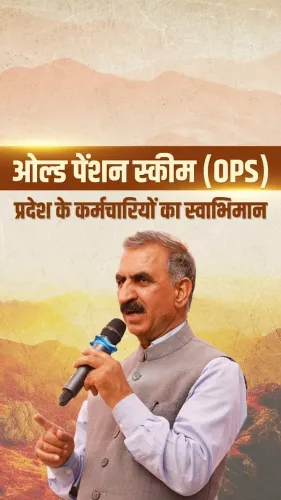
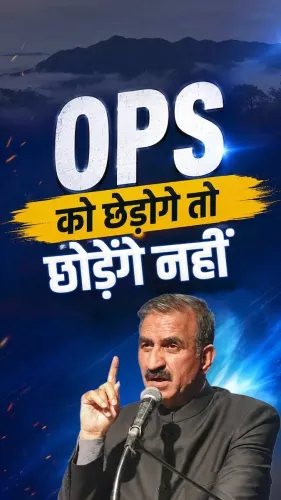
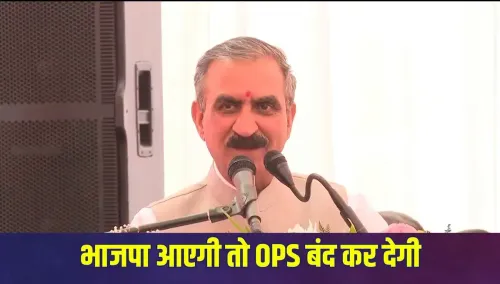
A promise kept — and a promise extended. Himachal Pradesh Chief Minister Sukhvinder Singh Sukhu on Saturday, 24 October 2026, declared in no uncertain terms that his government has delivered the Old Pension Scheme and will continue to do so, signalling that OPS remains a non-negotiable pillar of the Congress administration in Shimla.
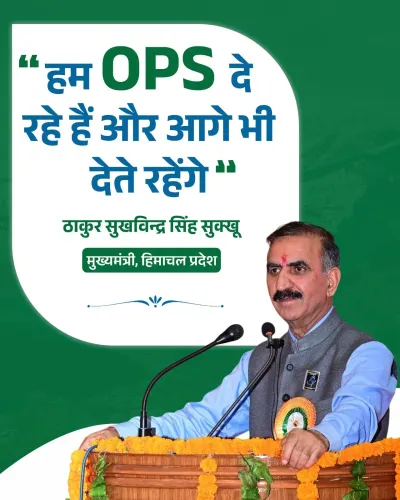
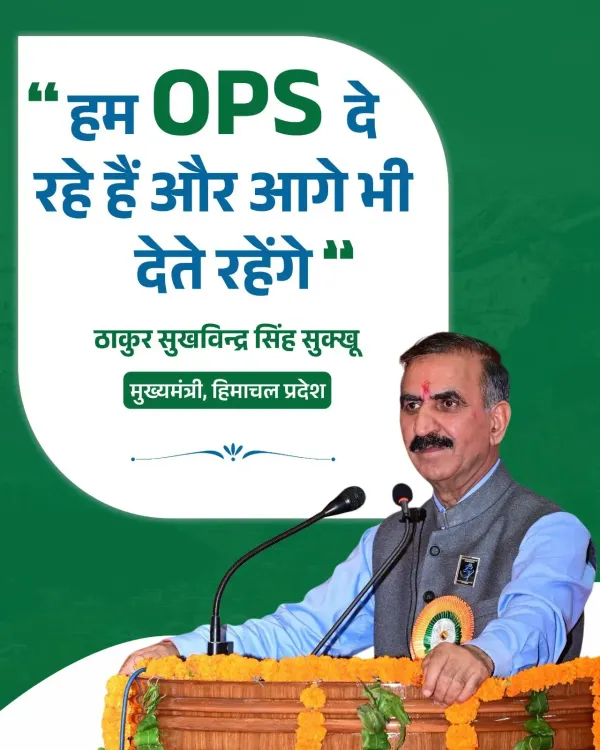
Posting in Hindi, CM Sukhu wrote: 'हम OPS दे रहे हैं और आगे भी देते रहेंगे।' — 'We are giving OPS and we will keep giving it.' Short, declarative, and pointed at every state government employee who voted with pension security in mind.
What the OPS Restoration Actually Means for HP Employees
The Old Pension Scheme (OPS) is a defined-benefit guarantee: a government employee retires with a fixed pension calculated on their last drawn salary, with no market exposure. Its replacement, the National Pension System (NPS) introduced by the central government in 2004, is contributory and market-linked — offering no guaranteed floor. For hundreds of thousands of state employees, the difference is the difference between security and uncertainty.
The Himachal Pradesh cabinet approved the restoration of OPS in December 2022, covering employees appointed on or after 15 May 2003 — the cohort that had been forced onto NPS since its rollout. The move placed Himachal among the first wave of Congress-governed states to break from the central framework, following similar decisions in Rajasthan and Chhattisgarh after their respective assembly elections that year.
The Wider Opposition Push Against NPS
Himachal's decision was never an isolated one. Across several opposition-ruled states, employee unions had campaigned hard — and loudly — for OPS restoration, treating NPS as an imposition that shifted retirement risk onto workers. The Congress party nationalised that demand, embedding OPS as a signature welfare plank in multiple state election manifestos.
That political calculus creates a direct fault line with New Delhi: the central government has consistently cautioned that OPS restoration carries long-term fiscal liabilities that could strain state finances. State budget documents and pension liability projections remain the clearest stress-test of how sustainable the restoration proves over time.
Why Sukhu Is Saying This Now
A four-word post with no new policy announcement is still a political act. By publicly reaffirming OPS delivery, CM Sukhu is tending to his core constituency of state government employees — reminding them of a promise fulfilled while signalling that no future pressure, fiscal or federal, will reverse the course. In a state where government employment runs deep and employee unions wield real electoral weight, that reassurance is its own kind of governance.
The question now is not whether Himachal has OPS — it does. The question is whether the state budget can carry the liability forward without compromising other welfare commitments. That answer will be written in the numbers, not in a post.
Point of View
The Congress in Himachal has drawn a durable line between its governance model and the Centre's NPS architecture — making any rollback politically toxic regardless of fiscal pressure. The broader pattern across opposition-ruled states suggests OPS has become a structural wedge issue in Centre-state relations, with pension liability sustainability increasingly the arena where that battle will actually be decided.
NationPress
24 Oct 2026
Frequently Asked Questions
What is the Old Pension Scheme in Himachal Pradesh?
The Old Pension Scheme (OPS) in Himachal Pradesh guarantees state government employees a fixed pension based on their last drawn salary. The Himachal Pradesh cabinet restored OPS in December 2022 for employees appointed on or after 15 May 2003, who had previously been covered under the contributory National Pension System.
Why did Himachal Pradesh restore OPS?
Himachal Pradesh restored OPS in response to long-standing demands from state government employee unions who opposed the market-linked National Pension System introduced by the central government in 2004. The Congress party had made OPS restoration a key election promise.
Which states have restored the Old Pension Scheme?
Several Congress-governed states including Himachal Pradesh, Rajasthan, and Chhattisgarh restored the Old Pension Scheme following their respective assembly elections in 2022, breaking from the central government's National Pension System framework.
What is the difference between OPS and NPS?
OPS (Old Pension Scheme) is a defined-benefit system guaranteeing a fixed pension based on last drawn salary with no market risk to the employee. NPS (National Pension System) is contributory and market-linked, offering no guaranteed pension floor, with retirement corpus depending on investment returns.
What are the fiscal concerns around OPS restoration?
The central government and fiscal analysts have cautioned that OPS restoration creates long-term pension liabilities on state budgets. Unlike NPS, where the risk is shared with employees, OPS places the full liability on the state government, which must fund guaranteed payouts regardless of fiscal conditions.