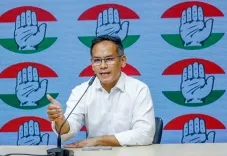
CM Tamang thanks PM Modi for ₹365 cr tax devolution to Sikkim

Synopsis
Sikkim Chief Minister Prem Singh Tamang publicly thanked Prime Minister Modi and Finance Minister Sitharaman for an advance tax devolution of ₹365 crore, calling it a timely boost to the state's development agenda and reaffirming Sikkim's cooperative posture with the Centre.
Key Takeaways
Sikkim received an advance tax devolution of ₹365 crore from the Centre, announced on 1 August 2026 .
CM Prem Singh Tamang publicly credited PM Narendra Modi and FM Nirmala Sitharaman for the release.
Tax devolution is mandated under Article 280 of the Constitution; the 15th Finance Commission set states' share at 41 percent of the divisible pool for 2021–26.
Northeastern states including Sikkim receive enhanced shares and grants beyond the standard formula due to limited own-revenue capacity.
The advance release gives Sikkim's government immediate fiscal headroom for infrastructure, organic farming, and tourism spending.
The public acknowledgment reinforces the SKM government's strategy of leveraging cooperative Centre-state relations as a governance credential.
A ₹365 crore advance tax devolution from the Centre has landed in Sikkim — and Chief Minister Prem Singh Tamang is making sure the credit lands squarely where he believes it belongs. On Saturday, 1 August 2026, Tamang publicly thanked Prime Minister Narendra Modi and Union Finance Minister Nirmala Sitharaman for what he called a timely allocation that will 'further strengthen our developmental efforts.'
What ₹365 crore means for India's smallest state
Sikkim, with a population of roughly 6.9 lakh, is one of India's smallest states by both area and headcount — but its development needs are outsized relative to its own revenue base. The advance devolution gives the state administration immediate fiscal headroom to push spending on infrastructure, organic farming support, and tourism — the three pillars of Sikkim's growth model. An advance release, as opposed to a standard monthly tranche, signals Centre-state coordination aimed at front-loading capital before a spending cycle.
Fiscal federalism and Sikkim's special position
Tax devolution is not a favour — it is a constitutional obligation. Under Article 280 of the Constitution, the Finance Commission determines how central tax revenues are shared with states. The 15th Finance Commission fixed the states' aggregate share at 41 percent of the divisible pool for 2021–26. Smaller northeastern states like Sikkim receive enhanced shares and additional grants on top of the formula-based allocation, recognising their limited own-tax capacity and higher per-capita development costs.
Advance devolution — releasing funds ahead of the standard monthly schedule — is a tool the Centre has used periodically to help states manage cash flow, particularly before major expenditure periods. For Sikkim, where state revenues are structurally thin, such releases carry real weight.
Tamang's political calculus in the thank-you
Chief Minister Tamang, founder-president of the Sikkim Krantikari Morcha (SKM) and in power since 2019, has consistently cultivated a cooperative relationship with the BJP-led Centre — a pragmatic posture for a small state that depends heavily on central transfers. The public acknowledgment on X is as much a political signal as a courtesy: it reinforces the SKM government's narrative of delivering through productive Centre-state ties. In Sikkim's intimate political ecosystem, visible federal goodwill translates directly into governance credibility.
Point of View
The optics of federal goodwill matter as much as the rupees themselves. The SKM government has built its second-term identity partly around visible delivery through Centre-state cooperation, and each such acknowledgment reinforces that narrative for a Sikkimese electorate that watches New Delhi's attention closely. More broadly, the use of advance devolution as a fiscal tool reflects the Centre's continued reliance on front-loaded transfers to keep smaller states' capital expenditure pipelines moving. Watch whether the next Union Budget formalises enhanced northeastern grants as the 15th Finance Commission's mandate nears its end.
NationPress
15 Sept 2026
Frequently Asked Questions
What is tax devolution and why does Sikkim receive it?
Tax devolution is the constitutionally mandated transfer of a share of central tax revenues to states, governed by the Finance Commission under Article 280. Sikkim receives devolution as part of the standard formula, plus enhanced grants due to its small revenue base and northeastern status.
How much money did Sikkim receive from the Centre in August 2026?
Sikkim received an advance tax devolution of ₹365 crore, as acknowledged by Chief Minister Prem Singh Tamang on 1 August 2026.
What is the 15th Finance Commission's devolution formula?
The 15th Finance Commission recommended that states collectively receive 41 percent of the divisible pool of central taxes for the period 2021–26, distributed among states based on a weighted formula.
Who is Prem Singh Tamang and which party does he lead?
Prem Singh Tamang, also known as Golay, is the Chief Minister of Sikkim since 2019 and the founder-president of the Sikkim Krantikari Morcha (SKM).
What sectors will the ₹365 crore devolution support in Sikkim?
CM Tamang stated the funds will strengthen developmental efforts across 'key sectors.' Sikkim's primary development focus areas include infrastructure, organic farming, and tourism.